Char Dham Highway and India’s Road Infrastructure Revolution: A 2026 Travel Update

India’s road infrastructure is undergoing a transformation of historic proportions, and nowhere is this more visible — or more consequential — than in the mountains of Uttarakhand, where the Char Dham Highway project is reshaping access to four of Hinduism’s most sacred pilgrimage sites. The project, which aims to provide all-weather connectivity to Yamunotri, Gangotri, Kedarnath, and Badrinath, is simultaneously an engineering marvel, a religious imperative, a tourism catalyst, and an environmental controversy. As of March 2026, with significant sections complete and others advancing rapidly, the Char Dham Highway offers a window into both the promise and the complexity of India’s road-building ambitions.
The Char Dham Project: Scope and Scale
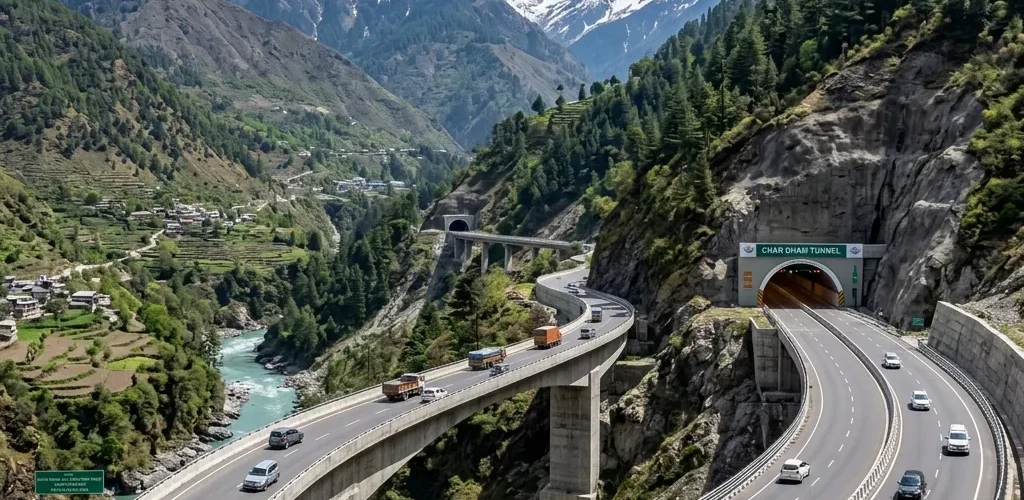
The Char Dham Mahamarg Vikas Pariyojana (Char Dham Highway Development Project), announced in 2016 by Prime Minister Modi, envisions the construction or widening of approximately 900 kilometres of national highway connecting the four sacred sites to the plains. The project, executed by the Border Roads Organisation (BRO) and the National Highways and Infrastructure Development Corporation Limited (NHIDCL), involves widening roads to a minimum of 7-10 metres, constructing bridges, tunnels, and bypasses, and improving drainage and retaining structures along routes that traverse some of the most geologically unstable terrain in the world.
The four routes radiate from the confluence points in the Garhwal Himalayas: Rishikesh to Yamunotri (approximately 250 km), Rishikesh to Gangotri (approximately 260 km), Rishikesh to Kedarnath (approximately 250 km), and Rishikesh to Badrinath (approximately 300 km). Of these, the Kedarnath and Badrinath routes carry the heaviest traffic, as these two temples attract the largest number of pilgrims annually — Kedarnath, in particular, has seen a dramatic surge in visitors following reconstruction after the devastating 2013 floods.
Progress and Engineering Challenges
By early 2026, the project has achieved approximately 70 per cent completion, with several key sections opened to traffic. The route from Rishikesh to Badrinath has seen the most progress, with the recently completed Chamba-Rishikesh bypass and significant widening along the Alaknanda valley. The construction of the Helang-Marwari bypass on the Badrinath route, which avoids a particularly landslide-prone section, represents one of the project’s most important safety achievements.
The engineering challenges are formidable. The Himalayan terrain is geologically young and inherently unstable, with loose rock formations, active seismic zones, and monsoonal rainfall that triggers landslides with devastating frequency. The 2013 Kedarnath disaster — in which flash floods and landslides killed over 6,000 people — demonstrated the catastrophic consequences of natural events in this environment. Road construction in such terrain requires extensive slope stabilisation, including rock bolting, shotcrete application, retaining walls, and sophisticated drainage systems that prevent water accumulation behind cut slopes.
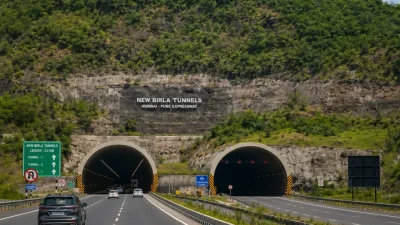
Tunnels have emerged as the project’s most impressive technical achievement. The Silkyara-Barkot tunnel on the Yamunotri route, at 4.53 kilometres the longest single-tube tunnel in the project, gained international attention in November 2023 when a section collapsed during construction, trapping 41 workers for 17 days before their rescue. The incident highlighted both the risks of Himalayan tunnel construction and the determination to complete the project. The tunnel has since resumed construction with enhanced geological monitoring and safety protocols.
The Environmental Debate
The Char Dham project has been one of India’s most contested infrastructure projects on environmental grounds. A Supreme Court-appointed High-Powered Committee (HPC), chaired by environmentalist Ravi Chopra, recommended in 2020 that the road width be limited to 5.5 metres (intermediate width) rather than the planned 7-10 metres, arguing that wider roads would require excessive cutting of mountain slopes, destabilising hillsides and increasing landslide risk.
The government contested this recommendation, arguing that wider roads were necessary for national security (the routes approach the India-China border) and for the safety of the millions of pilgrims who use them. The Supreme Court ultimately permitted the wider configuration, with conditions including mandatory environmental impact assessments, slope stabilisation measures, and compensatory afforestation.
Environmental organisations, including the Wildlife Institute of India and several civil society groups, have documented the impacts of construction: felled trees, muck dumped into rivers, increased siltation in the Ganga’s tributaries, and visibly destabilised hillsides along several sections. The debate reflects a tension that runs through India’s development discourse: the genuine need for infrastructure to support economic growth and social welfare versus the equally genuine need to protect fragile ecosystems. This tension is visible across India’s environmental landscape, including in the ongoing debate about pollution control funding.
Impact on Pilgrimage and Tourism
Despite the controversies, the improved road infrastructure has had a measurable impact on pilgrimage and tourism numbers. The Char Dham Yatra — the annual pilgrimage circuit that is one of Hinduism’s most important religious journeys — attracted over 56 lakh (5.6 million) pilgrims in 2023, a record that was exceeded in subsequent years as road conditions continued to improve.
The improved accessibility has changed the pilgrim demographic. Where once the Char Dham Yatra was undertaken primarily by elderly devotees willing to endure days of difficult road travel, the improved highways have attracted younger families, adventure tourists, and international visitors. The government has promoted the yatra as both a spiritual journey and a tourist experience, with helicopter services to Kedarnath and Badrinath supplementing road access.
The economic impact on local communities along the routes has been significant. New hotels, restaurants, and tourism services have proliferated in towns along the highways, generating employment and economic activity in regions that historically depended on subsistence agriculture. However, this growth has also brought challenges: waste management, water supply, and the commercialisation of sacred sites are growing concerns that local administrations are not always equipped to address.
Beyond Char Dham: India’s Broader Road Revolution
The Char Dham project is part of a much larger transformation of India’s road infrastructure. The Bharatmala Pariyojana, a mega highway programme approved in 2017, envisions the development of approximately 65,000 kilometres of national highway at an estimated cost of ₹10.63 lakh crore. By 2026, significant progress has been made, with several major expressways completed or nearing completion.
The Delhi-Mumbai Expressway, at 1,350 kilometres the longest expressway in India, is operational on most sections, reducing travel time between the two mega-cities from 24 hours to approximately 12 hours. The Purvanchal Expressway in Uttar Pradesh has transformed connectivity for eastern UP and Varanasi. The Bengaluru-Mysuru Expressway has cut travel time between the two Karnataka cities to approximately 90 minutes.
India’s total national highway length exceeded 150,000 kilometres in 2025, with construction progressing at approximately 28 kilometres per day — among the fastest rates of road construction in the world. The quality of construction has also improved, with wider carriageways, better surface materials, and modern highway amenities (including electronic tolling, rest areas, and emergency services) becoming standard on new projects.
The Road Trip Renaissance
Improved road infrastructure has catalysed a renaissance in Indian road trip culture. Where once long-distance road travel in India was an endurance test — characterised by potholed roads, missing signage, and unpredictable conditions — the new expressways and improved national highways have made road trips a genuinely enjoyable form of travel. The growth of car rental services, mapping applications, and roadside amenities has further lowered barriers.
Popular road trip routes in 2026 include Delhi to Jaipur via the NH48, Mumbai to Goa via the new coastal highway, Bengaluru to Coorg, and the Golden Quadrilateral connecting Delhi, Mumbai, Chennai, and Kolkata. For the more adventurous, the Himalayan highways — including the Manali-Leh Highway and the Char Dham routes — offer some of the most spectacular driving in the world.
Looking Forward
India’s road infrastructure transformation is far from complete. The gap between new expressways and the often-poor condition of state highways and rural roads remains wide. Urban traffic congestion in major cities contradicts the progress on intercity routes. And the environmental costs of massive road construction — deforestation, habitat fragmentation, and induced demand for vehicle travel — require honest assessment.
Yet the direction of travel is unmistakable. India is building the road network of a modern economy, and the Char Dham Highway is its most symbolic expression — a project that connects faith, infrastructure, ambition, and the enduring human desire to traverse difficult terrain in search of something higher. Whether that something is divine grace, mountain beauty, or simply the thrill of a well-engineered highway curving through the Himalayas, the journey is now open to all.