Rahul Mishra and Gaurav Gupta at Paris Couture Week 2026: Indian Craftsmanship Conquers Global Fashion

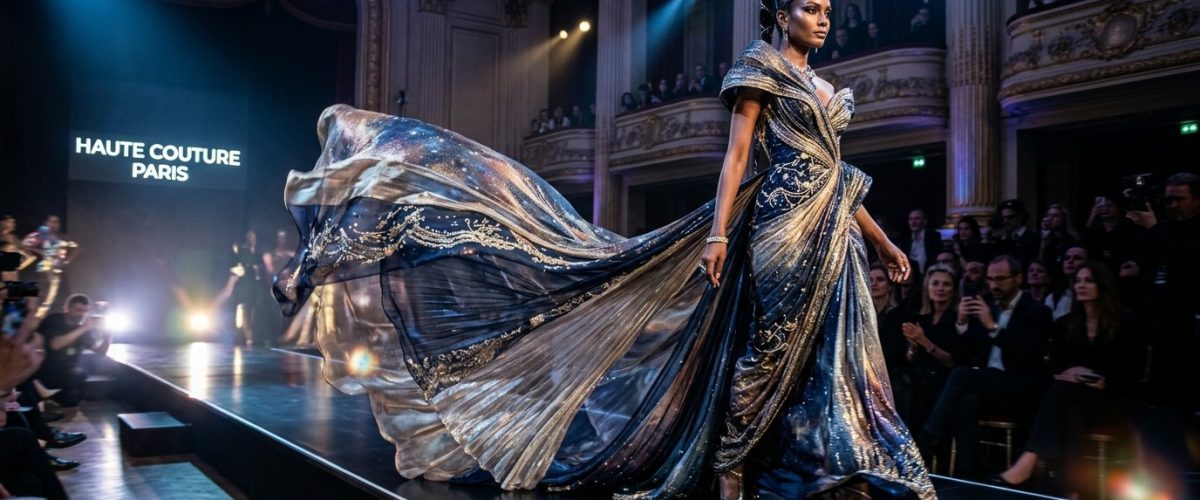
Paris Couture Week, the fashion calendar’s most prestigious platform for haute craftsmanship, has once again affirmed India’s rising influence on global fashion. During the Haute Couture Spring Summer 2026 edition (26-29 January), two Indian designers — Rahul Mishra and Gaurav Gupta — delivered collections that earned critical acclaim, generated viral social media moments, and reinforced a transformative truth: Indian designers are no longer guests at the global fashion table but essential contributors shaping its future direction.
Gaurav Gupta’s Divine Androgyne: Spiritual Philosophy as Couture
Gaurav Gupta returned to Paris with a collection titled Divine Androgyne, and what emerged was nothing short of sculptural theatre. Rooted in ancient Indian spiritual philosophy, the collection explored cosmic duality, androgyny, and the concept of wholeness — drawing inspiration from Ardhanarishvara, the half-male, half-female form of Shiva and Parvati. This is couture not as decoration but as philosophical statement, garments serving as material meditations on unity and transcendence.
On the runway, Gupta translated these abstract concepts into flowing, gender-fluid silhouettes that blurred boundaries between structure and softness. His signature corsetry appeared to melt into molten drapes, while architectural shoulders transitioned seamlessly into cascading forms, creating garments that seemed alive with motion. Swirling metallic structures formed halos, orbiting rings, and cocoon-like shells around the body, evoking energy, balance, and transformation.
The colour palette leaned heavily into an interstellar mood: astral whites, cosmic silvers, obsidian blacks, and muted metallic tones dusted with shimmer. The effect was simultaneously futuristic and deeply spiritual — a visual meditation on unity rather than division. Gupta’s Instagram caption, “When you and I are one,” was widely shared, distilling the collection’s philosophy into a phrase that resonated far beyond the fashion community.
Rahul Mishra: Nature as Narrative
Rahul Mishra, the first Indian designer to be invited to present at Paris Haute Couture Week (in 2020), continued to build on his reputation as a couturier whose work bridges the botanical and the sartorial. His Spring Summer 2026 collection drew from the intricate ecosystems of India’s forests and waterways, translating the textures, colours, and rhythms of the natural world into garments of extraordinary complexity.
Mishra’s hallmark technique — three-dimensional embroidery that creates the illusion of flora and fauna growing from the fabric itself — has evolved in sophistication with each successive couture season. His 2026 pieces featured embroidered ecosystems so detailed that individual insects, petals, and leaf veins were discernible from close range. The craftsmanship required for each garment represents hundreds of hours of skilled handwork by artisans in Mishra’s Delhi atelier — a labour-intensive process that is itself an argument for the preservation of India’s textile craft traditions.
Indian Craftsmanship: The Global Fashion Differentiator
What both Gupta and Mishra share — and what distinguishes them from their European counterparts — is a foundational relationship with Indian craft traditions. India possesses an unmatched depth of textile knowledge, from the zardozi embroidery of Lucknow to the Kanjeevaram silk weaving of Tamil Nadu, from Chikankari threadwork to Bandhani tie-dye techniques. These are not aesthetic choices but living traditions sustained by millions of artisans whose skills represent centuries of accumulated knowledge.
Mishra and Gupta have both built their couture practices on the foundation of these craft ecosystems, employing artisans whose techniques cannot be replicated by machines or by artisans from other traditions. In doing so, they have positioned Indian craftsmanship not as an exotic novelty within global fashion but as an irreplaceable resource — one that offers complexity, authenticity, and narrative depth that factory-produced luxury cannot approach.
The Red Carpet Pipeline
The commercial implications of Paris Couture Week success extend far beyond the runway. Both Gupta and Mishra have cultivated red carpet clienteles that span Bollywood and Hollywood. Gaurav Gupta’s sculptural gowns have been worn by international celebrities at events including the Met Gala, Cannes Film Festival, and the Grammy Awards, while Mishra’s nature-inspired creations have attracted actresses and public figures who value the combination of visual spectacle and ethical craft that his garments represent.
For India’s fashion industry, these high-profile placements serve a dual function: they generate commercial opportunities for the designers themselves and they elevate the profile of Indian fashion globally, creating a halo effect that benefits Indian designers at all market levels. When a Gaurav Gupta gown appears on an international red carpet, it reinforces the perception that Indian design is world-class — an association that benefits everyone from couturiers to high-street brands producing for the domestic market.
Sustainability as Philosophy
An increasingly important dimension of Indian couture’s global appeal is its inherent relationship with sustainability. The handcraft techniques employed by designers like Mishra and Gupta are, by their nature, low-waste and low-energy compared to industrial garment production. The artisanal model supports rural livelihoods, preserves intangible cultural heritage, and produces garments of a quality and longevity that fast fashion cannot match.
This alignment between Indian craft traditions and global sustainability concerns has created a powerful narrative advantage. As India’s broader creative industries gain international recognition, the fashion sector’s ability to offer luxury that is both aesthetically exceptional and ethically compelling positions it for continued growth in markets where conscious consumption is becoming a priority.
Looking Ahead: Indian Fashion’s Global Moment
The success of Rahul Mishra and Gaurav Gupta at Paris Couture Week 2026 is not an isolated achievement but the leading edge of a broader trend. Indian fashion weeks in Delhi and Mumbai continue to attract international buyers and press, while a new generation of designers is developing collections with global distribution from the outset. The infrastructure supporting Indian fashion — from textile mills to logistics to digital marketing — has improved dramatically, enabling designers to compete at the highest levels of international fashion commerce.
As India’s cultural exports in cinema and entertainment reshape global perceptions, fashion is following a parallel trajectory. The message from Paris in January 2026 was unequivocal: Indian design is not merely participating in global fashion — it is helping to define its future. For the artisans in Delhi and Lucknow whose hands create these extraordinary garments, that recognition is both vindication and inspiration.

- Northeast India Emerges as 2026’s Hottest Travel Destination as Jorhat-Majuli Searches Spike - March 25, 2026
- Mamaearth, boAt, and Noise: How India’s D2C Champions Are Chasing Profitability in 2026 - March 24, 2026
- India’s D2C Brands Bet Big on Offline Expansion as Quick Commerce Reshapes the Playbook - March 24, 2026