Kashmiri Wazwan in 2026: How the Valley’s Royal Feast Tradition Is Finding New Audiences Across India

In the snow-dusted valley of Kashmir, where the Jhelum River winds through saffron fields and walnut groves beneath the gaze of the Himalayas, a culinary tradition of royal proportions has endured for centuries. The Wazwan — a formal feast of 36 courses prepared by master chefs called Wazas and served on a communal copper platter called the trami — is one of the world’s most elaborate and symbolically rich dining rituals. In 2026, this magnificent tradition is finding new audiences far beyond the Valley, as Kashmiri restaurants, pop-up dining experiences, and cultural festivals bring the Wazwan to cities across India, introducing millions to a feast that is simultaneously a culinary marathon, a social ceremony, and a profound expression of Kashmiri identity.
Anatomy of a Wazwan: The 36-Course Marvel
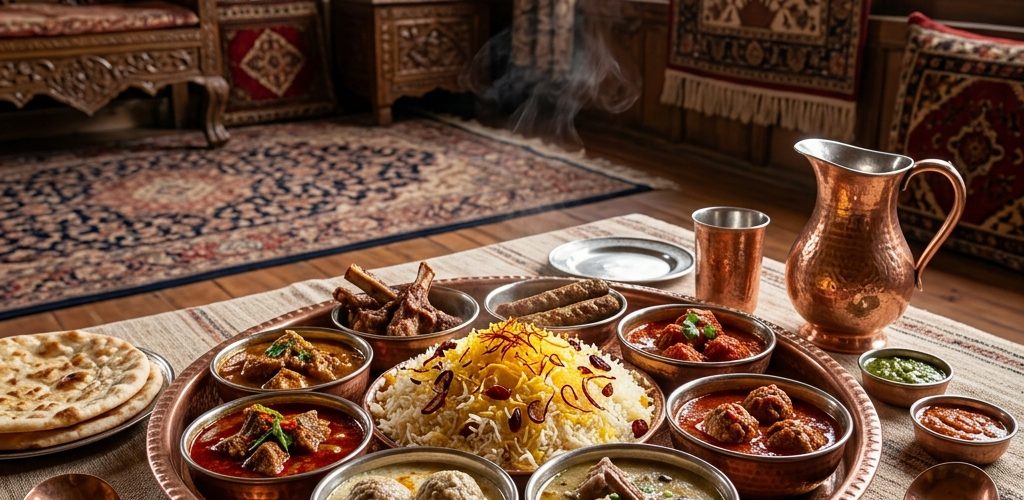
A traditional Wazwan is a carefully choreographed sequence of dishes, each with its designated place in the hierarchy of the feast. The meal opens with a ritual hand-washing ceremony — guests pour water from a tash-t-nari (ornate copper basin) over their hands as a mark of purification and respect. The trami, a large copper plate shared by four diners, is then placed before the guests, mounded with fragrant steamed rice and arranged with the signature Wazwan dishes.
The cornerstone preparations include Rogan Josh, a slow-cooked lamb curry that derives its deep red colour from Kashmiri chillies and its richness from copious yoghurt and onion; Tabak Maaz, twice-cooked lamb ribs that are first braised in spiced milk and then fried to golden crispness; Gushtaba, large lamb meatballs in a silky white yoghurt gravy that traditionally concludes the feast; Rista, bright red lamb meatballs in a fiery chilli sauce; and Yakhni, a yoghurt-based preparation subtly flavoured with fennel, dried ginger, and saffron. Each dish demonstrates a different technique, a different spice profile, and a different facet of the Waza’s mastery.
The Waza: Master Chefs of a Living Tradition
The Waza — the master chef who presides over a Wazwan — is a figure of considerable prestige in Kashmiri society. The profession is traditionally hereditary, with knowledge and technique passed from father to son over generations. A Waza begins training in childhood, spending years as an apprentice before being entrusted with the preparation of signature dishes. The most respected Wazas — several families in Srinagar’s old city have maintained the tradition for over ten generations — are booked months in advance for weddings and celebrations, and their presence at a feast is itself a mark of the host family’s status.
The Waza’s workspace is the wood-fired kitchen set up outdoors for large feasts, where enormous copper degchis (cooking vessels) simmer over controlled fires, and the air is thick with the aromas of saffron, fennel, and dried ginger. The preparation of a complete Wazwan for 100 guests begins 48 hours before the feast, with the slow rendering of lamb fat, the pounding of meat for meatball preparations, and the assembly of the complex spice pastes that define each dish. It is a feat of culinary logistics that requires a team of 10-15 assistants working under the Waza’s precise direction.
Beyond the Valley: Wazwan Reaches New Audiences
The most significant development in Wazwan culture in 2026 is its geographical expansion. Kashmiri restaurants in Delhi, Mumbai, Bengaluru, Hyderabad, and Pune are offering Wazwan-style dining experiences that range from individual Wazwan platters (scaled down from the communal trami for restaurant service) to full-scale Wazwan feasts hosted as ticketed dining events. Establishments such as Haakh in Delhi, Zaika-e-Kashmir in Mumbai, and Wazwan by Khanqah in Bengaluru have built loyal followings among food enthusiasts eager to experience Kashmir’s royal cuisine without making the journey to the Valley.
Pop-up Wazwan experiences have become particularly popular. Chef Waza Mohammad Yousuf, one of Srinagar’s most celebrated practitioners, has conducted Wazwan pop-ups in Delhi, Jaipur, and Goa during the 2025-26 winter season, attracting sell-out crowds willing to pay Rs 3,000-5,000 per person for an authentic 16-course Wazwan experience prepared by a master chef. These events function as both dining experiences and cultural education, with the Waza explaining the significance, technique, and history of each dish as it is served.
The Saffron Connection: From Kashmir’s Fields to Its Plates
Saffron, the world’s most expensive spice, is Wazwan’s defining luxury ingredient. Kashmir’s saffron — cultivated in the Pampore region, approximately 15 kilometres from Srinagar — is regarded as the finest in the world, distinguished by its intense colour, aroma, and flavour profile from the more commonly available Iranian and Spanish varieties. Kashmiri saffron holds a Geographical Indication tag and, since 2020, a dedicated branding initiative that certifies its purity and origin.
In Wazwan cooking, saffron appears in multiple preparations — in the yoghurt gravy of Yakhni, in the finishing of Rogan Josh, in the rice that forms the bed of the trami, and in the kahwa (green tea with saffron, cardamom, cinnamon, and almonds) that bookends the feast. The spice’s use is both gastronomic and ceremonial: the golden-orange threads scattered over the final plating symbolise prosperity, welcome, and the host’s generosity. This connection between ingredient and identity is a theme that resonates across India’s regional cuisines, from the pepper of Chettinad to the kokum of Konkan, each defining the character of its place.
Wazwan and Kashmiri Identity in 2026
The Wazwan is more than food — it is an expression of Kashmiri identity, hospitality, and community. In Kashmiri culture, the Wazwan is the centrepiece of wedding celebrations, the medium through which families demonstrate honour and generosity, and the ritual through which community bonds are renewed. The act of sharing a trami — four people eating from a single plate, a practice that enforces equality and intimacy — embodies values of communality that stand in deliberate contrast to the individualism of modern dining culture.
In 2026, as the Wazwan reaches new audiences across India, it carries with it these cultural meanings. Indian diners who experience a Wazwan for the first time frequently describe it as more than a meal — it is an event, a performance, and an education. The feast demands time, attention, and a willingness to surrender to a culinary narrative controlled by the Waza, which is precisely what makes it so memorable in an age of instant gratification and on-demand food delivery. This philosophy stands in fascinating contrast to the efficiency-driven cloud kitchen revolution reshaping urban India’s food culture.
Where to Experience Wazwan in 2026
For the most authentic experience, a visit to Srinagar during the wedding season (May-September or October-November) offers the opportunity to attend or observe a full-scale Wazwan. Several heritage hotels and houseboats on Dal Lake also offer curated Wazwan experiences for tourists, with advance booking recommended. Those combining a Kashmir trip with broader North Indian travel will find that Varanasi’s revamped cultural offerings and Rajasthan’s heritage tourism experiences create a compelling multi-destination itinerary spanning the spectrum of North Indian culture.
In Delhi, the restaurants in the Lajpat Nagar and Hauz Khas areas frequented by the Kashmiri community offer the most reliable year-round Wazwan experiences outside the Valley. In Bengaluru and Mumbai, following the social media pages of Kashmiri food pop-up organisers is the best way to stay informed about upcoming Wazwan events, which typically sell out within hours of announcement.
A Feast That Feeds the Soul
In a world of hurried meals and algorithmic menus, the Kashmiri Wazwan is a magnificent anachronism — a feast that demands hours, honours centuries of tradition, and treats the act of eating as a sacred communal experience. In 2026, as it finds new audiences across India and the world, the Wazwan is not merely surviving — it is thriving, proving that in an age of convenience, the hunger for meaning, connection, and extraordinary food is stronger than ever. For those ready to sit cross-legged around a copper trami and surrender to the Waza’s art, the Wazwan offers a reward that no Michelin star or Instagram post can capture: the experience of being fed, in every sense of the word, by one of the world’s greatest culinary traditions.

- Regional Indian Cuisine Goes Mainstream: How Forgotten Flavours Are Conquering Urban Menus in 2026 - March 27, 2026
- Street Food Revolution: How India’s Chaat and Momos Vendors Are Going Digital in 2026 - March 26, 2026
- Wellness Diets Take Over Indian Kitchens: Seven Viral Food Trends Dominating 2026 - March 25, 2026