Bharatiya Antariksh Station: India’s Space Station Programme Takes Shape as ISRO Charts a Path Beyond Low Earth Orbit

India’s space ambitions have long been defined by a combination of pragmatic engineering and audacious vision, and no programme better encapsulates this duality than the Bharatiya Antariksh Station (BAS). Announced as a logical successor to the Gaganyaan human spaceflight programme, the BAS represents India’s intent to establish a permanent crewed presence in low Earth orbit—a capability currently possessed only by the International Space Station consortium and China’s Tiangong. As ISRO’s 2026 roadmap takes concrete form, the BAS programme is transitioning from aspirational concept to engineering reality, with module design, technology development, and international partnership frameworks advancing simultaneously.
The Modular Architecture
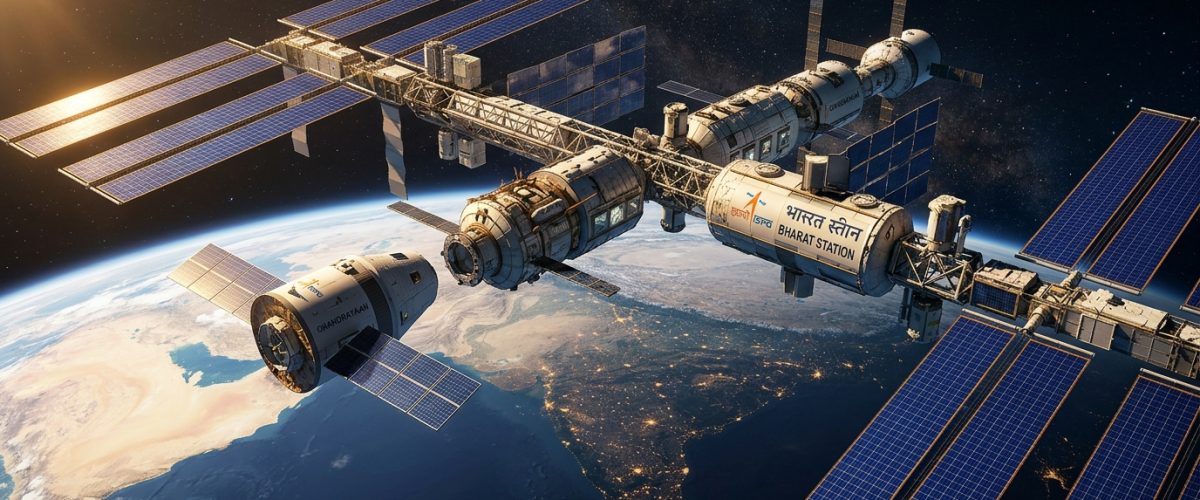
ISRO’s approach to the Bharatiya Antariksh Station follows the modular construction philosophy that has proven successful in every space station programme to date. Rather than launching a single monolithic structure, the BAS will be assembled in orbit through the sequential launch and docking of independently functional modules, each carrying specific capabilities: habitation quarters, scientific laboratories, power generation systems, and docking ports for crew and cargo vehicles.
The initial BAS configuration, as described in ISRO’s preliminary design documents, envisions a core module providing life support, power management, and attitude control, connected to a science module equipped with microgravity research facilities and external experiment platforms. This initial two-module configuration would support a crew of two to three astronauts for missions lasting several weeks, with subsequent modules expanding both the station’s capacity and its scientific capabilities over a planned development period extending into the 2030s.
The modular approach offers strategic flexibility. Each module can be developed, tested, and launched independently, spreading costs and technical risks across multiple mission opportunities. If a particular module encounters development delays, the overall programme can proceed with a modified configuration—a resilience that monolithic designs cannot offer. As Gaganyaan’s critical uncrewed test flight in 2026 progresses through its critical validation phase, each successful test builds the foundation of human spaceflight expertise that BAS will require.
Technology Building Blocks from Gaganyaan
The BAS programme’s technical feasibility rests substantially on the capabilities being developed through Gaganyaan. The human-rated LVM3 launch vehicle, the crew module design, the life support system architecture, the thermal protection technologies, and the mission operations infrastructure all serve double duty—designed for Gaganyaan but engineered with space station applications in mind.
Critical among these building blocks is the docking and rendezvous technology validated through ISRO’s SPADEX (Space Docking Experiment) mission, launched in December 2024. SPADEX demonstrated autonomous orbital docking between two spacecraft—a capability absolutely essential for modular space station assembly, crew rotation, and cargo resupply operations. The successful validation of this technology removed one of the most significant technical uncertainties from the BAS programme’s critical path.
The Environmental Control and Life Support System (ECLSS) being developed for Gaganyaan’s crew module represents the starting point for BAS life support, but the station’s longer-duration missions will require significant enhancements. While Gaganyaan’s ECLSS uses consumable-based approaches suitable for week-long missions, the BAS will need regenerative systems that recycle water, recover oxygen from carbon dioxide, and minimise the resupply mass required to sustain crew operations over months rather than days.
Scientific Objectives: Microgravity Research for India
The scientific case for the BAS centres on providing Indian researchers with dedicated access to a microgravity laboratory environment. Currently, Indian scientists seeking to conduct space-based research must compete for limited experiment slots on the International Space Station—a process that is both time-consuming and dependent on international partnership arrangements. A national space station would provide sovereign research access, enabling sustained experimental programmes that require extended microgravity exposure.
Priority research domains for the BAS include materials science—where microgravity enables the synthesis of novel alloys, crystals, and pharmaceutical compounds impossible to produce under Earth’s gravity—and life sciences, where the effects of spaceflight on biological systems inform both human health research and agricultural science. India’s pharmaceutical industry, which is globally competitive in generic drug manufacturing, could benefit significantly from microgravity-enabled drug development research. The convergence of space science with India’s broader research infrastructure, as demonstrated through institutions like the ISRO-NASA NISAR satellite mission, creates synergies that multiply the scientific return from space station investments.
Space-based technology demonstration is another key BAS objective. The station would serve as a testbed for advanced technologies—including next-generation solar cells, radiation-hardened electronics, and autonomous robotic systems—that require validation in the space environment before deployment on operational missions. This technology maturation function accelerates the development cycle for both ISRO missions and India’s growing commercial space sector.
International Partnerships and Diplomacy
ISRO has signalled its openness to international participation in the BAS programme, recognising that collaboration can reduce costs, accelerate timelines, and enhance the station’s scientific output. Potential partnership models range from contributed modules and experiment facilities to crew exchange arrangements and shared operational responsibilities.
India’s strategic positioning in the international space partnership landscape has never been stronger. As the United States re-evaluates its space station strategy following the planned retirement of the International Space Station later this decade, and as geopolitical tensions complicate cooperation with Russia and China, India represents an attractive partner for nations seeking space station access. The BAS programme could serve as a nucleus for a broader network of international space cooperation, particularly among Global South nations with growing space capabilities.
Japan’s JAXA, France’s CNES, and the European Space Agency have all engaged in preliminary discussions with ISRO about potential BAS collaboration. Australia, which has rapidly expanded its space programme, is another likely partner. These partnerships would bring not just financial contribution but also complementary technical capabilities—particularly in areas such as robotic systems, advanced materials, and precision manufacturing where India’s partners maintain technological leadership.
Budgetary Realities and Phased Implementation
The financial architecture of the BAS programme reflects India’s pragmatic approach to space investment. Rather than committing to a single massive appropriation, ISRO has structured the programme as a phased development effort with incremental funding tied to milestone achievements. This approach mirrors the successful funding model used for Gaganyaan and previous flagship missions, maintaining political and budgetary sustainability over the programme’s multi-decade timeline.
Cost estimates for the complete BAS programme remain preliminary, but informed assessments suggest a total investment significantly lower than the International Space Station’s approximately USD 150 billion development cost. India’s demonstrated ability to achieve space mission objectives at a fraction of international cost benchmarks—Mangalyaan’s Mars mission cost less than many Hollywood films depicting Mars exploration—provides reason to expect that the BAS can be realised within a fiscally responsible envelope.
The programme’s success will ultimately depend on sustained political commitment across government transitions—a challenge that has historically complicated long-duration space programmes worldwide. ISRO’s institutional credibility, built through decades of mission successes, provides a strong foundation for maintaining the political support necessary for a programme that will span multiple parliamentary terms. As India’s technology and science sectors continue their rapid expansion—from the digital payments ecosystem documented in India’s UPI revolution and digital payments surge to the semiconductor and space industries—the BAS represents the most ambitious expression yet of India’s aspiration to operate at the frontier of human capability.

- ISRO and AIIMS Sign Landmark MoU for Space Medicine Research Ahead of Gaganyaan Mission - March 25, 2026
- Rising Temperatures Reshape Wildlife Behaviour Across India as Scientists Sound Climate Alarm - March 25, 2026
- UPI Crosses 800 Million Daily Transactions as CRED Gets Payment Aggregator Licence From RBI - March 25, 2026