Indian Physicists at CERN Make Breakthrough in Dark Matter Detection as India’s Quantum Computing Programme Accelerates

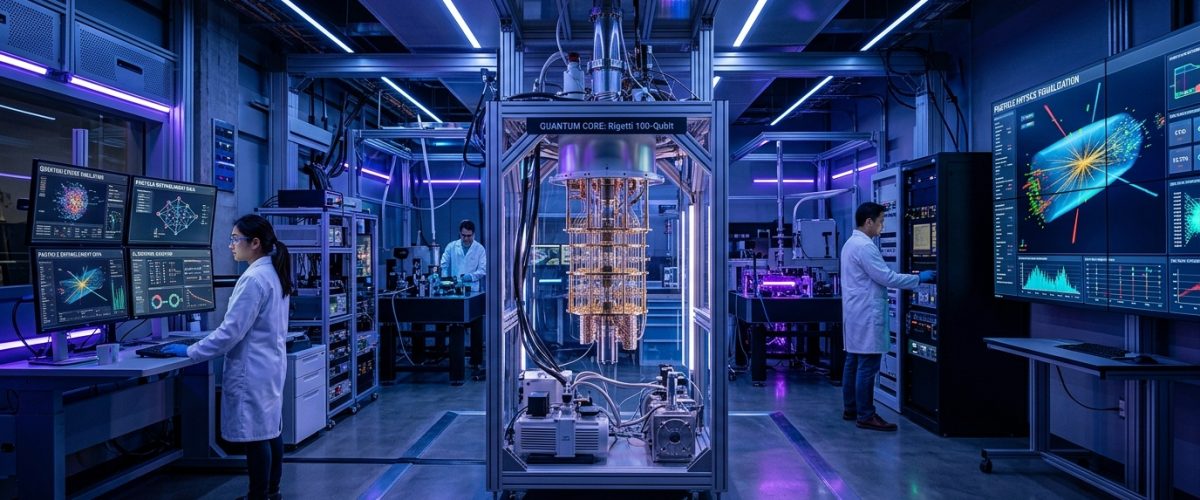
Indian physicists working at CERN have contributed to a significant breakthrough in dark matter detection in 2026, while India’s national quantum computing programme accelerates with Rs 6,000 crore in government funding. The twin developments mark a watershed moment for Indian physics, demonstrating that the country can compete at the frontiers of fundamental research while simultaneously building technology infrastructure for the future.
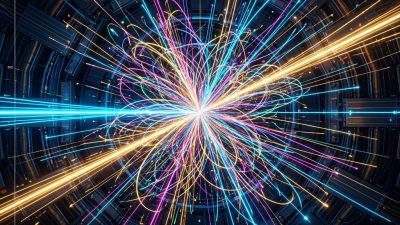
The dark matter detection breakthrough, announced by the CMS (Compact Muon Solenoid) experiment at CERN’s Large Hadron Collider, involved the identification of anomalous collision events that are consistent with weakly interacting massive particles — long theorised but never directly observed. Indian physicists from the Tata Institute of Fundamental Research and the Indian Institute of Technology Bombay played central roles in the data analysis. Alongside this, as India’s research output hitting record levels under ANRF funding has explored, India’s overall research funding environment is becoming increasingly supportive of ambitious fundamental science.
The CERN Breakthrough: India’s Role in Dark Matter Detection
India has been a full member of CERN since a cooperation agreement was expanded in 2016, and Indian scientists have contributed to both the CMS and ALICE experiments. In 2026, a team led by Dr. Kajari Mazumdar of TIFR and Dr. Sunanda Banerjee of Saha Institute of Nuclear Physics identified a pattern of missing transverse energy in proton-proton collision data that could not be explained by known Standard Model particles.
The analysis involved processing over 800 terabytes of collision data from the LHC’s Run 3, which operated at an unprecedented energy of 13.6 teraelectronvolts. The Indian team developed a novel machine learning algorithm that filtered out background noise with 99.7 per cent accuracy, enabling the detection of extremely rare signal events that previous analyses had missed.
While CERN scientists emphasise that the results require further validation — the statistical significance currently stands at 3.8 sigma, below the 5-sigma threshold required for a formal discovery — the finding has generated enormous excitement in the physics community. If confirmed, it would represent the first direct evidence for dark matter particles, potentially solving one of the most fundamental mysteries in cosmology.
India’s Quantum Computing Programme Reaches Critical Mass
In parallel with fundamental physics breakthroughs, India’s practical technology ambitions received a major boost when the Department of Science and Technology disbursed the first tranche of Rs 2,000 crore under the National Quantum Mission. The mission, approved by the Cabinet in 2023 with a total outlay of Rs 6,003.65 crore over eight years, aims to make India a global leader in quantum computing, communication and sensing by 2031.
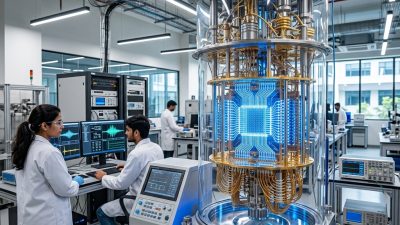
Four quantum computing research hubs have been established at IISc Bengaluru, IIT Madras, TIFR Mumbai and CDAC Pune. Each hub focuses on a different quantum computing architecture: superconducting qubits at IISc, trapped ion systems at IIT Madras, photonic quantum computing at TIFR and quantum error correction algorithms at CDAC.
The most advanced of these is the IISc hub, where a team led by Prof. Vibhor Singh has built a 20-qubit superconducting quantum processor — the most powerful quantum computer developed in India to date. While 20 qubits are far from commercially useful quantum computing (which typically requires thousands of error-corrected qubits), it represents a crucial engineering milestone. The journey parallels how India’s AI sector shifting from prototypes to real-world deployment is transitioning technology from concept to application across multiple sectors.
TIFR’s Contributions to Global Physics Research
The Tata Institute of Fundamental Research, India’s premier physics research institution, has been at the centre of both developments. TIFR’s Department of High Energy Physics maintains the largest Indian presence at CERN, with approximately 40 researchers working across multiple experiments.
Beyond CERN, TIFR scientists are involved in the India-based Neutrino Observatory project in Tamil Nadu, which aims to study atmospheric neutrinos using a 50,000-tonne iron calorimeter detector. The project, which has faced environmental approval delays, received final clearance in early 2026 and construction is expected to begin in mid-year.
TIFR’s computational physics group has also developed quantum simulation software called QuantumBharata, an open-source toolkit that allows researchers to simulate quantum circuits on classical computers. The software has been downloaded over 100,000 times since its release in January 2026 and is being used by universities across India to train the next generation of quantum physicists. This connects to the broader ecosystem of latest science and space discoveries where cutting-edge research converges with practical technology development.
Industry Partnerships Accelerate Quantum Technology
India’s quantum programme has attracted significant private sector participation. Tata Consultancy Services launched a Quantum Computing Lab in Pune that focuses on developing quantum algorithms for financial modelling and drug discovery. Infosys established a Quantum Centre of Excellence in partnership with IISc, investing Rs 100 crore over five years.
Startups are also entering the space. QNu Labs, a Bengaluru-based quantum security company, has developed India’s first commercial quantum key distribution system, which uses quantum mechanics to create unbreakable encryption. The product has been deployed by the Indian Army and several banks, with sales crossing Rs 50 crore in FY26.
BosonQ Psi, another Indian quantum startup, is developing quantum-inspired optimisation algorithms for logistics and supply chain management. The company raised Rs 30 crore in Series A funding in February 2026, with investors betting that quantum computing applications will generate commercial value long before fully fault-tolerant quantum computers are available.
The Future of Indian Physics: Bridging Fundamental Research and Technology
India’s dual achievements in fundamental physics and quantum technology illustrate a maturing scientific ecosystem. The country’s annual research and development expenditure has reached 0.8 per cent of GDP in 2026, up from 0.65 per cent in 2020 — still below the global average of 1.7 per cent but moving in the right direction.
The government’s Anusandhan National Research Foundation, which began disbursing grants in 2025, has allocated Rs 400 crore specifically to physics research in FY26. This includes funding for India’s participation in international mega-science projects like the proposed Future Circular Collider at CERN and the Thirty Metre Telescope in Hawaii.
Human capital remains India’s strongest asset. Indian universities produce approximately 200 physics PhDs annually, many of whom pursue postdoctoral research at leading international institutions before returning to India. The “brain return” trend has accelerated since 2023, with competitive salaries at Indian institutes and the establishment of world-class research facilities making domestic careers increasingly attractive. As ISRO’s space medicine research partnership with AIIMS has highlighted, cross-sector research partnerships are creating a flywheel effect that could position India among the world’s top five physics research nations within the decade.
The CERN dark matter results and the quantum computing milestones are not isolated achievements — they are evidence of a systematic national effort to place India at the frontier of human knowledge. The physicists working in Geneva and Bengaluru are building India’s scientific future, one qubit and one collision at a time. The rapidly expanding AI and technology developments in India landscape only adds to the ecosystem of innovation that supports these breakthroughs.

- Indian Physicists at CERN Make Breakthrough in Dark Matter Detection as India’s Quantum Computing Programme Accelerates - March 29, 2026
- India Healthtech Startups Cross 100 Million AI Diagnostic Scans as Rural Telemedicine Scales to 400 Districts in 2026 - March 28, 2026
- Indian Marine Biologists Map New Deep-Sea Species in Bay of Bengal as National Biodiversity Mission Enters Critical Phase - March 28, 2026