Top Research Breakthroughs from Indian Universities in 2026: IISc, IITs Lead the Way

Indian universities have entered 2026 on a trajectory that would have seemed improbable a decade ago: consistently climbing global research rankings, attracting international collaborators, and delivering breakthroughs that address both national priorities and global challenges. The Indian Institute of Science (IISc) Bengaluru, the Indian Institutes of Technology (IITs), and a growing cohort of central and state universities are producing research of a calibre that is reshaping perceptions of Indian academia. This article examines the most significant research breakthroughs from Indian universities in early 2026 and analyses the structural factors that have made this moment possible.
IISc Bengaluru: Continuing the Leadership
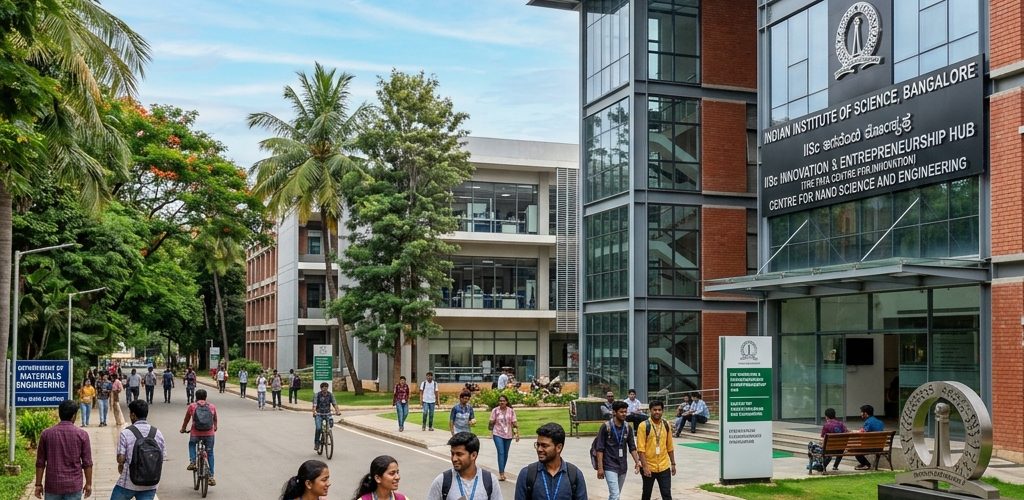
IISc Bengaluru, consistently ranked as India’s top research institution, has set the pace for 2026 with breakthroughs across multiple domains. In materials science, a team led by researchers at the Centre for Nano Science and Engineering (CeNSE) developed a novel perovskite solar cell architecture that achieved a power conversion efficiency of 26.3 per cent — approaching the theoretical limit for single-junction devices and surpassing the previous Indian record by nearly two percentage points. The development is significant because perovskite cells, made from abundant and inexpensive materials, could dramatically reduce the cost of solar energy generation if stability challenges can be resolved.
In computational biology, IISc researchers published a groundbreaking study using AI-driven protein structure prediction to identify potential drug targets for drug-resistant tuberculosis — a disease that kills approximately 100,000 Indians annually. The work, conducted in collaboration with the Indian Institute of Science Education and Research (IISER) Pune, leveraged the AlphaFold3 platform and identified three novel protein conformations that could be targeted by existing drug molecules in new combinations.
IISc’s Centre for Atmospheric and Oceanic Sciences also made headlines with a comprehensive study of the Indian Ocean Dipole’s effect on monsoon variability, providing the most detailed predictive model to date for monsoon onset timing. Given that agriculture employs over 40 per cent of India’s workforce and remains heavily monsoon-dependent, this research has immediate practical significance for crop planning and disaster preparedness.
IIT Bombay: Deep Tech and Semiconductor Innovation
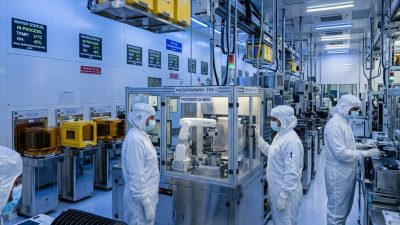
IIT Bombay has positioned itself at the intersection of academic research and industrial application, particularly in semiconductor technology. The institute’s Centre of Excellence in Nanoelectronics (CEN), one of the most advanced nanofabrication facilities in India, announced the successful fabrication of a 28-nanometre CMOS chip using an entirely Indian-designed process flow. While commercial semiconductor foundries operate at 3-5 nanometre nodes, the achievement is significant because it demonstrates India’s ability to complete the entire design-to-fabrication cycle domestically — a capability that is foundational to the country’s semiconductor self-reliance ambitions.
This research connects directly to India’s broader semiconductor strategy, which has attracted global attention. As detailed in our analysis of India’s semiconductor and AI surge, the country’s investments in chip design and manufacturing are creating an ecosystem that bridges the gap between academic innovation and commercial production.
IIT Bombay’s Department of Energy Science and Engineering also published notable work on solid-state batteries, demonstrating a lithium-sulphur cell with an energy density 40 per cent higher than conventional lithium-ion batteries. The potential applications span electric vehicles, grid storage, and portable electronics — markets projected to be worth trillions of dollars globally by 2035.
IIT Madras: Climate Technology and AI
IIT Madras has distinguished itself in 2026 with research at the nexus of climate technology and artificial intelligence. The institute’s AI4Bharat initiative, which develops AI tools for Indian languages and applications, released a new large language model trained specifically on Indian scientific literature — enabling researchers to search, analyse, and synthesise findings across thousands of papers published in Indian journals that are often excluded from international databases.
In climate technology, IIT Madras researchers demonstrated a pilot-scale direct air capture (DAC) system that uses a novel amine-based sorbent developed from agricultural waste. The system captures carbon dioxide from ambient air at a cost estimated at $150-200 per tonne — not yet competitive with the cheapest global alternatives but representing a significant improvement over previous Indian attempts and using locally available materials.
The institute’s collaboration with the National Centre for Polar and Ocean Research on deep-sea mineral exploration has also yielded results, with a remotely operated vehicle (ROV) successfully mapping polymetallic nodule deposits in the Indian Ocean’s Central Indian Basin. These deposits, rich in manganese, nickel, cobalt, and rare earth elements, are strategic resources for India’s clean energy transition.
Emerging Research Powerhouses
Beyond the established elite, several institutions have emerged as research powerhouses in specific domains. IIT Kanpur’s contributions to space technology — including components for ISRO’s missions — have been recognised internationally. The Gaganyaan programme, in particular, has benefited from IIT Kanpur’s expertise in materials science and thermal protection systems.
IISER Kolkata has produced notable work in quantum chemistry, while IIT Hyderabad has become a leading centre for biomedical device development, with several devices receiving regulatory approval for clinical use. The National Institute of Technology (NIT) Rourkela has contributed to metallurgical research that supports India’s steel and manufacturing industries.
Among state universities, Savitribai Phule Pune University’s contributions to biodiversity research and Banaras Hindu University’s archaeological studies using ground-penetrating radar have attracted international attention. These institutions demonstrate that research excellence is not confined to centrally-funded institutions — a trend that bodes well for India’s research ecosystem as a whole.
Structural Factors Behind the Rise
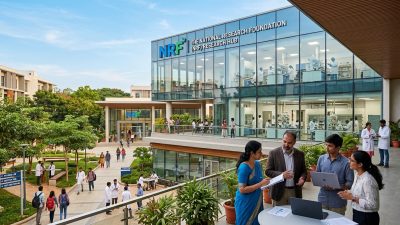
Several structural changes have contributed to the improvement in Indian university research output. The Institutes of Eminence (IoE) programme, launched in 2018, gave selected institutions greater autonomy in hiring, curriculum design, and international collaboration. The National Education Policy (NEP) 2020, while still in its implementation phase, has encouraged multidisciplinary research and established the National Research Foundation (NRF) with a planned budget of ₹50,000 crore over five years.
International collaboration has been another catalyst. Indian institutions have signed hundreds of memoranda of understanding with leading global universities, enabling joint research projects, faculty exchanges, and shared access to expensive equipment. The number of Indian-authored papers in high-impact journals (those in the top 10 per cent by citations) has increased by approximately 40 per cent over the past five years.
Private sector engagement has also grown, with companies including TCS, Infosys, and Reliance establishing research partnerships and funding chairs at IITs and IISc. The Tata Trusts’ endowment to IISc, one of the largest philanthropic contributions to Indian academia, has funded new research centres and attracted world-class faculty.
Challenges Remaining
Despite the progress, significant challenges persist. India’s gross expenditure on research and development (GERD) remains at approximately 0.7 per cent of GDP — well below the 2-3 per cent seen in leading research nations. Faculty vacancies at IITs and central universities often exceed 30 per cent, limiting teaching and research capacity. The bureaucratic processes governing research funding, procurement, and international collaboration, while improving, still create friction that slows the pace of research.
The translation of research into commercial products — the so-called “valley of death” between laboratory and market — remains a persistent weakness. While technology transfer offices have been established at most major institutions, the ecosystem of venture capital, mentorship, and regulatory support needed to commercialise university research is still developing.
Looking Forward
The research breakthroughs of 2026 represent not an anomaly but a trend — the result of sustained, if imperfect, investment in human capital, infrastructure, and institutional reform. If the trajectory continues, Indian universities could, within a decade, join the ranks of global research leaders not just in individual excellence but in systemic capability. The talent exists; the ambition exists; the question is whether the supporting ecosystem — funding, governance, and industry linkages — can keep pace.

- New Heavy Particle Discovered at CERN in 2026: What It Means for the Future of Physics - March 24, 2026
- Gaganyaan 2026: India’s Human Spaceflight Programme Enters Its Most Critical Phase - March 24, 2026
- India’s Semiconductor and AI Surge: How Research Labs Are Powering a Global Transformation - March 24, 2026