India Healthtech Startups Cross 100 Million AI Diagnostic Scans as Rural Telemedicine Scales to 400 Districts in 2026

India’s healthtech startups have crossed a landmark milestone in 2026, with cumulative AI diagnostic scans exceeding 100 million across platforms including Qure.ai, Niramai and SigTuple. Simultaneously, telemedicine services have scaled to cover 400 of India’s 766 districts, driven by integration with the Ayushman Bharat Digital Mission infrastructure and a surge in government and private investment that has pushed the sector’s combined valuation past Rs 85,000 crore.
The twin achievements represent a fundamental transformation in how healthcare is delivered in India, where 65 per cent of the population lives in rural areas with limited access to specialist doctors and diagnostic facilities. As India’s AI sector shifting from prototypes to real-world deployment, healthtech is emerging as perhaps the most consequential application of AI technology in the Indian context, directly impacting health outcomes for hundreds of millions of people.
AI Diagnostics: From Pilot Projects to Population Scale
The journey from experimental AI diagnostic tools to population-scale deployment has been remarkably rapid. Qure.ai, the Mumbai-based company that specialises in AI-powered chest X-ray analysis, has processed over 45 million scans across 2,800 healthcare facilities in India. Its algorithm can detect tuberculosis, pneumonia, lung cancer and 30 other conditions within 60 seconds, with sensitivity exceeding 95 per cent — comparable to experienced radiologists.
The Indian government’s decision to mandate Qure.ai’s TB screening tool in all public health centres under the National TB Elimination Programme has been transformative. In 2025-26, the tool identified 1.2 million presumptive TB cases that might otherwise have gone undetected, contributing to a 15 per cent increase in treatment initiation rates. The World Health Organization has cited India’s AI-powered TB screening as a model for other developing nations.
Niramai, which uses thermal imaging and AI to detect breast cancer without radiation or physical contact, has screened over 8 million women in 2026. The technology is particularly significant for India, where cultural barriers prevent many women from undergoing traditional mammography. The company reports a 92 per cent sensitivity rate for early-stage breast cancer detection.
Rural Telemedicine Scales Through ABDM Integration
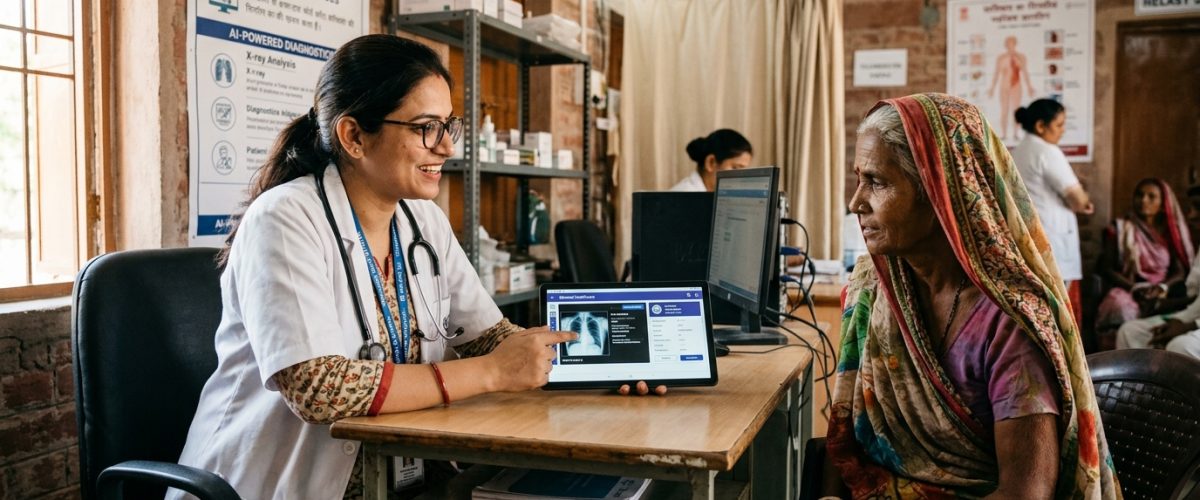
The Ayushman Bharat Digital Mission, India’s ambitious digital health infrastructure, has become the backbone of rural telemedicine expansion. By connecting Ayushman Bharat Health Accounts with telemedicine platforms, patients in remote areas can now access specialist consultations, digital prescriptions and lab test bookings through a single unified interface.
Practo, India’s largest telemedicine platform, now serves 18,000 villages through partnerships with Common Service Centres and primary health centres. The company reports that 60 per cent of its rural consultations are for conditions that previously required a 50-plus kilometre journey to a district hospital — skin conditions, diabetes management, prenatal care and mental health being the most common.
Tata Health has deployed mobile diagnostic units in 150 districts, combining telemedicine consultations with point-of-care testing devices that can perform blood tests, ECGs and ultrasounds. Each unit, housed in a modified Tata Ace vehicle, serves an average of 80 patients per day. The initiative has been funded through a combination of CSR spending and government subsidies.
Investment Landscape: Growth-Stage Capital Flows In
Healthtech funding in India reached Rs 8,500 crore in Q1 2026, making it the second-most-funded sector after fintech. The majority of capital has gone to growth-stage companies with proven unit economics, reflecting a market that has moved beyond the hype-driven investment of 2021-22.
Key deals include Qure.ai’s Rs 1,200 crore Series D led by SoftBank Vision Fund, PharmEasy’s Rs 800 crore round focused on its diagnostic vertical, and MediBuddy’s Rs 600 crore raise to expand its employer health benefits platform. Early-stage funding remains healthy too, with 42 healthtech seed rounds closed in Q1 2026 at an average size of Rs 8 crore. This investment pattern is similar to how Indian startups attracting major growth-stage capital across India’s startup ecosystem more broadly.
International investors are particularly active. Japan’s SBI Holdings, Singapore’s Temasek and Abu Dhabi’s Mubadala have all made significant healthtech bets in India, attracted by the combination of massive market size, proven technology and supportive government policy. The sector’s growth potential is creating opportunities similar to other tech-enabled transformations like digital infrastructure like UPI enabling India’s tech transformation.
Regulatory Framework Catches Up With Innovation
India’s regulatory approach to healthtech has evolved significantly. The Central Drugs Standard Control Organisation issued comprehensive guidelines for AI-based medical devices in January 2026, creating a clear approval pathway that distinguishes between low-risk screening tools, moderate-risk diagnostic aids and high-risk treatment recommendation systems.
The Telemedicine Practice Guidelines, updated in February 2026, now permit AI-assisted diagnosis when supervised by a registered medical practitioner. This framework enables telemedicine platforms to use AI as a first-line screening tool while maintaining the requirement for human clinical oversight. Data privacy protections under the Digital Personal Data Protection Act, 2023, apply specifically to health data, with enhanced consent requirements and data localisation mandates.
The artificial intelligence developments in India are advancing rapidly, and healthtech represents one of the most impactful intersections of technology and social welfare. The National Health Authority has also launched a sandbox programme where startups can test innovative solutions in controlled environments before seeking full regulatory approval.
Impact on Health Outcomes: Early Evidence
Early data suggests that healthtech deployment is having measurable impact on health outcomes. Districts with active telemedicine and AI diagnostic programmes show 12 per cent higher treatment adherence rates for chronic conditions like diabetes and hypertension. Maternal mortality rates in districts with telemedicine-enabled prenatal care have declined 18 per cent faster than the national average.
The National Health Mission’s 2026 annual report credits AI-powered screening with the detection of 45,000 additional cancer cases at early stages, when treatment is most effective and least expensive. Cost savings to the public health system are estimated at Rs 3,400 crore annually, as early detection reduces the need for expensive late-stage interventions.
For the latest developments across India’s startup and innovation news, our coverage tracks the companies and technologies transforming how the country builds and innovates. As India’s healthtech sector matures, the combination of AI capability, digital infrastructure and policy support positions it to become a global model for technology-enabled healthcare delivery in developing nations.

- India Healthtech Startups Cross 100 Million AI Diagnostic Scans as Rural Telemedicine Scales to 400 Districts in 2026 - March 28, 2026
- Indian Marine Biologists Map New Deep-Sea Species in Bay of Bengal as National Biodiversity Mission Enters Critical Phase - March 28, 2026
- India’s Research Output Hits Record High as Anusandhan National Research Foundation Begins Funding in 2026 - March 27, 2026