AI Summit 2026: India Showcases Ambitions but Structural Gaps Expose Long Road Ahead

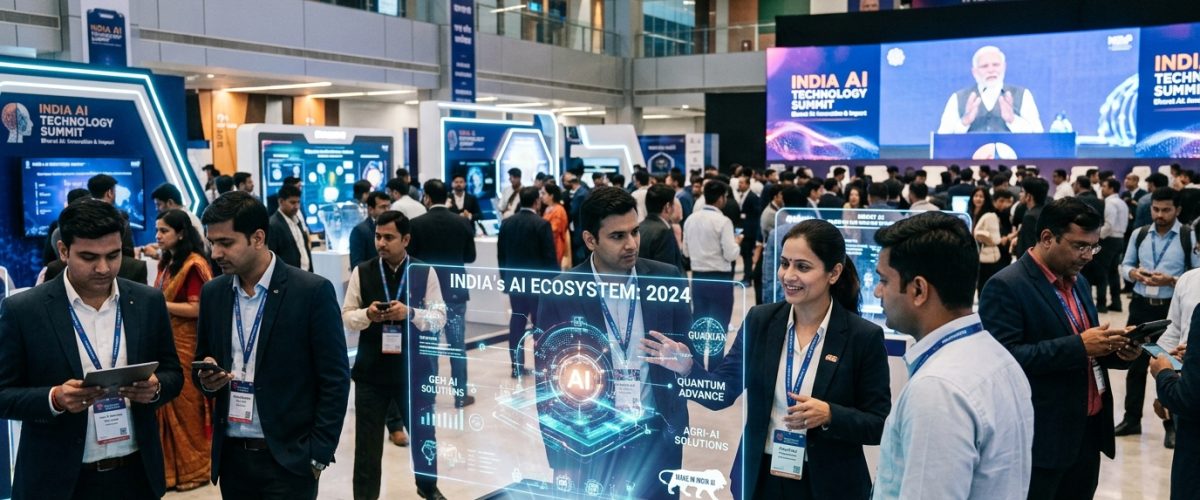
India’s week-long AI Summit 2026, held at a sprawling exhibition complex in the heart of New Delhi, was designed to showcase the nation’s growing capabilities in artificial intelligence. While the event succeeded in drawing heads of state, global technology leaders, and billions of dollars in investment commitments, it also inadvertently exposed the structural challenges that continue to impede India’s rise as a genuine AI innovation hub.
Pockets of Spark Amid Broader Concerns
The summit was not without its achievements. Three Indian start-ups used the platform to unveil homegrown large language models (LLMs), marking a significant step in the country’s quest for technological sovereignty. A series of commitments to invest in local data centre infrastructure were announced, with several global cloud providers pledging multi-billion-dollar expansions across key Indian cities.
A senior minister took the podium to declare that India had achieved a world record for the number of pledges taken by citizens to use AI responsibly — a figure that, while symbolically significant, prompted questions about the gap between pledges and practical policy frameworks. The emphasis on responsible AI usage aligns with India’s broader positioning as a bridge between the rapid deployment ambitions of Western technology firms and the regulatory caution advocated by many developing nations.
Consumer Market Scale Masks Innovation Deficit
A Bank of America Global Research report released during the summit offered a sobering counterpoint to the optimism on display. The analysis confirmed that India now leads all global markets in active users across major LLM platforms, driven by cheap mobile data, a 700-million-plus smartphone user base, and aggressive bundling strategies by telecom operators.
ChatGPT leads the Indian market with approximately 145 million monthly active users, followed by Google Gemini at 105 million and Perplexity at over 20 million. These figures represent remarkable adoption rates that have made India arguably the most important consumer market for American AI companies outside the United States.
However, the report warned that this consumer-side dominance by foreign platforms carries significant risks for India’s domestic AI ecosystem. “The network effect of global LLMs would make them better placed to meet local consumer demand via agentic AI wrappers than Indian start-ups,” the Bank of America analysis noted, drawing parallels with how Meta and Google came to dominate India’s social media and search markets.
The concern is not merely commercial. If India remains primarily a consumer of AI rather than a producer of foundational models, the country risks entrenching a technological dependency that could have implications for everything from economic policy to national security.
The Sovereignty Paradox
One of the most discussed aspects of the summit was a tension that several observers described as paradoxical. India’s top policymakers repeatedly identified technological sovereignty as a central theme of the event, positioning the country as a champion of nations’ rights to develop and control their own AI capabilities.
Yet a disproportionate share of the summit’s speaking slots, exhibition space, and media attention was allocated to representatives of the very foreign technology companies that dominate India’s AI landscape. OpenAI, Google, Meta, and Anthropic all maintained prominent presences at the event, using the platform to announce India-specific product launches and partnership programmes.
Critics argued that the summit’s programming inadvertently reinforced the dynamic it claimed to challenge. “You cannot talk about AI sovereignty while handing over your largest stages to companies whose business model depends on the absence of local alternatives,” a Delhi-based technology policy researcher said on the sidelines of the event.
The Start-Up Ecosystem: Promise and Pressure
India’s AI start-up ecosystem found itself at a crossroads during the summit. The three homegrown LLMs that were unveiled demonstrated genuine technical capability, with models specifically optimised for Indian languages and cultural contexts — an area where global platforms continue to underperform despite significant investment.
However, the scale gap remains daunting. While Indian start-ups are developing models with tens of billions of parameters, their American counterparts are operating at scales that are orders of magnitude larger, with correspondingly larger training datasets and compute budgets. The question facing Indian AI entrepreneurs is whether specialisation in local languages, cultural understanding, and domain-specific applications can create defensible competitive advantages against globally scaled platforms.
The funding landscape offers mixed signals. Venture capital investment in Indian AI start-ups reached record levels in the fiscal year ending March 2026, but the bulk of that capital was concentrated in a handful of well-established companies. Early-stage founders working on foundational AI research reported increasing difficulty in raising capital, with investors preferring application-layer companies that can demonstrate near-term revenue potential.
Infrastructure Commitments and Talent Challenges
The data centre investment commitments announced at the summit represent perhaps the most tangible outcome of the event. India’s current data centre capacity significantly lags behind its consumption patterns, with the majority of AI inference for Indian users currently processed at facilities located outside the country. The pledged investments, if fully realised, would substantially narrow this gap over the next three to five years.
The talent dimension presents both strengths and vulnerabilities. India produces more AI and machine learning engineers annually than any other country, yet a substantial proportion of that talent emigrates to the United States, United Kingdom, and other markets that offer higher compensation and more advanced research infrastructure. Addressing this brain drain requires not just competitive salaries but the creation of research environments that can attract and retain world-class talent.
Looking Ahead
The AI Summit 2026 ultimately served as both a celebration of India’s undeniable progress and a candid assessment of the distance still to be covered. The country’s scale, demographic dividend, and digital infrastructure provide a foundation that few nations can match. But converting those advantages into genuine AI innovation leadership will require sustained policy attention, strategic public investment in foundational research, and a willingness to create regulatory frameworks that protect domestic innovation without stifling global collaboration.
As the global AI race accelerates, India’s decisions in the coming years will determine whether it becomes a consequential producer of AI technology or remains the world’s largest and most sophisticated consumer market for tools built elsewhere. The summit made clear that the country’s leadership understands the stakes. Whether that understanding translates into effective action remains the defining question of India’s technology future.

- New Heavy Particle Discovered at CERN in 2026: What It Means for the Future of Physics - March 24, 2026
- Gaganyaan 2026: India’s Human Spaceflight Programme Enters Its Most Critical Phase - March 24, 2026
- India’s Semiconductor and AI Surge: How Research Labs Are Powering a Global Transformation - March 24, 2026