UPI Transactions Surge 11x in Four Years: How India Became the World’s Digital Payments Capital

The Numbers That Changed Everything
When the Department of Financial Services released its comprehensive study on India’s digital payments ecosystem in February 2026, one statistic stood above the rest: digital transactions in India have surged nearly eleven-fold between 2021 and 2025. At the centre of this transformation sits the Unified Payments Interface — UPI — which now accounts for approximately 80 per cent of all digital transactions in the country. These are not merely impressive numbers; they represent a fundamental restructuring of how 1.4 billion people engage with money.
The findings, presented during the Chintan Shivir 2026 conference and prepared in consultation with the National Payments Corporation of India (NPCI), confirm what market participants have long observed: India has not merely adopted digital payments — it has built the world’s most successful real-time payments infrastructure, and it continues to scale at a pace that no other economy has matched.
A Survey of Ten Thousand Voices
The DFS study surveyed 10,378 respondents across 15 states, encompassing users, merchants, and service providers in both urban and semi-urban areas. The results paint a picture of a society in rapid transition. Fifty-seven per cent of respondents now prefer UPI over cash, citing instant fund transfers and ease of use as primary reasons. Only 38 per cent still prefer cash as their primary transaction method — a dramatic reversal from just five years ago.
Adoption patterns reveal generational dynamics. Users aged 18 to 25 showed the highest digital payment adoption at 66 per cent, indicating that India’s youngest adults are growing up with UPI as their default financial interface. Multiple daily digital transactions have become routine, with 65 per cent of UPI users reporting frequent usage throughout the day.
Perhaps most significantly, confidence in digital payments has increased among 90 per cent of surveyed users. This trust metric is crucial because payment systems are ultimately built on confidence. When a vegetable vendor in a tier-3 town trusts that the money will arrive in her account instantly, the entire edifice of digital commerce becomes self-reinforcing.
The Merchant Revolution
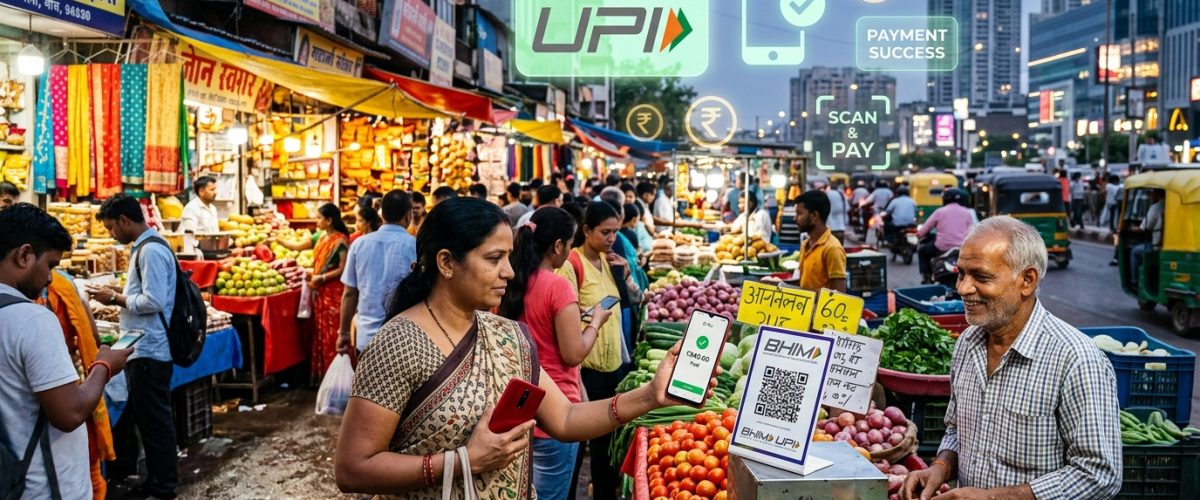
If user adoption has been impressive, merchant adoption has been transformational. The study found that 94 per cent of small merchants now accept UPI payments. This statistic is remarkable when placed in context. India’s small merchant base — comprising neighbourhood kirana stores, street vendors, auto-rickshaw drivers, and market stall operators — has historically operated almost entirely in cash. The near-universal adoption of UPI among this demographic represents one of the most successful technology deployments in Indian economic history.
Cashback incentives have played a measurable role, with 52 per cent of merchants citing incentive schemes as a factor in their adoption decision. However, 74 per cent highlighted transaction speed as the key advantage, suggesting that the technology’s intrinsic value has become more important than financial inducements. The government’s incentive scheme promoting RuPay debit cards and low-value BHIM-UPI Person-to-Merchant transactions appears to have served its intended purpose: priming the pump before organic adoption took over.
Infrastructure That Enables Scale
UPI’s success is inseparable from the broader digital infrastructure stack that India has assembled over the past decade. Aadhaar provides the identity layer, Jan Dhan accounts provide the banking layer, and mobile connectivity provides the access layer. Together, this JAM trinity — Jan Dhan, Aadhaar, Mobile — has created the conditions for a cashless revolution that policy alone could not have achieved.
The scale of UPI’s transaction processing is now staggering. In February 2026, UPI processed over 18 billion transactions worth approximately ₹22 lakh crore in a single month. The system handles peak loads exceeding 1,500 transactions per second without significant downtime — a technical achievement that rivals the processing capabilities of global card networks Visa and Mastercard combined.
NPCI’s technical architecture, which distributes processing across multiple data centres and employs real-time fraud detection algorithms, has been studied by central banks from Brazil to Saudi Arabia as a model for national payment systems. The success of India’s approach has validated the idea that developing economies can build world-class financial infrastructure without relying on Western payment networks.
Global Expansion and Cross-Border Ambitions
India’s UPI is no longer a purely domestic story. NPCI International has signed agreements to enable UPI-based payments in over 10 countries, including Singapore, the UAE, France, Sri Lanka, and Mauritius. Indian travellers can now use their familiar UPI apps to pay at merchant terminals abroad, while foreign visitors to India can link their home bank accounts to make UPI payments during their stay.
The Reserve Bank of India and the Monetary Authority of Singapore launched the UPI-PayNow linkage in 2023, and transaction volumes on this corridor have grown by over 400 per cent since then. Similar linkages with Thailand’s PromptPay and Malaysia’s DuitNow are in advanced stages of integration.
These international connections align with India’s broader digital diplomacy agenda. As India builds sovereign AI infrastructure through the IndiaAI Mission, UPI’s global footprint demonstrates that Indian technology standards can achieve international adoption — a crucial precedent for the country’s aspirations in AI, semiconductor manufacturing, and space technology.
Challenges in the Cashless Transition
Despite the extraordinary progress, challenges remain. Rural adoption, while growing, still lags behind urban areas due to intermittent internet connectivity and limited smartphone penetration in the most remote districts. The ongoing expansion of 5G networks by Jio and Airtel is expected to address connectivity gaps, but the benefits will take time to reach India’s most underserved regions.
Cybersecurity is another persistent concern. UPI-related fraud cases, while representing a tiny fraction of total transactions, have grown in absolute numbers as the system scales. Phishing attacks targeting less tech-savvy users, particularly in semi-urban and rural areas, require continuous investment in user education and technical safeguards.
The revenue model for UPI also remains a subject of debate within the broader fintech regulatory framework being shaped by the RBI. Person-to-merchant transactions below ₹2,000 carry zero merchant discount rate, which has been excellent for adoption but has limited the revenue available to payment service providers. Finding a sustainable economic model that preserves UPI’s accessibility while compensating the infrastructure providers is an ongoing policy challenge.
A Blueprint for the World
When historians assess India’s economic transformation in the first quarter of the 21st century, the UPI story will occupy a central chapter. In an era where technology often widens inequalities, India’s digital payments revolution has done something rare: it has made the most sophisticated financial technology available to the smallest merchant and the most modest consumer. That achievement — democratic, scalable, and uniquely Indian — is worth more than any single transaction number.

- ISRO and AIIMS Sign Landmark MoU for Space Medicine Research Ahead of Gaganyaan Mission - March 25, 2026
- Rising Temperatures Reshape Wildlife Behaviour Across India as Scientists Sound Climate Alarm - March 25, 2026
- UPI Crosses 800 Million Daily Transactions as CRED Gets Payment Aggregator Licence From RBI - March 25, 2026