March 2026 Smartphone Wars in India: Samsung, Vivo, Nothing, and Xiaomi Battle for the Mid-Range Crown

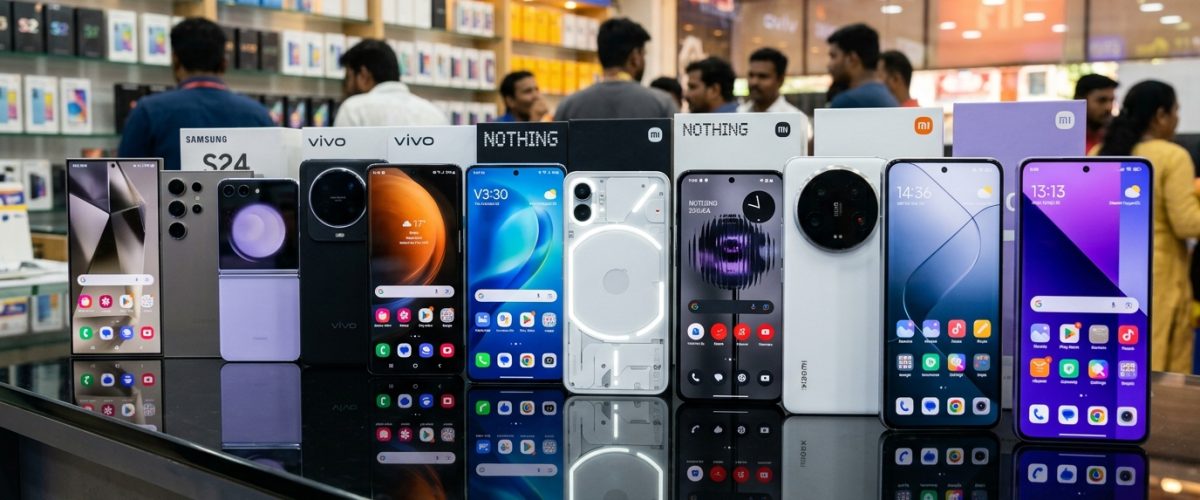
March 2026 has emerged as one of the most competitive months in recent memory for India’s smartphone market, with a rapid-fire succession of launches from Samsung, Vivo, Nothing, Xiaomi, Motorola, and OPPO that collectively redefine what consumers can expect from devices priced between Rs 10,000 and Rs 40,000. The mid-range segment—historically the battleground where India’s smartphone wars are won and lost—is seeing an unprecedented convergence of features that were once exclusive to flagship devices, driven by fierce competition, component cost reductions, and the relentless pressure of a market where over 150 million smartphones are sold annually.
Nothing Phone 4(a) Series: Design Meets Substance
Nothing Technology has emerged as perhaps the most intriguing challenger in India’s mid-range smartphone market, and its Phone 4(a) and Phone 4(a) Pro, which went on sale in India in mid-March, represent the company’s most commercially ambitious devices yet. Carl Pei’s London-based startup has built a distinctive brand identity centred on transparent design aesthetics and clean software experiences—a proposition that has resonated strongly with India’s design-conscious young consumers.
The Phone 4(a) features a refined version of Nothing’s signature Glyph Interface—the pattern of LED lights on the transparent back panel that serves as a customisable notification system. Beyond the design language, the device delivers compelling specifications: a custom-tuned display panel with 120Hz refresh rate, an upgraded camera system developed in partnership with computational photography specialists, and Nothing OS 3.0, which maintains the near-stock Android experience that has become the brand’s software hallmark.
The Phone 4(a) Pro extends this proposition with premium materials, enhanced camera optics, and expanded storage configurations. What makes Nothing’s India strategy particularly noteworthy is its pricing aggression—both devices are positioned competitively against established mid-range champions from Samsung and Xiaomi, signalling Nothing’s intent to compete on value rather than relying solely on brand differentiation. The company’s growing service network in India, with authorised repair centres now operational in over 100 cities, addresses the after-sales concern that has traditionally limited premium challenger brands.
Samsung Galaxy M17e 5G: The Volume Play
Samsung’s Galaxy M series has been the Korean giant’s primary weapon in India’s price-sensitive market segments, and the Galaxy M17e 5G continues this tradition with a focus on affordability, battery endurance, and 5G accessibility. Priced to compete at the entry-level 5G segment—typically between Rs 10,000 and Rs 15,000—the M17e targets the vast cohort of Indian consumers making their first transition from 4G to 5G connectivity.
The device’s specifications reflect Samsung’s understanding of Indian consumer priorities. A large battery capacity exceeding 5,000mAh addresses the endurance demands of users who depend on their smartphones as primary computing devices. The inclusion of 5G connectivity ensures future-proofing as India’s 5G networks expand rapidly beyond metropolitan centres. Samsung’s One UI software, while more feature-laden than stock Android, includes India-specific integrations including regional language support across all 22 scheduled languages and integration with popular Indian apps and payment systems.
Samsung’s competitive advantage in India extends beyond device specifications to its unmatched distribution and service infrastructure. With over 2,000 exclusive brand stores, deep penetration in multi-brand retail, and the country’s largest authorised service network, Samsung offers a purchase and ownership experience that purely online brands cannot match. This infrastructure advantage becomes particularly significant in smaller cities and towns, where brand trust and physical touchpoints remain important purchase drivers.
Xiaomi 17 Series: The Flagship Democratiser
Xiaomi’s numbered series has traditionally represented the company’s mainstream flagship proposition, and the Xiaomi 17 series—which commenced its early bird sale in India in March—represents the brand’s most ambitious attempt to bridge the gap between flagship capability and accessible pricing. The series, comprising multiple variants targeting different price points, incorporates Qualcomm’s latest processing platforms, advanced camera systems developed with Leica’s optical expertise, and MIUI 16—Xiaomi’s most refined software experience to date.
The Xiaomi 17 Pro, positioned at the upper end of the series, features a camera system that represents a significant leap forward. A high-resolution primary sensor, paired with Leica-tuned optics and Xiaomi’s custom image signal processing algorithms, delivers photographic quality that independent reviewers have favourably compared with devices costing twice the price. For India’s Instagram-savvy young consumers—a demographic where camera quality often determines purchase decisions—this capability represents compelling value.
Xiaomi’s broader strategy in India is evolving beyond smartphones into a connected ecosystem encompassing wearables, smart home devices, electric scooters, and lifestyle products. The Xiaomi 17 series serves as the hub of this ecosystem, with seamless integration features that encourage consumers to invest across the Xiaomi product family. This ecosystem lock-in strategy mirrors approaches pioneered by Apple, adapted for India’s price-sensitive market context. As digital ecosystems expand from India’s UPI revolution and 11-fold payments surge to consumer electronics, the integration of payment, communication, and device platforms is becoming a defining competitive dimension.
Vivo T5x and OPPO K14x: The Battery-First Approach
Vivo’s T5x, launching on March 17, and OPPO’s K14x 5G represent a distinct competitive philosophy: prioritising battery capacity and charging speed above all other specifications. The Vivo T5x houses a massive 7,200mAh battery—a specification that Vivo claims makes it the segment leader in endurance—while the OPPO K14x offers its own impressive battery specifications paired with proprietary fast charging technology.
This battery-first approach reflects a deep understanding of Indian usage patterns. In a market where smartphones serve as primary entertainment devices—streaming video, gaming, social media—and where unreliable electricity supply in many areas makes charging opportunities unpredictable, battery capacity is not merely a specification but a practical necessity. Both Vivo and OPPO have positioned their devices as two-day smartphones, targeting consumers who find daily charging inconvenient or impractical.
The MediaTek processors powering both devices represent another significant trend in India’s mid-range segment. MediaTek’s Dimensity series has steadily closed the performance and efficiency gap with Qualcomm’s Snapdragon platforms, while offering cost advantages that enable device manufacturers to deliver competitive specifications at lower price points. The resulting price-performance improvements benefit Indian consumers, who gain access to capable 5G-enabled devices at increasingly accessible price points.
Motorola Edge 70 Fusion: The Comeback Continues
Motorola’s resurgence in India continues with the Edge 70 Fusion, which went on sale in March at a competitive price point. Motorola, which once dominated the Indian mobile market before being eclipsed by Chinese brands, has methodically rebuilt its presence through a combination of clean software experiences, competitive pricing, and strategic distribution partnerships.
The Edge 70 Fusion features Motorola’s signature near-stock Android experience—a proposition that appeals to consumers fatigued by the heavy customisation layers that characterise Chinese brand software. The device’s camera system, display quality, and processing performance place it firmly in mid-range contention, while Motorola’s brand heritage provides a trust factor that newer Chinese entrants must earn over time.
Market Dynamics: What March 2026 Reveals
The concentration of competitive launches in March 2026 reveals several structural dynamics shaping India’s smartphone market. First, the mid-range segment between Rs 15,000 and Rs 30,000 has become the decisive battleground. Premium flagship devices above Rs 50,000 remain a niche market in India, while the ultra-budget segment below Rs 10,000 offers limited differentiation opportunity. The mid-range, where feature innovation meets price sensitivity, is where market share is won and lost.
Second, the feature convergence across brands is remarkable. Specifications that were flagship-exclusive two years ago—120Hz AMOLED displays, multi-lens camera systems, 5G connectivity, fast charging—are now standard across the mid-range. This convergence shifts the competitive basis from specifications to brand experience, software quality, after-sales service, and ecosystem integration.
Third, India’s role as a smartphone manufacturing hub is influencing product strategy. With production-linked incentive schemes encouraging domestic manufacturing, brands are increasingly designing India-specific variants optimised for local market conditions—including extended battery life, dual SIM 5G support, and regional language integration—rather than simply importing global models. As India’s digital economy matures across sectors from RBI’s digital lending framework for 2026 to entertainment streaming, the smartphone remains the indispensable gateway device for a billion consumers navigating an increasingly digital world.

- ISRO and AIIMS Sign Landmark MoU for Space Medicine Research Ahead of Gaganyaan Mission - March 25, 2026
- Rising Temperatures Reshape Wildlife Behaviour Across India as Scientists Sound Climate Alarm - March 25, 2026
- UPI Crosses 800 Million Daily Transactions as CRED Gets Payment Aggregator Licence From RBI - March 25, 2026