Samsung Galaxy S27 Ultra: Everything We Know About Samsung’s 2026 Flagship and What It Means for India

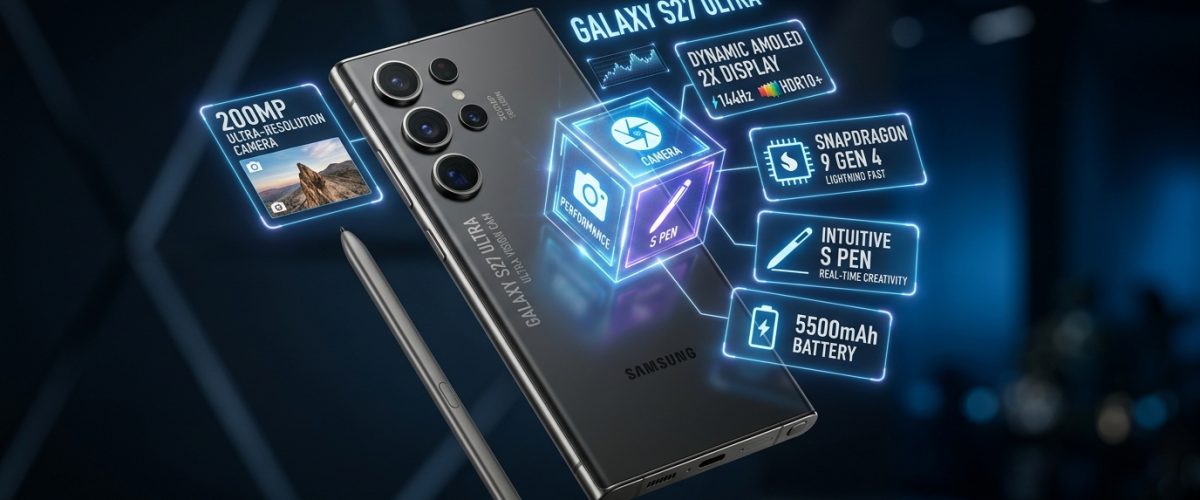
Samsung’s Galaxy S Ultra series has established itself as the benchmark for premium Android smartphones, and the upcoming Galaxy S27 Ultra promises to push the boundaries even further. Expected to launch in January 2027 — with an India release anticipated within the same timeframe — the device is already generating significant buzz based on a series of credible leaks that paint a picture of Samsung’s most technologically ambitious handset yet. From a custom-designed 2nm processor to a revolutionary camera system and a new biometric authentication method, here is everything we know about Samsung’s next flagship and its implications for India’s premium smartphone market.
Snapdragon 8 Elite Gen 6 Pro: The 2nm Revolution
At the heart of the Galaxy S27 Ultra will be Qualcomm’s Snapdragon 8 Elite Gen 6 Pro processor, manufactured using a 2-nanometre process technology. This represents a generational leap in mobile computing, with the 2nm fabrication delivering significant improvements in both performance and power efficiency compared to the 3nm chips powering the current Galaxy S26 series.
The custom-designed chipset for Samsung is expected to feature enhanced AI processing capabilities, with a dedicated Neural Processing Unit (NPU) capable of running large language models and generative AI tasks on-device without requiring cloud connectivity. This on-device AI processing capability has profound implications for privacy-conscious users and for applications in regions with inconsistent internet connectivity — a consideration particularly relevant for the Indian market.
Benchmark leaks suggest performance improvements of approximately 30-40 per cent in CPU tasks and 50 per cent in GPU performance compared to the Snapdragon 8 Elite Gen 5 in the Galaxy S26 Ultra. The power efficiency gains are equally impressive, with early testing indicating up to 25 per cent reduction in power consumption during sustained workloads — translating directly into improved battery life.
Camera System: A Complete Overhaul
Perhaps the most significant upgrade in the Galaxy S27 Ultra concerns its camera system, where multiple leaks suggest Samsung may replace all three rear cameras with new sensors and optics — the most comprehensive camera overhaul in the Ultra series’ history.
The main camera is rumoured to feature a new 200MP Samsung ISOCELL sensor with a larger 1/1.3-inch optical format, significantly improved low-light performance through advanced pixel binning technology, and optical image stabilisation with sensor-shift capabilities similar to those found in Apple’s iPhone Pro series. The upgraded main sensor is expected to deliver noticeably better dynamic range, colour accuracy, and detail preservation in challenging lighting conditions.
The periscope telephoto camera, a hallmark of the Ultra series, is reportedly being upgraded to a new 5x optical zoom module with improved clarity at extended focal lengths. Samsung’s computational photography algorithms, powered by the enhanced NPU, will enable AI-driven scene optimisation, subject detection, and post-processing that bridges the gap between smartphone and dedicated camera photography.
The ultrawide camera and the secondary telephoto are also expected to receive sensor upgrades, creating a more balanced and versatile multi-camera system. For India’s vibrant photography community — which has embraced smartphone photography for everything from wedding documentation to street photography and social media content creation — these improvements represent a meaningful upgrade.
Polar ID: A New Approach to Biometric Security
One of the most intriguing features rumoured for the Galaxy S27 Ultra is “Polar ID” — a new biometric authentication system that represents a departure from the fingerprint and facial recognition methods currently used in smartphones. While detailed technical specifications remain under wraps, industry sources suggest that Polar ID may utilise iris scanning combined with facial geometry mapping to create a more secure and reliable biometric profile.
If implemented as rumoured, Polar ID could address the limitations of existing biometric methods — fingerprint sensors that struggle with wet or dirty fingers, and facial recognition systems that can be fooled by photographs or have difficulty with certain skin tones and lighting conditions. For the Indian context, where biometric authentication is increasingly used for financial transactions through UPI, banking apps, and government services, a more robust and inclusive biometric system would be particularly valuable.
S Pen: Staying Put in the Ultra
Amidst periodic speculation about Samsung discontinuing the S Pen stylus, recent reports confirm that the Galaxy S27 Ultra will retain the integrated S Pen with its built-in digitiser. The stylus, which traces its heritage to the Galaxy Note series, remains a key differentiator for the Ultra lineup and is valued by professionals, students, and creative users who rely on it for note-taking, document annotation, and digital art.
The S Pen is expected to receive AI-powered enhancements, including smarter handwriting-to-text conversion that works across multiple languages — an upgrade that would be particularly beneficial for Indian users who write in scripts such as Devanagari, Tamil, Telugu, and Bengali. Integration with Samsung’s Galaxy AI suite for features like real-time translation and smart summarisation will further enhance the S Pen’s utility as a productivity tool.
Battery and Charging: The Silicon-Carbon Promise
The Galaxy S27 Ultra may be the first Samsung flagship to incorporate silicon-carbon battery technology, which enables higher energy density within the same physical volume. This could translate into a battery capacity exceeding 6,000 mAh — a significant increase from the current 5,000 mAh standard — without increasing the device’s size or weight.
Combined with the 2nm processor’s improved power efficiency, the larger battery could deliver substantial real-world endurance improvements. Samsung’s smartphone division has faced persistent criticism for conservative battery specifications relative to Chinese competitors, and the adoption of silicon-carbon technology would represent a meaningful response to this competitive pressure.
India Market Strategy and Pricing Expectations
India is Samsung’s second-largest market globally by volume and a critical battleground in the premium segment, where the company competes with Apple’s iPhone and increasingly aggressive Chinese brands including OnePlus, Xiaomi, and Vivo. The Galaxy S Ultra series has consistently been Samsung’s best-selling premium device in India, with the country typically among the first markets to receive new launches.
Pricing for the Galaxy S27 Ultra in India is expected to start at approximately ₹1,34,999 for the base 12GB/256GB variant, with the top-tier 16GB/1TB configuration potentially reaching ₹1,79,999. Samsung is likely to continue its strategy of aggressive trade-in offers, bank cashback partnerships, and no-cost EMI options to make the device accessible to a broader range of premium buyers.
India’s premium smartphone segment has grown significantly, driven by rising disposable incomes, the aspirational appeal of flagship devices, and the increasing centrality of smartphones to both professional and personal life. As explored in our coverage of personal financial planning trends, technology purchases are increasingly being integrated into household budgeting, with EMI options making premium devices more accessible.
The Competitive Landscape
Samsung’s Galaxy S27 Ultra will enter a fiercely competitive premium market in India. Apple’s iPhone 17 Pro Max, expected around the same timeframe, will bring its own set of technological innovations. Chinese brands, particularly OnePlus and Xiaomi’s premium sub-brands, continue to offer compelling flagship-grade specifications at significantly lower price points, squeezing Samsung’s value proposition in the ₹60,000-₹1,00,000 segment.
However, Samsung’s ecosystem advantages — including integration with Galaxy tablets, watches, earbuds, and the broader SmartThings platform — create switching costs that help retain existing Samsung users. The company’s strong offline retail presence in India, with Samsung Experience Stores in virtually every major city, provides a try-before-you-buy advantage that online-first Chinese brands struggle to match.
For Indian consumers eagerly awaiting the Galaxy S27 Ultra, the device represents not just a smartphone upgrade but a statement about the premium technology experiences now available in the Indian market. As India’s economy and markets continue their upward trajectory, the demand for world-class consumer technology products shows no signs of slowing.

- New Heavy Particle Discovered at CERN in 2026: What It Means for the Future of Physics - March 24, 2026
- Gaganyaan 2026: India’s Human Spaceflight Programme Enters Its Most Critical Phase - March 24, 2026
- India’s Semiconductor and AI Surge: How Research Labs Are Powering a Global Transformation - March 24, 2026