Gaganyaan Uncrewed Mission: ISRO’s Giant Leap Toward India’s First Human Spaceflight

India’s Space Ambitions Reach New Heights
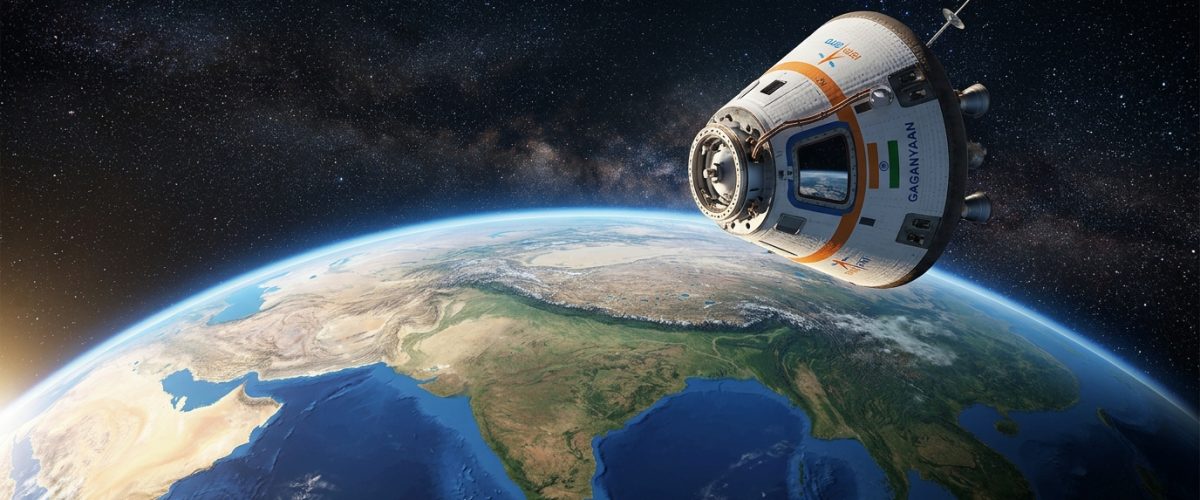
The Indian Space Research Organisation is preparing to launch the most consequential mission in its six-decade history. The first uncrewed Gaganyaan flight, scheduled for the first half of 2026, will demonstrate the entire mission architecture for India’s maiden human spaceflight programme — from launch vehicle performance and orbital module operations to atmospheric re-entry and crew module recovery in the Bay of Bengal. If successful, it will place India firmly on the path to becoming the fourth nation to independently send humans into space.
The stakes could not be higher. Gaganyaan is not merely an engineering demonstration; it is a national prestige project that has consumed over ₹12,000 crore in development funding across nearly a decade. Its success would validate India’s approach of building space capabilities incrementally — from Chandrayaan’s lunar landing to Aditya-L1’s solar observation mission — culminating in the ultimate test of putting human lives in the hands of indigenous technology.
Vyommitra: The Robot That Will Fly First
Aboard the uncrewed orbital module will be Vyommitra, ISRO’s half-humanoid robot designed to simulate the physiological responses of a human crew member. Developed at the ISRO Inertial Systems Unit in Thiruvananthapuram, Vyommitra can perform panel operations, respond to voice commands, monitor environmental parameters inside the crew module, and simulate breathing patterns to test the life support system under realistic conditions.
The name Vyommitra — derived from Sanskrit words meaning “friend of the sky” — is fitting for a robot that will endure the precise conditions human astronauts will later face. During the mission, Vyommitra will be subjected to microgravity, radiation exposure, and the violent g-forces of re-entry, while continuously transmitting telemetry data back to mission control in Bengaluru.
Engineers have designed Vyommitra to operate autonomously during communication blackout periods, which occur when the spacecraft passes through plasma during re-entry. This autonomous capability is critical for validating the crew module’s ability to keep occupants safe even when ground communication is temporarily lost.
The Human-Rated Launch Vehicle
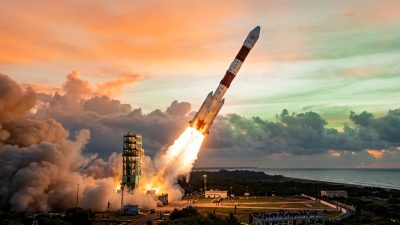
Gaganyaan will ride atop a human-rated variant of ISRO’s proven LVM3 (formerly GSLV Mk III) rocket. Modifying a cargo launcher for human spaceflight is an enormously complex undertaking. Every system must meet redundancy standards far exceeding those for satellite launches. The Crew Escape System (CES), which sits atop the crew module, must be capable of pulling the capsule away from the rocket within milliseconds if a catastrophic failure is detected during ascent.
ISRO successfully tested the CES in a pad abort test in 2023 and a high-altitude abort test in 2024. Both tests demonstrated that the system could rapidly separate the crew module and deploy parachutes for a safe ocean splashdown. However, the uncrewed mission will be the first integrated test where the CES operates as part of the complete launch and orbital stack.
The LVM3 itself has an impressive track record, having successfully placed Chandrayaan-3 on its lunar trajectory and delivering heavy communication satellites to geostationary orbit. But the human-rated version incorporates over 200 design modifications, including additional sensors, strengthened structures, and software changes that enable the rocket to detect and respond to anomalies in real time.
Mission Profile and Recovery Operations
The uncrewed Gaganyaan mission will follow a three-day orbital profile at an altitude of approximately 400 kilometres — the same altitude as the International Space Station. During this period, the orbital module will perform a series of manoeuvres to test navigation, propulsion, and communication systems.
The Indian Navy has been extensively involved in recovery preparations. A dedicated recovery team, trained at the Cochin Shipyard and at water survival facilities in Goa, will be deployed in the Bay of Bengal with specialised vessels and helicopters. The crew module is designed to splash down within a defined recovery zone, and the Navy has conducted multiple rehearsals simulating different sea states and wind conditions.
This naval cooperation represents an important institutional linkage. As India’s IndiaAI Mission builds sovereign technology infrastructure, the Gaganyaan programme similarly demands cross-institutional coordination spanning defence, civilian research, and industrial manufacturing — a capability that India has historically struggled to execute at scale.
Industrial Ecosystem and Private Sector Participation
Gaganyaan has catalysed India’s space industrial base like no previous mission. Over 500 Indian companies, ranging from established aerospace contractors such as Hindustan Aeronautics Limited and Larsen and Toubro to startups like Skyroot Aerospace and Agnikul Cosmos, have contributed components, subsystems, and testing services to the programme.
The crew module’s heat shield, which must withstand temperatures exceeding 1,600 degrees Celsius during re-entry, was developed by ISRO’s Vikram Sarabhai Space Centre in collaboration with private sector partners who manufactured the carbon-carbon composite tiles. This technology, once the exclusive domain of NASA and Roscosmos, is now being produced domestically.
Private space companies have also benefited from technology transfers originating from Gaganyaan research. Skyroot’s Vikram series of launch vehicles, for instance, has incorporated propulsion technologies validated during Gaganyaan development testing.
From Uncrewed Test to Crewed Mission
Success in the uncrewed mission will clear the path for a second uncrewed flight with enhanced testing, followed by the crewed mission targeted for 2027. Four Indian Air Force pilots — Group Captain Prasanth Balakrishnan Nair, Group Captain Ajit Krishnan, Group Captain Angad Pratap, and Wing Commander Shubhanshu Shukla — have been training at ISRO’s astronaut training facility in Bengaluru and previously completed modules at Russia’s Gagarin Cosmonaut Training Centre.
The astronauts have undergone microgravity simulation, survival training, and extensive study of the orbital module’s systems. They will eventually spend approximately three days in orbit before returning to Earth — a modest duration compared to missions on the ISS, but a monumental achievement for India’s first attempt.
As India’s 5G networks expand to enable real-time data transmission from ground stations nationwide, and as the broader ISRO START 2026 programme trains the next generation of space scientists, Gaganyaan sits at the apex of a technology pyramid that India has spent decades building, brick by patient brick.
The countdown to India’s human spaceflight era has truly begun.

- ISRO and AIIMS Sign Landmark MoU for Space Medicine Research Ahead of Gaganyaan Mission - March 25, 2026
- Rising Temperatures Reshape Wildlife Behaviour Across India as Scientists Sound Climate Alarm - March 25, 2026
- UPI Crosses 800 Million Daily Transactions as CRED Gets Payment Aggregator Licence From RBI - March 25, 2026