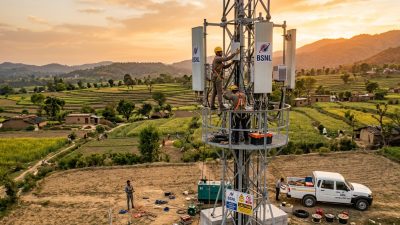
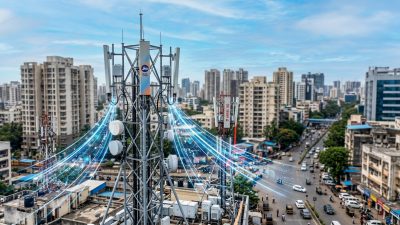
BSNL’s Indigenous 4G Network Crosses 98,000 Sites: Can India’s State Telecom Giant Stage a Comeback?

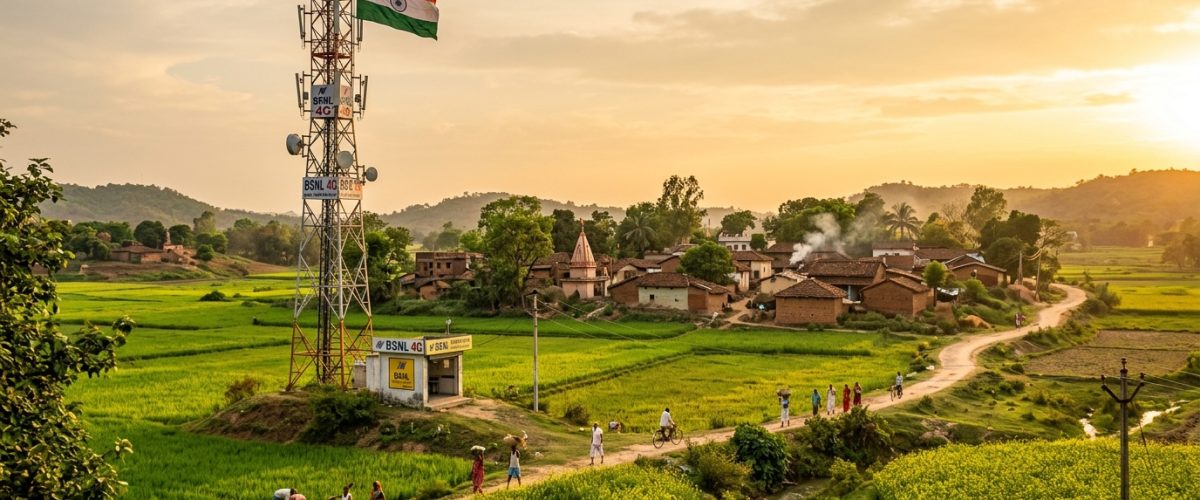
In the sprawling landscape of Indian telecommunications — dominated by the towering private sector giants Reliance Jio and Bharti Airtel — Bharat Sanchar Nigam Limited is quietly executing one of the most significant infrastructure deployments in the state-owned enterprise’s history. With approximately 98,000 4G sites now operational across the country, BSNL’s network modernisation programme represents not merely a corporate revival effort but a strategic national initiative to build indigenous telecom capability and ensure connectivity reaches the last mile of India’s vast geography.
The deployment, executed through a consortium led by Tata Consultancy Services and incorporating equipment from Tejas Networks — India’s leading telecom equipment manufacturer — is notable for its reliance on domestically developed technology. In a global telecom equipment market historically dominated by European firms Ericsson and Nokia and Chinese giant Huawei, BSNL’s indigenous 4G network stands as a proof of concept for India’s ability to build world-class telecommunications infrastructure using homegrown technology.
The TCS-Tejas Consortium: Building India’s Telecom Stack
The ₹26,821 crore contract awarded to the TCS-led consortium in 2023 was the largest indigenous telecom deployment project ever undertaken in India. The scope encompassed not just the installation of radio access network equipment but the development of a complete 4G core network, base stations, and integration with BSNL’s existing infrastructure — all using technology designed and manufactured in India.
Tejas Networks, which was acquired by the Tata Group in 2023, has been the hardware backbone of the project. The company’s 4G radio units, developed at its Bangalore facilities, have been deployed across BSNL’s network covering all 22 telecom circles. The technology has been tested for compliance with 3GPP standards and has demonstrated performance comparable to equipment from established global vendors — a significant validation of Indian telecom engineering capability.
The deployment has not been without challenges. Initial phases faced delays due to the complexity of integrating new equipment with BSNL’s legacy network infrastructure, site acquisition issues in certain states, and the inherent difficulties of deploying at scale across India’s diverse geography. However, the pace of deployment has accelerated significantly in recent months, with the consortium adding approximately 5,000-6,000 sites per month through the latter half of 2025 and into 2026.
Expansion on the Horizon: 22,000 Additional Sites
Building on the initial deployment’s momentum, the government is now considering an additional expansion of 22,000 new 4G sites, which would take BSNL’s total 4G footprint to approximately 1,20,000 sites. BSNL’s CMD Robert Ravi has confirmed that 4G expansion will continue into FY2026-27, with the organisation evaluating strategies for future indigenous technology upgrades.
The proposed expansion is targeted at addressing coverage gaps in rural and semi-urban areas where BSNL retains a significant subscriber base. Unlike private operators, which prioritise commercially attractive urban markets, BSNL has a mandate to provide universal service — including connectivity in remote, border, and strategically important areas where private sector investment may not be commercially viable.
This universal service mandate, while expensive, gives BSNL a unique strategic role in India’s connectivity landscape. The company provides telecom services in regions critical for national security, disaster management, and rural governance, making its operational viability a matter of strategic national interest beyond mere commercial considerations.
The Competitive Reality: 4G in a 5G World
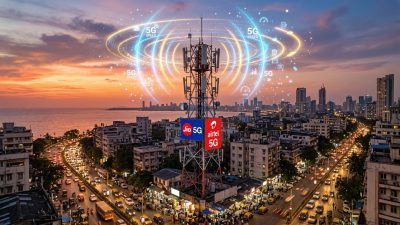
BSNL’s most fundamental challenge is temporal. The company is deploying a 4G network at a time when its private sector competitors have already established comprehensive 5G networks. Jio and Airtel collectively serve approximately 350 million 5G subscribers, offering significantly faster speeds and lower latency than 4G technology can provide.
For urban consumers who have experienced 5G speeds exceeding 500 Mbps, reverting to 4G — which typically delivers speeds of 20-40 Mbps in Indian conditions — would represent a significant downgrade. This reality limits BSNL’s ability to attract or retain subscribers in urban markets where 5G coverage is ubiquitous.
However, in rural and semi-urban India, where 5G deployment by private operators remains patchy, BSNL’s 4G service fills a genuine connectivity gap. For users in these areas, a reliable 4G connection represents a transformative improvement over the 2G/3G services or complete absence of coverage that characterised their previous experience. The ability to access video streaming, digital payments, e-governance services, and online education through a dependable 4G connection has significant socioeconomic implications for rural India.
The 5G Roadmap: Leveraging Indigenous Technology
Looking beyond 4G, the critical question is whether BSNL can evolve its indigenous technology platform to support 5G deployment. The TCS-Tejas consortium is reportedly working on 5G technology development, with the government expressing interest in a phased approach that would see BSNL deploy 5G using Indian-designed equipment — potentially making it the world’s first large-scale 5G network built entirely on indigenous technology.
The viability of this ambition depends on several factors. 5G technology, particularly for the standalone core network and advanced features like network slicing and edge computing, requires sophisticated engineering capabilities that are still being developed domestically. The timeline for achieving 5G readiness will be critical — too long a delay would further widen the gap between BSNL and its private sector competitors.
Industry experts have suggested a pragmatic approach: deploy 5G using indigenous technology where available, while selectively sourcing components from global vendors for capabilities that cannot be developed domestically within acceptable timelines. This hybrid strategy would balance the goal of technological self-reliance with the practical necessity of delivering competitive services to consumers.
Financial Health and Government Support
BSNL’s financial turnaround remains a work in progress. The company received a massive ₹89,047 crore revival package from the government in 2023, including spectrum allocation, capital infusion, and debt restructuring. While these measures have stabilised the company’s finances and enabled the 4G deployment, BSNL has yet to achieve sustained profitability.
Revenue from operations has shown modest improvement, driven by the growing 4G subscriber base, enterprise services, and the company’s fibre broadband business. BSNL’s FTTH service, leveraging the BharatNet fibre backbone, has gained traction in Tier-2 and Tier-3 cities where it often provides the only viable high-speed broadband option.
The government’s continued willingness to support BSNL reflects a strategic calculus that extends beyond commercial returns. A viable state-owned telecom operator provides the government with a trusted partner for sensitive communications, a vehicle for universal service obligations, and a check on private sector pricing power. These considerations ensure that BSNL will continue to receive policy and financial support, though the scale and duration of such support will depend on the company’s ability to demonstrate operational improvement.
Implications for India’s Tech Sovereignty
BSNL’s indigenous 4G deployment carries implications that extend beyond the telecom sector. The project has demonstrated that India can develop, manufacture, and deploy complex network technology at national scale — a capability that enhances the country’s strategic autonomy in an era where technology supply chains have become instruments of geopolitical competition.
The experience gained through the 4G deployment is being applied to other domains, including defence communications, smart city infrastructure, and industrial IoT networks. Tejas Networks, buoyed by the BSNL contract, has expanded its product portfolio and is now competing for international telecom equipment orders — potentially creating an export opportunity for Indian telecom technology as explored in the broader context of India’s ambitions for technological sovereignty across AI and semiconductors.
As India’s telecom sector continues to evolve through the complex interplay of public and private enterprise, BSNL’s story is one of resilience and strategic persistence. The company may never match Jio or Airtel in market share or profitability, but its role in building indigenous technology capability, ensuring rural connectivity, and maintaining competitive diversity in India’s telecom market makes it an institution whose value cannot be measured by commercial metrics alone.
The 98,000 4G sites already deployed are more than telecommunications infrastructure — they represent India’s determination to be a maker, not merely a buyer, of the technology that will define the twenty-first century.

- New Heavy Particle Discovered at CERN in 2026: What It Means for the Future of Physics - March 24, 2026
- Gaganyaan 2026: India’s Human Spaceflight Programme Enters Its Most Critical Phase - March 24, 2026
- India’s Semiconductor and AI Surge: How Research Labs Are Powering a Global Transformation - March 24, 2026