India’s 5G Revolution: Jio and Airtel’s Race to 85% Market Domination by FY28

The Duopoly That Defines Indian Telecom
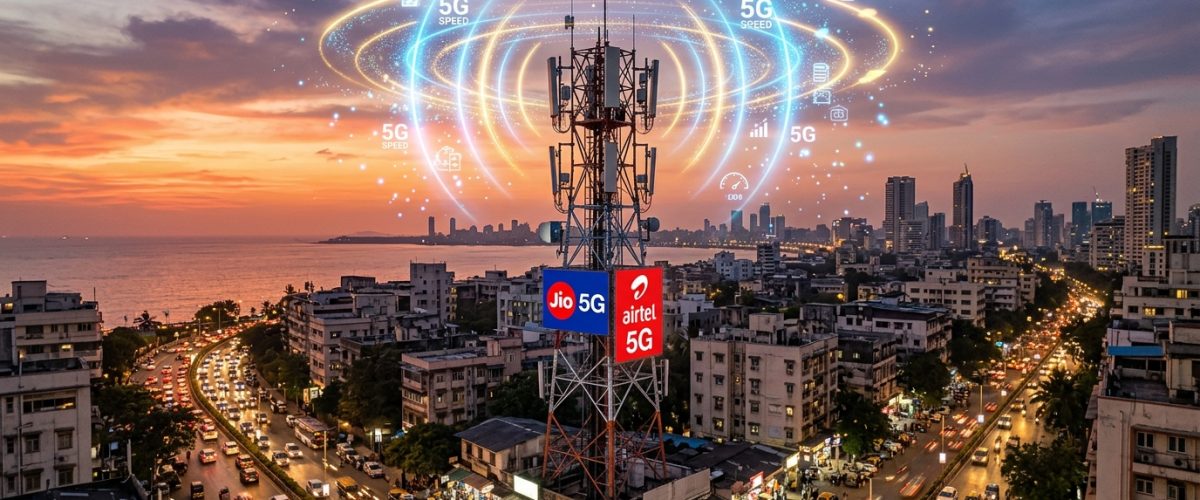
Three years after the commercial launch of fifth-generation networks in India, the country’s telecom landscape has crystallised into a decisive two-horse race. Reliance Jio and Bharti Airtel have collectively added nearly 401 million 5G subscribers, capturing a combined revenue share of 81 per cent — a figure that analysts at CLSA project will expand to 85 per cent by FY28. The rise of 5G has not merely introduced faster internet speeds; it has fundamentally reshaped the competitive dynamics of India’s $50 billion telecommunications market.
The numbers are striking in their scale. Jio’s 5G subscriber base has reached an estimated 234 million — 46 per cent of its 506 million total subscribers. Airtel mirrors this proportion, with 5G users constituting 46 per cent of its 364 million mobile subscribers. Together, the two operators cover virtually every major urban centre and are rapidly expanding into tier-2 and tier-3 cities, where 5G adoption is accelerating faster than initial projections suggested.
Two Architectures, One Destination
Perhaps the most technically interesting aspect of India’s 5G story is the divergent network architectures chosen by its two leading operators. Jio deployed 5G standalone (SA) architecture from the outset, building a completely new core network designed natively for 5G capabilities. Airtel opted for 5G non-standalone (NSA) architecture, which layers 5G radio access onto its existing 4G core network.
Each approach has tradeoffs. Jio’s SA network offers lower latency and native support for network slicing — the ability to create virtual networks optimised for specific applications such as industrial IoT, autonomous vehicles, or remote surgery. Airtel’s NSA approach allowed faster deployment at lower initial cost, leveraging existing infrastructure while gradually transitioning to a fully standalone core.
Despite these architectural differences, both operators have achieved comparable user experience metrics in most markets. Average 5G download speeds in India range from 200 to 400 Mbps, with peak speeds exceeding 1 Gbps in some locations — a dramatic improvement over the 20 to 40 Mbps typical of 4G connections. The consumer experience, rather than the underlying architecture, is ultimately what drives adoption.
The Revenue Opportunity
5G is not just about speed — it is about revenue. India’s average revenue per user (ARPU) has been among the lowest globally, hovering around ₹200 per month for leading operators. CLSA estimates that 5G-driven tariff increases will push ARPU to ₹258 for Jio and ₹311 for Airtel by FY28, representing growth of 21 to 22 per cent. These projections assume continued migration of subscribers to 5G-enabled plans, which carry a premium of approximately 17 per cent over equivalent 4G tariffs.
The revenue uplift matters enormously for an industry that has invested over ₹1.5 lakh crore in spectrum acquisition and network deployment. Jio alone spent ₹88,078 crore in the 2022 spectrum auction, acquiring the largest share of 5G frequencies. Airtel invested ₹43,084 crore. Recovering these investments requires either higher ARPU, larger subscriber bases, or both — and 5G provides the mechanism for achieving both simultaneously.
The financial health of the telecom sector has direct implications for India’s broader technology ambitions. The IndiaAI Mission’s plans for sovereign AI infrastructure depend on robust, high-speed connectivity to deliver AI services to edge devices. Similarly, the continued growth of India’s UPI digital payments ecosystem requires reliable mobile networks in even the most remote locations.
Vodafone Idea’s Belated Entry
The third major operator, Vodafone Idea (Vi), launched commercial 5G services in the second quarter of FY26, after signing multi-year equipment deals worth $3.6 billion with Ericsson, Nokia, and Samsung. Vi’s belated entry reflects the financial difficulties that have plagued the company since the 2018 merger of Vodafone India and Idea Cellular.
Vi initially priced its introductory 5G plan at ₹299 — approximately 15 per cent below Jio and Airtel’s comparable offerings — in an attempt to arrest subscriber losses. However, the company has been selectively withdrawing this promotional pricing and replacing it with a ₹349 plan aligned with its competitors. Whether Vi can build a commercially viable 5G network while managing a debt burden exceeding ₹2 lakh crore remains the central question in Indian telecom.
Industry observers note that Vi’s primary challenge is not technology but trust. Years of service quality issues, network outages, and uncertain financial viability have eroded consumer confidence. Rebuilding that trust while simultaneously deploying a new network generation is a tall order, though not an impossible one.
5G Smartphone Penetration
The demand side of the 5G equation is equally important. India’s 5G smartphone shipments now account for 91 per cent of overall smartphone volumes — a remarkable penetration rate driven by aggressive pricing from Chinese manufacturers such as Xiaomi, Realme, and Vivo, alongside premium offerings from Samsung, Apple, and OPPO. The latest flagship devices like the OPPO Find X9 Pro showcase how 5G connectivity is now a baseline expectation rather than a premium feature.
This device ecosystem is critical. Even the most advanced 5G network is useless if consumers lack compatible handsets. India’s smartphone manufacturers have responded to this imperative by introducing 5G-capable devices at price points as low as ₹8,000, ensuring that 5G access is not restricted to premium consumers.
Beyond Consumer Broadband
While consumer mobile broadband remains the primary 5G use case, enterprise applications are emerging as the next growth frontier. Jio has launched enterprise 5G solutions for manufacturing, logistics, and healthcare, leveraging its standalone architecture’s native network slicing capabilities. Airtel’s enterprise division has partnered with companies including Tech Mahindra, Capgemini, and Bosch to develop 5G-enabled industrial automation solutions.
Fixed wireless access (FWA) — using 5G to deliver home broadband without physical fibre connections — represents another significant opportunity, particularly in areas where laying fibre is prohibitively expensive. Jio’s AirFiber product, launched in 2023, has gained significant traction in semi-urban markets, offering broadband speeds that rival fibre at a fraction of the deployment cost.
The Road to 6G
Even as India’s 5G networks continue expanding, the government has already established a 6G task force to ensure the country is positioned for the next generational transition. The Department of Telecommunications has allocated ₹2,000 crore for 6G research, targeting commercial deployment by 2030. For the first time, India aims to be a technology contributor rather than merely a technology adopter in the evolution of global mobile standards.
The current 5G deployment, for all its competitive intensity, is building the infrastructure and expertise that will make that ambition achievable. India’s telecom revolution is far from over — it is, if anything, just getting started.

- New Heavy Particle Discovered at CERN in 2026: What It Means for the Future of Physics - March 24, 2026
- Gaganyaan 2026: India’s Human Spaceflight Programme Enters Its Most Critical Phase - March 24, 2026
- India’s Semiconductor and AI Surge: How Research Labs Are Powering a Global Transformation - March 24, 2026