Visa-Free Nations for Indians Reach 56 in 2026 as Global Destinations Court India’s Booming Travel Market

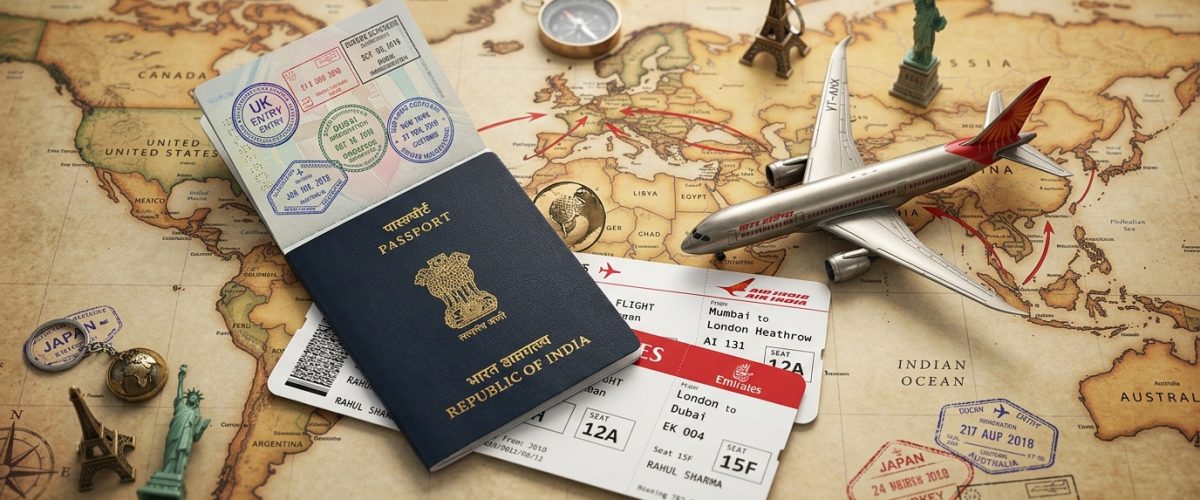
Indian passport holders can now travel without a prior visa to 56 countries and territories worldwide — a figure that reflects the steady, if gradual, improvement in India’s passport strength and the growing eagerness of nations across the globe to attract the country’s rapidly expanding outbound travel market. The 2026 Henley Passport Index ranks the Indian passport 76th globally, a position that, while still modest, represents meaningful progress from the early 2010s when visa-free access was limited to fewer than 40 destinations.
The Expanding Map of Visa-Free Travel
The 56 countries and territories offering visa-free or visa-on-arrival access to Indian nationals span a diverse geographic range, from island nations in the Pacific and Indian Oceans to countries in Southeast Asia, Central Asia, Africa, and the Caribbean. The list includes established tourism destinations such as the Maldives, Sri Lanka, Thailand (for short stays), Mauritius, and Indonesia (Bali), as well as emerging destinations including Kazakhstan, Uzbekistan, Fiji, and several African nations.
The expansion of visa-free access has been driven by two converging forces: India’s rising economic and diplomatic weight, which gives it leverage in bilateral visa negotiations; and the commercial calculation by destination countries that easing entry for Indian nationals will capture a share of one of the world’s fastest-growing outbound travel markets. With over 28 million Indians travelling abroad in 2025, and projections suggesting this figure will exceed 50 million by 2030, the economic incentive for facilitating Indian travel is substantial.
“Every country that has liberalised visa access for Indians has seen significant increases in Indian arrivals,” noted Dr. Didar Singh, former secretary-general of the Federation of Indian Chambers of Commerce and Industry (FICCI). “The correlation is clear: visa facilitation translates directly into tourism revenue. Countries that maintain burdensome visa processes for Indians are, quite simply, leaving money on the table.”
Recent Additions and Developments
Several countries have introduced or expanded visa facilitation measures for Indian nationals in 2025 and early 2026. Malaysia has extended its visa-free transit policy, allowing Indian travellers to stay for up to 30 days without a visa under certain conditions. Kenya has launched an electronic travel authorisation system that replaces the traditional visa application process. Several Caribbean nations have introduced visa-on-arrival facilities targeted at the growing Indian luxury and honeymoon travel segment.
The European Union, while maintaining its Schengen visa requirement for Indian nationals, has made significant improvements in processing efficiency. The typical processing time for Indian Schengen visa applications has been reduced from 15-20 days to under 10 days at most consulates, and the introduction of appointment booking systems has reduced the queueing that previously deterred some Indian travellers.
The United Arab Emirates and Saudi Arabia, key destinations for Indian travellers, have introduced streamlined visa-on-arrival and e-visa systems that have dramatically simplified entry procedures. These Gulf states, which host large Indian diaspora communities and significant business travel, have recognised that visitor-friendly visa policies are essential to their tourism diversification strategies.
The Indian Passport: Strength in Context
The Indian passport’s 76th-place ranking on the Henley Index — which measures passport strength by the number of destinations accessible without a prior visa — places it significantly below the passports of Japan (1st, with access to 193 destinations), Singapore (2nd, 192 destinations), and most European nations. However, the metric can be misleading when applied to countries whose outbound travel volumes are growing rapidly.
India’s passport strength is influenced by factors beyond tourism policy. Security considerations, migration risk assessments by destination countries, and the sheer size of India’s population (which amplifies concerns about potential overstay volumes) all affect visa-waiver decisions. Additionally, India’s own visa reciprocity policies — it requires visas from nationals of most countries — create a framework where bilateral negotiations must address mutual concessions.
The Indian government has been proactive in pursuing visa facilitation through diplomatic channels. Visa agreements are now a standard component of bilateral state visits, and India’s External Affairs Ministry has established a dedicated division focused on improving Indians’ international travel access. The ongoing discussions with the European Union regarding a comprehensive mobility and migration partnership, if successful, could potentially lead to further visa liberalisation.
Impact on Travel Patterns
The availability of visa-free and visa-on-arrival access has a measurable impact on Indian travel patterns. Destinations that have introduced visa facilitation consistently report sharp increases in Indian arrivals within 12-18 months of implementation. The Maldives, which offers visa-on-arrival for Indian nationals and is accessible via short flights from multiple Indian cities, has seen Indian arrivals grow from approximately 90,000 in 2019 to over 300,000 in 2025, making India the Maldives’ largest source market.
Similarly, Georgia’s introduction of visa-free access for Indian nationals in 2020 transformed it from an obscure destination into a popular choice for Indian travellers, with arrivals increasing tenfold within three years. The “Georgia model” has been cited by tourism policy analysts as a compelling case study for the economic returns of visa liberalisation.
The growth in visa-free destinations complements India’s robust domestic tourism development, including the record-breaking coastal tourism season of 2026, which demonstrates that Indian travellers are both exploring their own country’s diversity and increasingly venturing abroad.
Digital Travel Documentation
India is also investing in digital travel documentation that could further facilitate international travel. The e-Passport programme, which embeds electronic chips containing biometric data in Indian passports, is being progressively rolled out and is expected to be standard for all new passport issuances by 2027. E-passports enable faster immigration processing at participating airports and are increasingly required by countries implementing automated border control systems.
The DigiYatra platform, already operational at Indian airports for domestic travel, is being evaluated for potential integration with international immigration systems. If successful, the platform could create seamless travel experiences where Indian travellers move through airports using facial recognition technology, eliminating the need for physical document checks at multiple touchpoints.
Economic Dimensions
The relationship between visa access and economic activity extends beyond tourism. Business travel, which constitutes a significant portion of India’s outbound travel, is heavily influenced by visa policies. Indian IT professionals, business executives, and entrepreneurs who face lengthy visa processing times report lost business opportunities and competitive disadvantages relative to counterparts from countries with stronger passport access.
The government’s advocacy for improved visa access is thus motivated by both tourism revenue considerations and broader economic competitiveness. As India’s economy grows and its global business footprint expands, the demand for frictionless international mobility will only intensify.
The Road to a Stronger Passport
Improving the Indian passport’s strength is a long-term project that depends on multiple factors — including India’s continued economic growth, its diplomatic relationships, its domestic security environment, and its own visa reciprocity policies. Progress has been steady, if not dramatic, and each new visa-free destination represents a concrete improvement in the travel freedom of 1.4 billion people.
As India’s technological prowess grows in domains from quantum computing to space exploration, and its economic weight in the global system continues to increase, the expectation is that passport access will improve correspondingly — though the pace of that improvement will depend on the diplomatic skill and strategic patience of India’s foreign policy establishment.

- Northeast India Emerges as 2026’s Hottest Travel Destination as Jorhat-Majuli Searches Spike - March 25, 2026
- Mamaearth, boAt, and Noise: How India’s D2C Champions Are Chasing Profitability in 2026 - March 24, 2026
- India’s D2C Brands Bet Big on Offline Expansion as Quick Commerce Reshapes the Playbook - March 24, 2026