Western Ghats Hill Stations 2026: Why Munnar and Meghalaya Are India’s Must-Visit Escapes

While the Himalayas command the world’s attention with their sheer altitude, India possesses another mountain system of extraordinary beauty and ecological importance: the Western Ghats, a 1,600-kilometre chain of mountains running parallel to the western coast from Gujarat to the tip of Kerala. Recognised as a UNESCO World Heritage Site and one of the world’s eight “hottest hotspots” of biological diversity, the Western Ghats are home to hill stations that offer experiences ranging from misty tea plantations to living root bridges, from ancient forests to some of Asia’s wettest landscapes. In 2026, two destinations stand out as essential escapes: Munnar in Kerala and the highlands of Meghalaya in India’s Northeast — destinations that, despite their geographical separation, share a commitment to natural beauty and increasingly, to sustainable tourism.
Munnar: Kerala’s Crown Jewel
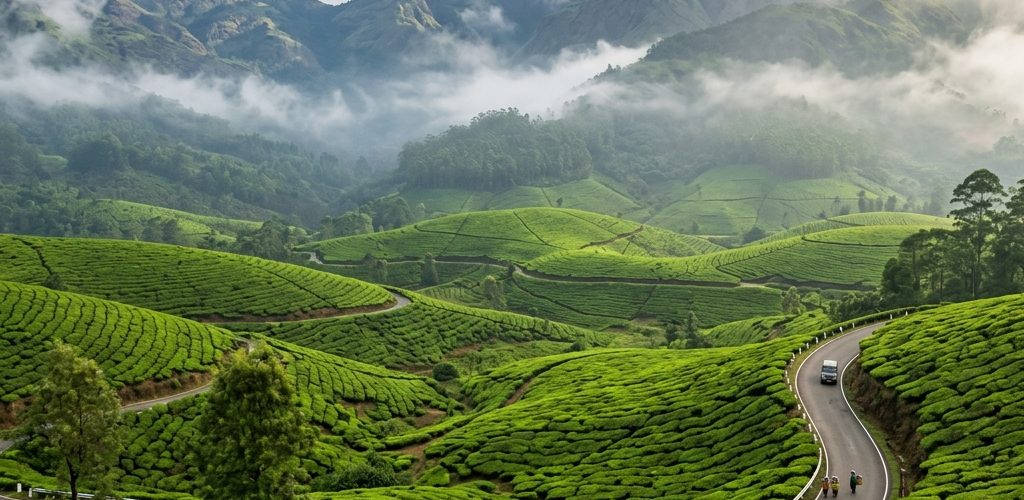
Munnar, perched at 1,600 metres in Kerala’s Idukki district, is often described as the most beautiful hill station in South India — and few who have seen its endless carpets of tea plantations, rolling through the mountains in every shade of green imaginable, would argue. The town, originally developed by the British as a summer retreat from the heat of the plains, has evolved into one of India’s most popular hill station destinations, attracting over 2 million visitors annually and significantly more during peak season.
The tea plantations themselves are the primary attraction. Munnar is the headquarters of Tata Tea (now Tata Consumer Products), and the surrounding hills are covered with manicured tea bushes that create a geometric pattern of extraordinary visual beauty. The Kolukkumalai Tea Estate, accessible only by jeep along a winding mountain track, claims to be the world’s highest organic tea plantation and offers factory tours, tasting sessions, and sunrise views over the Tamil Nadu border that justify the early-morning wake-up call.
Eravikulam National Park, located just outside Munnar, is home to the endangered Nilgiri tahr — a stocky mountain goat found only in the Western Ghats — and the spectacular Neelakurinji flower, which blooms once every twelve years, covering the hillsides in blue. The next bloom is expected around 2030, but the park is worth visiting year-round for its tahr sightings, trekking trails, and the views from its highest elevations. The park is typically open from September to mid-January and April to June.
For adventure enthusiasts, Munnar offers increasingly well-organised activities. Mountain biking through tea estate roads, paragliding from Top Station (the highest point in Munnar with views across to Tamil Nadu), and trekking to Anamudi — the highest peak in South India at 2,695 metres — cater to active travellers seeking more than scenic viewpoints. The drive from Kochi to Munnar, traversing 30 hairpin bends through progressively more dramatic scenery, is itself one of India’s great road journeys. This route connects naturally with a broader Kerala exploration itinerary.
Meghalaya: The Abode of Clouds
If Munnar represents the Western Ghats at their most cultivated and scenic, Meghalaya represents India’s highlands at their most wild, wet, and wonderful. This small northeastern state — its name translates as “Abode of Clouds” — contains some of the planet’s wettest places (Mawsynram and Cherrapunji receive over 11,000 mm of rain annually), extraordinary cave systems, thundering waterfalls, and the unique living root bridges of the Khasi and Jaintia Hills that have become one of India’s most iconic natural attractions.
Shillong, the state capital, serves as the gateway. Known as the “Scotland of the East” for its pine-covered hills and pleasant climate, Shillong offers a mix of colonial-era architecture, vibrant markets (particularly the Iewduh or Bara Bazaar), and a lively music scene that has earned it a reputation as India’s rock music capital. The city’s cafes, breweries, and live music venues create an atmosphere that feels distinctly different from anywhere else in India.
The living root bridges of Cherrapunji (Sohra) and Nongriat are Meghalaya’s most remarkable attraction. Over centuries, the Khasi people have guided the aerial roots of Ficus elastica (rubber fig) trees across rivers and streams, creating bridges entirely from living plant material. These bridges, some of which are over 500 years old and strong enough to support the weight of 50 people, represent a unique form of bio-engineering that has no parallel anywhere in the world. The double-decker root bridge at Nongriat, accessed by a steep descent of approximately 3,500 steps through dense jungle, is the most famous, and reaching it is a pilgrimage of sorts for nature enthusiasts.
Meghalaya’s cave systems are another underappreciated treasure. The state contains the longest and deepest caves in the Indian subcontinent, including Krem Liat Prah (over 31 km) and Krem Um Ladaw. While speleological tourism is still in its early stages, guided cave tours of the more accessible caverns offer a unique underground experience that complements the above-ground scenery.
Sustainable Tourism and Community Engagement
Both Munnar and Meghalaya face the challenge of managing tourism growth while preserving the natural and cultural assets that make them special. In Munnar, the proliferation of resorts and hotels — many constructed in violation of environmental regulations — has raised concerns about deforestation, water scarcity, and waste management. The Kerala High Court has ordered the demolition of illegal structures in ecologically sensitive areas, and stricter building regulations are being enforced for new developments.
Meghalaya has taken a different approach, leveraging community ownership of forests and resources through its traditional governance systems. Many tourist facilities in the Khasi Hills are community-owned and operated, with revenue supporting village development. This model, while imperfect, ensures that tourism benefits are distributed locally rather than extracted by outside investors.
India’s broader push towards sustainable tourism is evident in both destinations. Eco-certified accommodations, waste reduction initiatives, and trail maintenance programmes reflect a growing awareness that the long-term viability of tourism depends on environmental stewardship. These efforts parallel the national conversations about environmental protection that are becoming increasingly urgent across the country.
Getting There and Practical Tips
Munnar is accessible by road from Kochi (approximately 4 hours) or from Madurai in Tamil Nadu (approximately 4.5 hours). There is no railway station or airport; the nearest airport is Cochin International. The best time to visit is October through March, with the monsoon months (June-August) offering dramatic cloud formations and waterfalls but also heavy rain and occasional road closures.
Meghalaya is accessible via Guwahati in Assam, which has an international airport and major railway station. Shillong is approximately 3 hours by road from Guwahati, with shared taxis and buses operating frequently. The best time to visit is October through May, though Meghalaya has its own beauty during the monsoon — provided you do not mind getting very, very wet.
Both destinations offer accommodation ranging from budget homestays (₹500-1,500) to comfortable resorts (₹3,000-10,000). Meghalaya’s homestay network is particularly well-developed and offers authentic cultural immersion that hotel stays cannot match.
In a country of extraordinary geographic diversity, Munnar and Meghalaya represent two distinct but equally compelling visions of mountain tourism. One offers the cultivated beauty of a landscape shaped by human industry; the other, the raw power of nature at its most exuberant. Both reward the traveller who ventures beyond the familiar — and in 2026, both are more accessible and welcoming than ever before.

- Mamaearth, boAt, and Noise: How India’s D2C Champions Are Chasing Profitability in 2026 - March 24, 2026
- India’s D2C Brands Bet Big on Offline Expansion as Quick Commerce Reshapes the Playbook - March 24, 2026
- Himalayan Trekking in 2026: Top Routes and New Trails for Adventure Seekers in India - March 24, 2026