Tamil Nadu’s Temple Circuit and Heritage Tourism Renaissance Draws Global Attention in 2026

Tamil Nadu, the custodian of some of the world’s most magnificent temple architecture and a living repository of Dravidian cultural traditions stretching back over two millennia, is experiencing a renaissance in heritage tourism that is attracting unprecedented international attention. The convergence of government investment in heritage infrastructure, growing global interest in cultural tourism, and innovative digital interpretation technologies is transforming the way visitors engage with Tamil Nadu’s extraordinary built heritage — and, in the process, positioning the state as one of Asia’s premier cultural tourism destinations.
The Great Living Chola Temples: A UNESCO Treasure
At the heart of Tamil Nadu’s heritage tourism revival are the Great Living Chola Temples — the Brihadeeswarar Temple in Thanjavur, the Airavatesvara Temple in Darasuram, and the Gangaikondacholapuram Temple — collectively designated as a UNESCO World Heritage Site. These 11th-century masterpieces of Chola dynasty architecture represent the apex of South Indian temple building, combining monumental scale with extraordinary artistic refinement.
The Archaeological Survey of India (ASI), in collaboration with the Tamil Nadu government, has undertaken a comprehensive conservation and visitor experience enhancement programme at all three sites. The work includes structural conservation of stone carvings and frescoes, improved lighting systems that reveal architectural details invisible under previous conditions, landscaping that restores the temples’ original spatial relationship with their surroundings, and the construction of modern visitor centres equipped with multimedia interpretation facilities.
“These temples are not merely religious structures — they are among the greatest achievements of Indian civilisation,” explained Dr. S. Rajavelu, professor of history at Tamil University, Thanjavur. “Their architecture, sculpture, inscriptions, and bronzes constitute an encyclopedia of medieval South Indian society, religion, and art. Our challenge is to communicate this significance to visitors in a way that does justice to its depth.”
Augmented Reality and Digital Heritage
One of the most innovative aspects of Tamil Nadu’s heritage tourism programme is the deployment of augmented reality (AR) technology at major temple sites. Visitors using dedicated apps on their smartphones can now view digital reconstructions of temple frescoes in their original colours, access 3D models of architectural elements that are too high or too deteriorated to examine directly, and listen to contextual narratives that explain the religious iconography, historical events, and artistic techniques represented in the temple’s decoration.
The AR programme, developed in partnership with IIT Madras and several Indian technology start-ups, has been piloted at the Brihadeeswarar Temple and the Shore Temple at Mahabalipuram, with plans for expansion to additional sites throughout 2026. Early visitor feedback has been overwhelmingly positive, with international tourists in particular praising the technology for making the temples’ complex cultural significance accessible to non-specialist visitors.
This marriage of ancient heritage with modern technology exemplifies the innovative thinking visible across India’s development landscape, from cutting-edge CRISPR research at the Bose Institute to the deployment of AI in wildlife conservation and space mission planning.
The Madurai Meenakshi Experience
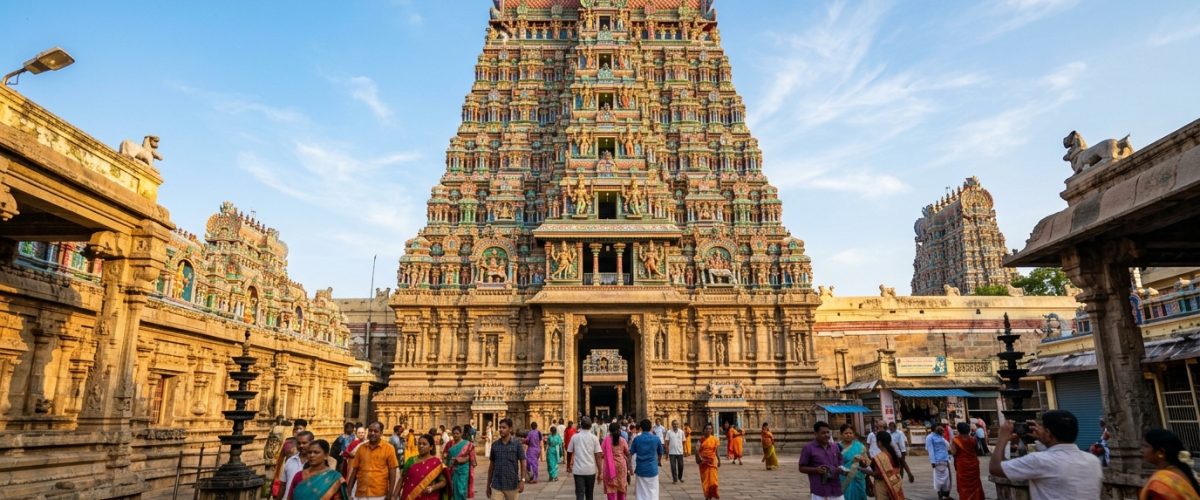
Madurai’s Meenakshi Amman Temple — one of India’s most visited pilgrimage sites, with its iconic multi-coloured gopurams rising above the ancient city — has been the focus of a dedicated tourism development programme. The Madurai Smart City initiative has invested in pedestrianisation of approach roads, creation of heritage walking trails through the surrounding Chettiar merchant quarters, and the development of a sound-and-light show that narrates the temple’s 2,000-year history.
The temple complex itself, which covers 14 acres and contains 33,000 sculptures, has been the subject of a major documentation project using laser scanning and photogrammetry — technologies that create precise digital records of the temple’s condition while also generating assets for virtual tourism experiences that can reach audiences worldwide.
Chettinad and Pondicherry: Cultural Depth Beyond Temples
Tamil Nadu’s heritage tourism portfolio extends well beyond its temples. The Chettinad region, with its palatial mansions built by the Nattukottai Chettiar merchant community, has emerged as a heritage tourism destination in its own right. The mansions’ distinctive architecture — featuring Burma teak pillars, Italian marble floors, and Athangudi tiles — combined with the region’s celebrated cuisine, has attracted a discerning international clientele seeking authentic cultural immersion.
Pondicherry, with its French colonial architecture, vibrant arts scene, and the Auroville international community, continues to attract a diverse mix of cultural tourists, spiritual seekers, and gastronomy enthusiasts. The city’s careful preservation of its colonial-era streetscapes and its integration of Tamil and French cultural influences offer a model of heritage management that balances conservation with contemporary vitality.
Mahabalipuram: Shore Temples and Sculpture Parks
Mahabalipuram (Mamallapuram), the ancient Pallava dynasty port city, is experiencing renewed tourism interest following the completion of a landscaping and infrastructure improvement project funded by the central government. The site’s collection of 7th-century rock-cut caves, monolithic temples, and the magnificent Shore Temple — all UNESCO World Heritage listed — has been enhanced with improved pathways, interpretive signage, and a sculpture park showcasing contemporary works inspired by the Pallava artistic tradition.
The 2024 underwater archaeological discovery of additional structural remains off the coast of Mahabalipuram has added a new dimension to the site’s appeal, with plans for an underwater heritage trail that would allow visitors to explore submerged temple remains through glass-bottomed boats and guided snorkelling excursions.
Economic Impact and Employment
Tamil Nadu’s heritage tourism revival is generating significant economic impact. The state’s tourism revenue exceeded ₹1 lakh crore in 2025, and the current trajectory suggests further growth in 2026. Heritage tourism, in particular, generates higher per-visitor spending than beach or leisure tourism, as cultural tourists tend to stay longer, purchase local crafts, and engage more extensively with food and accommodation services.
The employment implications are equally important. The heritage tourism sector supports not only direct tourism jobs but also sustains traditional craft communities — stone carvers, bronze casters, silk weavers, and Tanjore painting artists — whose skills might otherwise be lost to economic obsolescence. The integration of these artisan communities into the tourism experience creates a virtuous circle where tourism revenue supports cultural preservation, and cultural preservation enhances tourism value.
The Global Stage
Tamil Nadu’s heritage tourism narrative is increasingly being told on the global stage. The state’s participation in international tourism fairs, collaboration with foreign tour operators, and engagement with travel influencers and media have raised its profile among cultural travellers worldwide. The UNESCO designation of the Chola temples, the recent intangible cultural heritage recognition of Tamil classical music and dance traditions, and the growing international appreciation of South Indian cuisine all contribute to an emerging brand identity that positions Tamil Nadu as a destination of world-class cultural significance.
As India pursues its ambition to become a global tourism powerhouse, Tamil Nadu’s heritage renaissance offers a compelling proof of concept — demonstrating that innovation and tradition can coexist productively, and that the country’s deepest cultural assets, properly presented and promoted, can compete with any destination in the world for the attention and admiration of the discerning cultural traveller.

- Mamaearth, boAt, and Noise: How India’s D2C Champions Are Chasing Profitability in 2026 - March 24, 2026
- India’s D2C Brands Bet Big on Offline Expansion as Quick Commerce Reshapes the Playbook - March 24, 2026
- Himalayan Trekking in 2026: Top Routes and New Trails for Adventure Seekers in India - March 24, 2026