Indian Companies Navigate US Reciprocal Tariffs as Trade Deal Opens Doors for Key Export Sectors

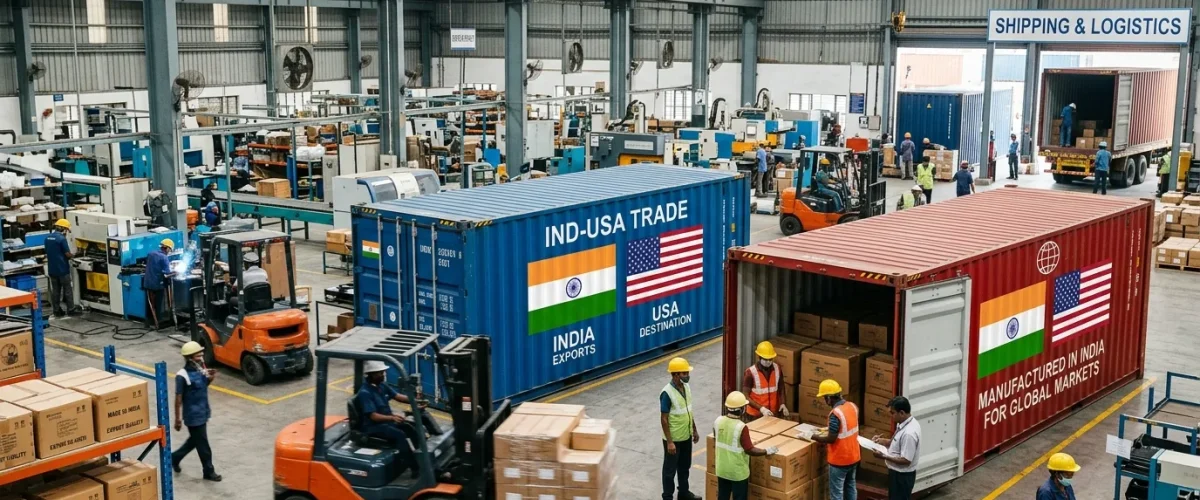
Indian companies across textiles, leather, chemicals and machinery are adjusting to the 18 per cent reciprocal tariff imposed by the United States under the US-India trade agreement signed in February 2026. The deal, announced in a White House joint statement, provides a structured framework that replaces the uncertainty of ad hoc tariff actions while opening exemptions for key export sectors including generic pharmaceuticals, gems and diamonds, and aircraft parts.
India has committed to eliminating or reducing tariffs on all US industrial goods and a wide range of food and agricultural products in return. The bilateral agreement marks the most significant trade reset between the two countries in over a decade.
Winners and Losers Among Indian Exporters
Generic pharmaceutical companies stand to benefit the most. The agreement exempts pharma exports from the reciprocal tariff, preserving India’s position as the pharmacy of the world. Companies like Sun Pharma, Dr Reddy’s and Cipla can continue exporting to the US without additional cost burdens.
Gems and diamonds, India’s second-largest export category to the US, also receive exemptions. The Surat-based diamond polishing industry, which processes over 90 per cent of the world’s diamonds, will maintain its competitive edge.
However, textiles, apparel, leather, footwear, organic chemicals and certain machinery face the full 18 per cent tariff. Exporters in Tirupur, Ludhiana and Mumbai’s garment clusters are recalibrating pricing strategies and diversifying toward EU and ASEAN markets.
IT Services and the Broader Corporate Landscape
India’s IT industry grew 6.1 per cent to $315 billion and is largely insulated from goods tariffs, as services trade falls outside the agreement’s scope. TCS, Infosys and HCL Technologies continue to win large contracts in the US market.
Technology companies are expanding their India presence. Kiran Mani joined OpenAI to lead Asia-Pacific growth, signalling that global tech firms see India as a strategic hub for talent and market access regardless of goods tariff dynamics.
Manufacturing Push Gains Momentum
The trade deal accelerates India’s manufacturing ambitions. Electronics and semiconductor companies are expanding production under the Production-Linked Incentive scheme. The agreement’s clarity on tariff rates allows manufacturers to plan multi-year investment cycles with confidence.
India’s GDP growth forecast remains optimistic despite global headwinds, supported by domestic consumption and infrastructure spending. The trade deal adds an export-oriented dimension to this growth story.
What Companies Are Doing to Adapt
Larger Indian exporters are setting up distribution hubs in the US to absorb tariff costs closer to the customer. Some are relocating portions of their supply chains to countries with lower US tariff rates. Smaller exporters are banding together through industry associations to negotiate better logistics and insurance terms.
Industry body FICCI has called the deal “a net positive despite the tariff reality” because it replaces unpredictability with a clear framework. The Confederation of Indian Industry echoed this sentiment, noting that the exemptions for pharma and gems protect India’s highest-value export categories.
Outlook for Indian Companies in FY27
The full impact of the tariffs will become clearer as Q4 FY26 results roll in starting next week. Companies with diversified export portfolios and strong domestic demand are best positioned to navigate the transition. The trade deal, while imperfect, provides the certainty that Indian businesses need to invest, hire and grow.

- India’s Startup Funding Crosses $7.2 Billion in H1 2026 - July 1, 2026
- After Ireland Shock, India’s T20I Side Faces Bigger Test - July 1, 2026
- Ireland Stun World Champions India 2-0 in Belfast, Sooryavanshi Debate Rages On - June 29, 2026