India’s Sovereign AI Push Accelerates as Sarvam AI Nears $1.5 Billion Valuation and Government Funds 12 Labs

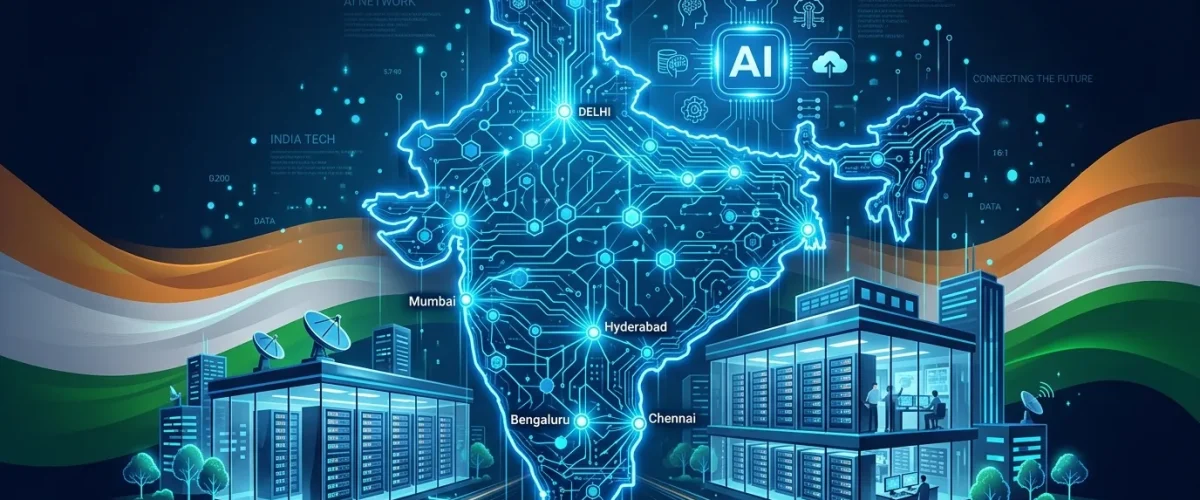
India’s artificial intelligence ecosystem crossed a significant milestone in April 2026 as multiple developments converged to accelerate the country’s push towards AI sovereignty. Bengaluru-based Sarvam AI is closing a funding round of $300 million to $350 million at a $1.5 billion valuation, backed by Lightspeed Venture Partners and Khosla Ventures. Simultaneously, the Indian government has committed public funding to 12 organisations building sovereign AI foundation models, while Microsoft’s $17.5 billion India investment is materialising through a hyperscale data centre in Hyderabad expected to go live by mid-2026.
The combined momentum of private capital, government policy and global tech investment is positioning India as one of the world’s most active AI markets, with total venture funding for the country’s top AI companies now exceeding $2.9 billion.
Sarvam AI Targets Unicorn Status With Massive Raise
Sarvam AI’s funding round represents one of the largest raises by an Indian AI startup to date. The company, which has built large language models specifically optimised for Indian languages, launched a 105-billion-parameter model in February 2026 that reportedly outperforms global competitors on mixed Hindi-English text, a capability known as Indic code-switching. The model handles the natural way millions of Indians communicate, seamlessly blending languages within single conversations.
At the India AI Impact Summit held in New Delhi in February, Sarvam unveiled several products including its Indus chatbot, which competes with OpenAI’s ChatGPT in the Indian market, and the Sarvam Kaze smart glasses, the company’s first hardware product. Prime Minister Narendra Modi tested the Kaze glasses at the expo, giving the device significant public visibility.
Sarvam has also announced partnerships with Qualcomm, HMD and Bosch to deploy its AI models on devices including smartphones, feature phones, cars, laptops and smart glasses. This on-device strategy differentiates the company from cloud-only approaches and addresses India’s data residency requirements while reducing latency for end users.
Krutrim, backed by Ola founder Bhavish Aggarwal, has already achieved unicorn status with $50 million in equity plus $230 million in committed financing, making the Indian AI startup space increasingly competitive. Global AI labs including Anthropic, which opened its first India office in Bengaluru, are also racing to capture the market.
Government Backs 12 Sovereign AI Labs Under IndiaAI Mission
The Indian government’s direct funding of 12 organisations to build sovereign AI foundation models marks a significant policy shift towards ensuring that India develops its own AI capabilities rather than relying entirely on foreign models. The selected organisations include Sarvam AI, Gnani AI, Fractal Analytics, Tech Mahindra’s Maker’s Lab and the IIT Bombay-led BharatGen consortium.
The BharatGen project received the largest allocation, with funding of approximately Rs 1,000 crore, roughly four times the next-highest funded project. The consortium released its Param 2 model at the AI Impact Summit, a 17-billion-parameter model supporting all 22 official Indian languages with multimodal capabilities including text, speech and images.
The sovereign AI strategy is driven by several considerations. India’s 1.4 billion population generates vast amounts of data in dozens of languages, and the government has determined that relying on foreign models trained primarily on English-language data is insufficient for governance, education and healthcare applications. By building indigenous models trained on Indian datasets, the country aims to ensure that AI tools work effectively for all citizens, not just English-speaking urban populations.
Under the IndiaAI Mission, approved in March 2024 with a budget of Rs 10,371.92 crore over five years, the government is also expanding its GPU compute infrastructure. Plans call for adding more than 20,000 GPUs to India’s existing base of 38,000 under the IndiaAI Compute Portal, with a separate secure cluster of 3,000 next-generation GPUs being built for sovereign and strategic applications.
Microsoft, Google and Adani Drive Infrastructure Build-Out
Microsoft’s $17.5 billion India commitment, its largest ever in Asia, is now moving from announcement to execution. The flagship hyperscale data centre in Hyderabad is scheduled to go live in mid-2026 with three availability zones. Microsoft is also doubling its pledge to train 20 million Indians in AI skills by 2030, addressing the talent pipeline that will be essential for the country’s AI ambitions.
At the AI Impact Summit, Google highlighted climate modelling, extreme weather prediction, language tools and an AI cricket coach tailored for Indian users. Amazon Web Services, Nvidia and Qualcomm also showcased platforms designed for scale in India, with a focus on cost efficiency and regulatory compliance.
India’s data centre market, valued at approximately $10 billion in 2025, is expected to more than double to $22 billion by 2030, according to a report released on 12 April. The Adani Group has announced plans to allocate $100 billion for AI data centres using renewable energy in India by 2035, with an additional $150 billion expected in supporting infrastructure including server manufacturing and sovereign cloud platforms.
The Indian IT industry, projected to grow 6.1 per cent to $315 billion in FY26, is also being reshaped by AI adoption. Companies including Tata Consultancy Services, Infosys and HCLTech are deploying AI tools across client engagements, with Anthropic partnering with Infosys to deploy Claude models in the telecommunications sector through a dedicated Centre of Excellence.
India’s Second Position in Global AI Adoption
India’s growing importance in the global AI ecosystem is reflected in several metrics. OpenAI CEO Sam Altman revealed at the summit that India accounts for more than 100 million weekly active ChatGPT users, second only to the United States. Anthropic confirmed India as the second-largest user of Claude after the US. These figures underscore both the demand for AI services and the opportunity for Indian companies to build products tailored to local needs.
On GitHub, India emerged as the second-largest contributor worldwide to public generative AI projects in 2024, reflecting the depth of the country’s developer talent pool. The government’s AI FutureSkills programme is supporting 500 PhD scholars, 5,000 postgraduates and 8,000 undergraduates in AI research and training, while 570 AI Data Labs across the country are building grassroots AI skills in Tier-2 and Tier-3 cities.
The convergence of government funding, private investment, global tech commitments and a massive user base is creating an AI ecosystem in India that few predicted. The broader technology sector is being reshaped at every level, from semiconductor design to cloud services, even two years ago. The challenge ahead lies in translating this momentum into tangible outcomes for citizens, from improved government services and healthcare diagnostics to agricultural productivity and financial inclusion. If the current trajectory holds, India’s sovereign AI push could reshape not just the country’s technology landscape but its economic future.

- India’s Startup Funding Crosses $7.2 Billion in H1 2026 - July 1, 2026
- After Ireland Shock, India’s T20I Side Faces Bigger Test - July 1, 2026
- Ireland Stun World Champions India 2-0 in Belfast, Sooryavanshi Debate Rages On - June 29, 2026