India’s Mobile Gaming Market Surges Past $3 Billion in 2026 as Smartphone Penetration Deepens

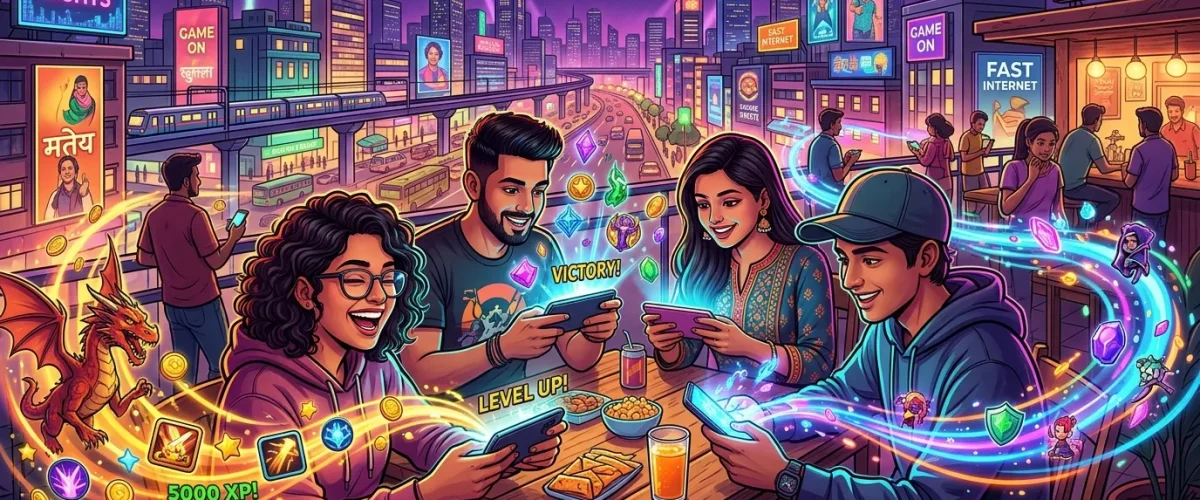
India’s mobile gaming market has officially crossed the $3 billion revenue mark in 2026, cementing the country’s position as one of the fastest-growing gaming ecosystems in the world. According to the latest report by the IMARC Group, India’s broader gaming market is expected to grow from $4.6 billion in 2025 to a staggering $13.5 billion by 2034, with mobile gaming constituting approximately 65 per cent of total industry revenues. The surge is powered by a confluence of factors: deepening smartphone penetration, affordable data plans, and a young, digitally native population increasingly turning to mobile devices for entertainment.
The numbers are hard to ignore. India now has an estimated 568 million mobile gamers, a figure that has roughly tripled over the past five years. The trend is being driven not just by metropolitan gamers in Mumbai, Delhi, and Bangalore, but by a massive expansion in Tier 2 and Tier 3 cities, where affordable Android handsets and Jio’s continued rollout of low-cost 5G plans are bringing high-quality gaming experiences to first-time smartphone users. Industry analysts at RedSeer Consulting note that nearly 45 per cent of all new gamers added in the past year came from non-metro regions.
5G and Cloud Gaming: The New Frontier
The rollout of 5G networks across India has been a critical catalyst. With Reliance Jio and Bharti Airtel now offering 5G coverage in over 700 cities, latency-sensitive mobile games—such as real-time multiplayer shooters and competitive battle royale titles—are performing better than ever on mobile devices. This has also opened the door for cloud gaming services like Xbox Cloud Gaming and Jio Cloud Gaming, which allow users to stream console-quality titles directly onto their smartphones without expensive hardware.
Industry veteran Rajan Navani, the founder of JetSynthesys, recently said at the NASSCOM Gaming Forum that cloud gaming could add another 100 million casual gamers to India’s ecosystem by 2028. “The barrier to entry has never been lower,” Navani observed. “A farmer’s son in Bihar can now access the same game quality as a teenager in South Mumbai. That’s the revolution 5G brings.”
Also read: IPL 2026 Season Preview: Key Transfers, Injuries, and Franchise Strategies
Also read: AI Summit 2026: India Showcases Ambitions but Structural Gaps Exposed
Battle Royale Still Rules, but Hyper-Casual Gains Ground
While battle royale titles like Battlegrounds Mobile India (BGMI) and Free Fire Max continue to dominate download charts and active user metrics, the hyper-casual gaming segment is emerging as a dark horse. Titles from Indian studios like Nautilus Mobile and Gameberry Labs are racking up tens of millions of downloads with simple, addictive gameplay formats that appeal to a wider demographic, including women and older adults.
The shift toward hyper-casual is also attracting advertising revenue. With in-app advertising models becoming more sophisticated—powered by AI-driven ad placement and personalisation—studios are finding they can monetise large user bases without relying on in-app purchases, which have historically seen low conversion rates in the Indian market.
Monetisation: The Persistent Challenge
Despite the impressive user numbers, monetisation remains a structural challenge. India’s Average Revenue Per User (ARPU) for mobile gaming stands at approximately $1.80 per month—significantly lower than $12.50 in the United States and $8.40 in China. The reluctance of Indian users to pay for games or in-game purchases has forced developers to rely overwhelmingly on ad-supported models.
However, there are signs this is changing. The success of paid contest models on platforms like Dream11, and the growing willingness of younger users to purchase battle passes in BGMI and other titles, suggest a gradual cultural shift toward spending on digital entertainment. Payment infrastructure improvements—particularly UPI-based microtransactions—are also helping reduce friction at the point of purchase.
Government Support and Industry Maturation
The Indian government’s continued push on the AVGC (Animation, Visual Effects, Gaming, and Comics) sector has brought new institutional support. The AVGC-XR Promotion Task Force, established in 2023, has now facilitated the opening of three new gaming incubators in Hyderabad, Pune, and Guwahati. Meanwhile, state governments in Karnataka and Telangana are offering tax incentives to gaming studios setting up operations in their jurisdictions.
The Ministry of Electronics and Information Technology (MeitY) has also fast-tracked the implementation of the Online Gaming (Regulation) Rules, 2023, which provide a clearer regulatory framework for both skill-based and casual mobile games. This clarity has been welcomed by investors, with venture capital inflows into Indian gaming startups reaching $420 million in the first quarter of 2026 alone.
What Lies Ahead
Looking forward, the Indian mobile gaming market is poised for several transformative developments. The entry of major global publishers—Epic Games recently announced a dedicated India studio, while Tencent has been quietly expanding its Krafton partnership—signals growing international confidence in the Indian market. Simultaneously, the rise of Indian-made intellectual property, from Ludo King to Real Cricket, is proving that domestic studios can build globally competitive products.
The convergence of 5G infrastructure, government policy support, a young demographic dividend, and improving monetisation pathways suggests that India’s mobile gaming boom is not merely a cyclical surge but a structural shift. As the IMARC Group projects, by the end of the decade, India could well be the world’s second-largest mobile gaming market by revenue, trailing only China. For now, the $3 billion milestone is both a celebration and a starting gun.

- India’s Startup Funding Crosses $7.2 Billion in H1 2026 - July 1, 2026
- After Ireland Shock, India’s T20I Side Faces Bigger Test - July 1, 2026
- Ireland Stun World Champions India 2-0 in Belfast, Sooryavanshi Debate Rages On - June 29, 2026