India GDP Growth Forecast 2026: RBI Holds Optimistic Outlook Despite Global Trade Headwinds


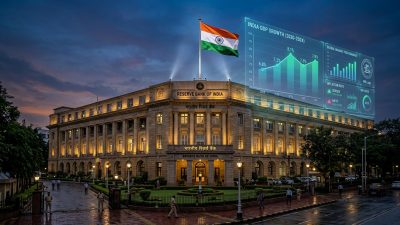
The Reserve Bank of India has maintained its GDP growth forecast for FY2026-27 at 6.7 per cent, making India one of the fastest-growing major economies in the world for the third consecutive year. The projection, reaffirmed in the RBI’s March 2026 monetary policy review, reflects confidence in domestic consumption, manufacturing expansion, and infrastructure investment — even as global trade headwinds, geopolitical tensions, and a volatile commodity environment create significant external uncertainties.
India GDP Growth 2026: The Numbers Behind the Optimism
India’s real GDP growth for FY2025-26, which concludes in March 2026, is now estimated at 6.5 per cent by the National Statistical Office. The trajectory shows an economy that has recovered fully from the pandemic-era disruption and is operating above its pre-2020 growth trend. Key contributors include robust private consumption — which accounts for approximately 57 per cent of GDP — steady government capital expenditure, and a services sector that continues to expand at over 7 per cent annually.
The manufacturing sector, a focal point of the government’s Make in India and Production Linked Incentive (PLI) schemes, has delivered mixed results. While electronics manufacturing — particularly mobile phone assembly and semiconductor packaging — has grown impressively, traditional manufacturing segments such as textiles, leather, and basic chemicals have underperformed due to weak export demand and rising input costs.
The economic indicators across sectors present a picture of uneven but broadly positive momentum. Services exports, led by IT and global capability centres, remain a structural strength, contributing over $350 billion annually to India’s current account.
Inflation: The Balancing Act Continues
Consumer price inflation has moderated to 4.3 per cent in February 2026, comfortably within the RBI’s 2-6 per cent target band and approaching the 4 per cent midpoint. Food inflation, which drove headline numbers higher through much of 2025, has eased following a strong rabi harvest and improved supply chain logistics.
Core inflation — excluding food and fuel — remains sticky at around 4.8 per cent, driven by services sector pricing power and wage growth in organised sectors. The RBI’s Monetary Policy Committee (MPC) has kept the repo rate unchanged at 6 per cent, signalling that while inflation is manageable, it is not yet low enough to justify rate cuts that markets have been anticipating.
Fuel prices remain a wildcard. Brent crude oil has fluctuated between $78 and $88 per barrel in the first quarter of 2026, with Middle East tensions and OPEC+ production decisions creating persistent uncertainty. India imports over 85 per cent of its crude oil requirements, making it vulnerable to supply disruptions and price spikes that can rapidly feed through to inflation and the fiscal deficit.
Global Trade Headwinds: Tariffs, China, and Supply Chain Shifts
The external environment presents India’s most significant growth risks. The United States has implemented additional tariffs on a range of imported goods under its evolving trade policy framework, creating uncertainty for Indian exporters in sectors including textiles, pharmaceuticals, and auto components. While India has not been targeted as aggressively as China, the overall reduction in global trade openness dampens export prospects.
China’s economic slowdown — growth there is projected at 4.2 per cent for 2026, the lowest in three decades — has mixed implications for India. Reduced Chinese demand lowers commodity prices, benefiting India as a net importer. However, Chinese manufacturers facing weak domestic demand are aggressively seeking export markets, increasing competitive pressure on Indian manufacturers across multiple sectors.
On the positive side, the global supply chain diversification trend — often described as “China Plus One” — continues to direct manufacturing investment toward India. Vietnam, Indonesia, and Mexico are competitors for this investment, but India’s combination of market size, labour availability, and improving infrastructure gives it a structural advantage for long-term manufacturing expansion. The startup investment trends reflect this manufacturing shift.
Infrastructure Investment: The Capex Engine
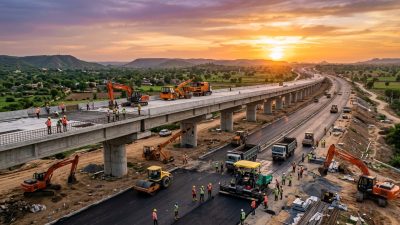
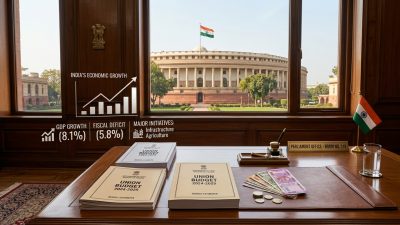
Government capital expenditure remains the single most reliable driver of India’s growth story. The FY2026-27 Union Budget allocated Rs 11.2 lakh crore to infrastructure spending — roads, railways, ports, airports, and urban development. This represents a continued increase from previous years and is designed to address infrastructure bottlenecks that have historically constrained India’s growth potential.
The National Infrastructure Pipeline, a multi-year programme covering over 9,000 projects, has reached approximately 50 per cent completion. Notable achievements include the expansion of the national highway network to over 155,000 kilometres, the commissioning of new metro systems in tier-2 cities, and advanced progress on dedicated freight corridors that will dramatically reduce logistics costs.
Private sector capital expenditure, which lagged public spending for several years, is showing signs of revival. Corporate balance sheets are the healthiest they have been in a decade, with debt-to-equity ratios at multi-year lows. Banks are reporting increased demand for project finance, particularly in renewable energy, data centres, and advanced manufacturing.
Employment and the Consumption Challenge
India’s growth narrative faces a persistent challenge: translating GDP expansion into broad-based employment and consumption growth. The unemployment rate, as measured by the Centre for Monitoring Indian Economy (CMIE), stands at approximately 7.5 per cent, with youth unemployment significantly higher. Much of the employment generated is in the informal sector, where wages and job security are limited.
Rural consumption, which accounts for roughly 35 per cent of total private consumption, has recovered from its 2023-24 weakness but remains sensitive to agricultural incomes and government transfer payments. The PM-KISAN direct cash transfer scheme and increased MGNREGA allocation provide support, but structural improvement requires higher agricultural productivity and rural non-farm employment opportunities.
The personal finance strategies of Indian households reflect this uncertainty, with savings rates remaining elevated as consumers balance aspiration with caution.
Outlook: Cautious Confidence
India’s economic outlook for 2026-27 can be characterised as cautiously confident. The domestic growth engines — consumption, investment, and services exports — are functioning well. External risks are real but manageable given India’s relatively low trade-to-GDP ratio compared with other major economies. The RBI’s monetary policy provides stability without constraining growth.
The medium-term trajectory will depend on whether India can convert its infrastructure investment into sustained manufacturing growth, address the employment challenge through labour market reforms and skill development, and navigate an increasingly complex geopolitical environment. At 6.7 per cent growth, India is moving in the right direction — the question is whether it can accelerate further toward the 7-8 per cent territory that would be genuinely transformative for a country of 1.4 billion people.

- India’s Edtech Reboot: How BYJU’S Collapse Reshaped the Sector and Who Is Rising in 2026 - March 26, 2026
- India Real Estate 2026: Housing Sales Hit Record High as Luxury Segment Outpaces Affordable Market - March 26, 2026
- India GDP Growth Forecast 2026: RBI Holds Optimistic Outlook Despite Global Trade Headwinds - March 26, 2026