How to Identify a Genuine Pashmina Shawl: 12 Tests That Work in India

| Quick Answer
To identify a genuine pashmina shawl in India, combine these signals: the price must be ₹10,000 or more for a plain shawl; the texture should feel warm and feather-soft — never slippery; the weave will show slight handmade irregularities; the fringes are hand-twisted, not machine-cut; and the seller must provide a GI Certification (Government of India Tag No. 46). No single test is definitive — always combine at least three. |
You are standing in a Kashmir market, or browsing online, and a vendor holds up a shawl and says the word every luxury buyer dreads hearing falsely: pashmina. It is unbelievably soft. The price seems reasonable. But something feels off.
You are right to be cautious. India’s pashmina market is flooded with counterfeits — viscose, acrylic, and polyester blends sold under the pashmina name at a fraction of the real cost. Even on major e-commerce platforms, you will find products listed from ₹400 upward with the word ‘pashmina’ in the title. None of them are genuine.
This guide gives you 12 practical tests — the same ones used by experienced buyers and Kashmiri artisans — so you never pay for a fake again.
What Is Real Pashmina?
Real pashmina is not simply a type of soft shawl. It is a specific natural fiber — the ultra-fine undercoat of the Changthangi goat (also called the Pashmina goat), which lives on the high-altitude plateaus of Ladakh at elevations above 4,500 metres, where temperatures drop as low as minus 40 degrees Celsius.
This extreme cold forces the goat to produce a remarkably fine inner fleece. Each fiber measures just 12 to 16 microns in diameter — thinner than a strand of silk, and significantly finer than ordinary cashmere (which is typically 15–19 microns). It is this fineness that gives pashmina its famous feather-weight warmth.
Every spring, nomadic herders called Changpas comb the undercoat from the goats by hand — it cannot be sheared. It then travels to Kashmir, where artisan families spin it by hand on traditional wooden charkhas, then weave it on handlooms over days, weeks, or months. A single plain shawl goes through more than 30 stages of production. An intricately embroidered piece can take a year or more.
| Why genuine pashmina is never cheap
• It takes the undercoat of 2–3 goats to make a single shawl • Combing, spinning, weaving, and finishing are all done entirely by hand • A plain shawl takes 2–3 weeks to weave; embroidered shawls can take months to years • India price: ₹10,000–₹12,000 for a plain handwoven shawl; ₹25,000–₹1,50,000+ for embroidered pieces • Red flag: Any ‘pashmina’ below ₹7,000 is almost certainly fake |
Why Fake Pashmina Is So Common in India
Pashmina’s reputation is its biggest vulnerability. The word alone commands trust and commands a premium — which is exactly why counterfeit sellers exploit it.
Tourist markets in Kashmir, Delhi, Jaipur, and Mysore are filled with vendors selling ‘pashmina’ products made from viscose, acrylic, or blended synthetics. These can feel surprisingly soft to an untrained hand and are often priced between ₹500 and ₹3,000 — low enough to feel like a bargain, high enough to seem credible.
On e-commerce platforms like Amazon and Myntra, product listings routinely use the word ‘pashmina’ for items priced as low as ₹400. These products are never genuine. The listings often use the term legally, because the word ‘pashmina’ is not itself protected — only ‘Kashmir Pashmina’ has a protected Geographical Indication (GI) tag.
| ⚠️ The ‘Pashmina Blend’ Labelling Loophole
A label reading ‘Pashmina Blend’, ‘70% Pashmina’, or ‘Pashmina with Silk’ is a major red flag. It is legally permissible to print these descriptions, but they mean the shawl is not genuine pashmina. Real pashmina shawls are labelled ‘100% Pashmina’ or ‘100% Cashmere’ — nothing else. |
12 Ways to Identify a Genuine Pashmina Shawl
No single test is fully conclusive. The most reliable approach is to combine at least three or four of the following checks. The more tests the shawl passes, the more confident you can be.
1. 💰 The Price Test
This is your first filter. Genuine pashmina can never be cheap — the raw material and labour costs make it structurally impossible. In India in 2026:
- A plain, unembroidered handwoven pashmina shawl starts at ₹10,000–₹12,000
- Sozni embroidered pashminas: ₹25,000 and above
- Kani or Jamawar shawls: ₹50,000 to ₹1,50,000+
If a seller is offering ‘pashmina’ for ₹1,000, ₹2,000, or even ₹5,000 — walk away. The raw Pashmina yarn alone costs upwards of ₹16,000 per kilogram, and a shawl requires approximately 300 grams of fiber.
| 💡 Quick Check: Anything below ₹7,000 is not genuine. A price around ₹10,000 is the absolute minimum for a plain piece. |
2. 🤲 The Touch and Texture Test
This is the easiest test you can do in a market, and one of the most reliable. Pick up the shawl and hold it in your hands for ten seconds.
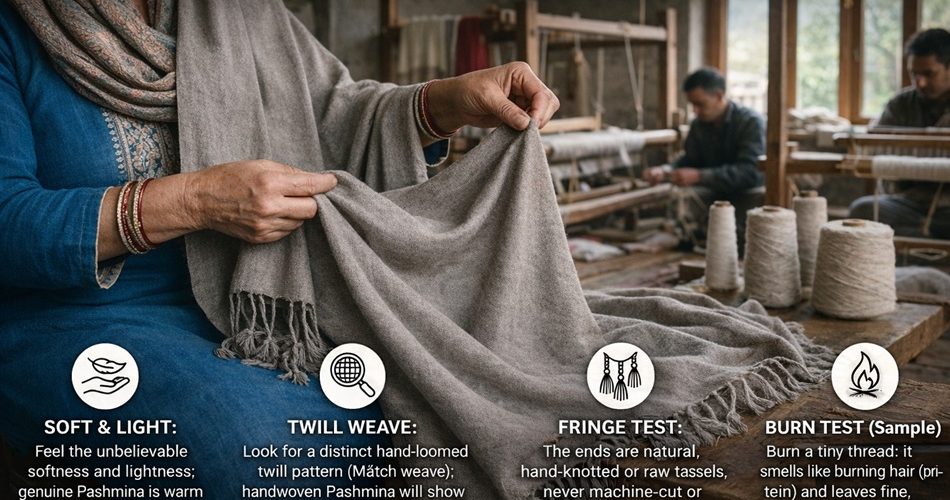
- Genuine pashmina feels incredibly soft — warm, feather-light, and buttery against the skin
- Place a corner against your cheek. Real pashmina feels warm immediately — it responds to body heat
- Run your fingers along the surface. There is a slight natural nap — organic and textured, not slick
- Fake alert: Viscose and synthetic blends feel smooth and slippery — almost silky-artificial. They do not warm up the way natural fiber does
| 💡 Quick Check: Place the shawl gently against your cheek. Genuine pashmina feels warm and feather-soft within seconds. Synthetic feels cold or plastic-like. |
3. 💍 The Ring Test
Because genuine pashmina fibers are so fine (12–16 microns), a full-sized shawl can be passed through a standard finger ring.
- Take a corner of the shawl and ease it through a ring. Genuine pashmina slips through with minimal resistance
- If it bunches, snags, or gets stuck — it is likely a blend or a fake
| Important limitation: The ring test is not conclusive on its own. Some lightweight synthetic blends can also pass through a ring. Always combine this with at least two other tests. |
4. 🔥 The Burn Test
This is one of the most reliable scientific tests. Natural protein fibers (like wool, silk, and cashmere) behave very differently from synthetics when burned.
- Carefully pull a single loose thread from the fringe — never from the body of the shawl
- Genuine pashmina: burns slowly, smells like burnt hair or singed keratin, and leaves behind a soft, crushable grey-black ash
- Synthetic (viscose/acrylic): melts, hardens into a bead, may drip, and smells chemical or plastic
| ⚠️ Safety note: Perform this test in a safe, open area with a lighter or match. Always get the seller’s permission, or test a thread from the packaging sample rather than the shawl itself. |
| 💡 Quick Check: Genuine pashmina smells like burnt hair and leaves soft ash. Synthetics melt, harden, or smell chemical. |
5. 🔍 The Weave Imperfection Test
Every genuine pashmina shawl is hand-woven on a traditional wooden handloom by a Kashmiri artisan. This process, by its very nature, produces slight variations in the weave.
- Hold the shawl up against a light source (window or lamp)
- Look for fine, slight irregularities in the threads — small variations in spacing, tension, or thickness
- These imperfections are not flaws — they are proof of human hands
- Machine-made fakes: have a perfectly uniform, flawless weave pattern — too regular to be handmade
- Also check the selvedge edges: on a handwoven piece, the side edges are slightly uneven and organic. Machine edges are perfectly straight and identical
| 💡 Quick Check: Hold the shawl to light. See slight irregularities in weave? Good — that’s the artisan’s hand. Perfect uniformity = machine-made. |
6. ⚖️ The Weight and Warmth Test
Genuine pashmina defies expectation — it is simultaneously one of the lightest and warmest fabrics in the world. This combination is almost impossible to replicate in synthetic fibers.
- A full-size pashmina shawl (200 cm × 100 cm) weighs approximately 100–150 grams — you can barely feel it in your hand
- Despite its lightness, it produces immediate warmth when wrapped around the body
- Synthetic test: Viscose blends tend to be slightly heavier and produce less warmth relative to their thickness. Acrylic can feel bulky or stiff
| 💡 Quick Check: Drape the shawl over your shoulders. Genuine pashmina is startlingly light but immediately warm. |
7. 🏛️ The GI Tag — India’s Official Guarantee
| This is the single most important test for buyers in India
The Government of India introduced the Geographical Indication (GI) Tag for Kashmir Pashmina in 2019, registered as GI No. 46. It is the strongest legal proof of authenticity available. • Ask the seller for the GI certification document before you pay • The certificate includes: a unique serial number, fiber origin proof, lab test results confirming fiber fineness, and an official government seal • GI-certified shawls carry a special label — often a stitched tag or hologram — and some have a verifiable QR code • Certification is issued by the Pashmina Testing & Quality Certification Centre (PTQCC) at the Craft Development Institute (CDI), Srinagar — a Government of India laboratory • The artisan’s tag: Each GI-tagged shawl has a rubber stamp with a unique ID synchronized with the weaver’s information. No two shawls share the same ID • 🚫 If a seller cannot produce GI documentation: the shawl is not certified genuine Kashmiri pashmina, regardless of what they claim |
8. 🏷️ The Label Check
Always read the care label and product label carefully before purchasing.
- Genuine labels read: ‘100% Pashmina’, ‘100% Cashmere’, or ‘Pure Cashmere’
- Reject any label reading: ‘Pashmina Blend’, ‘Pashmina with Silk’, ‘Viscose Pashmina’, ‘70% Pashmina’, or any mention of polyester
- The country of origin should read India (Kashmir / Ladakh)
- Reputable sellers include the artisan’s name or cooperative on the label alongside the GI tag
| 💡 Quick Check: If the label says anything other than ‘100% Pashmina’ or ‘100% Cashmere’ — put it down. |
9. ⚡ The Static Electricity Test
This is a quick, no-tool test you can do anywhere. It exploits a fundamental difference between natural and synthetic fibers.
- Rub the shawl briskly between your palms for 10–15 seconds
- Genuine pashmina (protein fiber): generates no static electricity. No sparks, no clinging
- Synthetic materials (viscose, acrylic, polyester): generate noticeable static — you may feel the crackle, see the shawl cling, or hear a faint snap in the dark
| 💡 Quick Check: Rub the shawl vigorously. Static electricity means synthetic. No static = natural fiber. |
10. 🧵 The Fringe and Selvedge Test
This test is easy to perform in any market and is one of the clearest visual indicators of authenticity. It is one of the most overlooked tests — but top-ranking pages for this keyword consistently highlight it.
- Genuine fringes: are the natural warp threads from the loom, released at the end of weaving. They are hand-twisted, slightly uneven, and have an organic, hair-like finish
- Fake fringes: are often cut and machine-stitched onto a separate fabric, or are perfectly uniform tassels — identical in length and twist. Look closely for a visible seam joining the fringe to the body
- Selvedge edges (the long sides of the shawl): on a handwoven piece, these are slightly wavy or irregular. On machine-made pieces, they are perfectly straight
- If the fringe material looks different from the body fabric — different texture, different color saturation — it is almost certainly fake
| 💡 Quick Check: Inspect the fringes closely. Hand-twisted and slightly uneven = real. Machine-uniform tassels or a visible seam joining the fringe = fake. |
11. ✨ The Shine Test
This is the fastest visual test — it takes three seconds and requires nothing but light.
- Hold the shawl under a bright light or near a window in direct sunlight
- Genuine pashmina: has a matte finish or a very soft, subtle natural lustre — understated and warm-toned
- Synthetic and viscose fakes: have a noticeable artificial shine — plastic-like and reflective under light. This is especially obvious in viscose blends, which can look almost glossy
- Natural silk-pashmina blends may have a gentle sheen, but it looks different from the flat plastic shine of a purely synthetic fabric
| 💡 Quick Check: Hold the shawl to direct light. Soft, warm-toned lustre = natural fiber. Bright plastic shine = synthetic. |
12. 🏪 The Seller Reputation and Documentation Test
Even if a shawl passes several physical tests, the seller’s credibility matters enormously — because sophisticated counterfeits have become very good at mimicking feel and appearance.
- Buy only from sellers who are GI-certified or registered with the J&K Handicraft Department
- Look for sellers whose products are certified by the Craft Development Institute (CDI), Srinagar
- Ask questions: a genuine seller will know the weaver’s name, the origin of the fiber, and the number of hours the shawl took to make — and will be proud to tell you
- A genuine seller will always have paperwork. A fake seller will deflect, become evasive, or suddenly offer a discount
- Online: look for return policies, authenticity certificates, and transparent pricing. Avoid listings without these, regardless of how the reviews look
| 🚫 Avoid: Street vendors at tourist markets offering ‘pashmina’ at ₹1,000–₹3,000; e-commerce listings without GI certificates; sellers who become defensive when you ask for documentation. |
Real vs Fake Pashmina: At a Glance
| Feature | ✅ Genuine Pashmina | 🚫 Fake / Synthetic |
| Material | Changthangi goat undercoat (12–16 microns) | Viscose, acrylic, polyester, or blends |
| Price in India | ₹10,000+ for a plain shawl | ₹400–₹5,000 — a clear red flag |
| Touch | Feather-soft, immediately warm, slight nap | Too smooth, slippery, or plasticky |
| Shine | Matte or subtle warm lustre | Artificial plastic shine under light |
| Weave | Slight handmade irregularities | Perfectly uniform, machine-made |
| Fringes | Hand-twisted, slightly uneven | Machine-cut, identical, may have seam |
| Burn test | Burnt hair smell; soft crushable ash | Melts, hardens, chemical smell |
| Static | None when rubbed | Generates static electricity |
| Pilling | Slight natural pilling over time | Stays synthetic-smooth or over-pills |
| Label | ‘100% Pashmina’ or ‘100% Cashmere’ | ‘Blend’, ‘with Silk’, ‘Viscose’ |
| GI Certification | Available; seller can produce paperwork | Not available; seller will avoid topic |
The GI Tag: India’s Strongest Pashmina Guarantee
If you only read one section of this guide, read this one.
In 2019, the Government of India introduced the Geographical Indication (GI) Tag for Kashmir Pashmina, registered as GI No. 46. This is an official government-backed certification that a product is genuinely made from Changthangi goat fiber, hand-spun, and woven in Kashmir using traditional methods.
How the GI System Works
- Kashmiri artisans register under a society called ‘Tahafuz’
- Each shawl is submitted to the Pashmina Testing & Quality Certification Centre (PTQCC) at the Craft Development Institute (CDI) in Srinagar — a centrally funded Government of India laboratory
- The shawl is tested for fiber fineness (must be ≤16 microns), origin, and handmade production
- Certified shawls receive a tag with a unique ID — no two shawls share the same code — along with the artisan’s details
- The tag uses a special rubber stamp and has serrated edges that cannot be replicated. If someone tries to lift the tag, it self-destructs
What to Ask the Seller
| • “Can I see the GI certification documentation for this shawl?”
• “What is the GI tag number?” • “Which artisan wove this, and which CDI testing batch does it belong to?” A genuine seller answers all three with confidence and paperwork. A fake seller cannot. |
Common Myths About Pashmina (Debunked)
Myth 1: ‘If it’s soft, it must be pashmina’
False. Modern synthetics — particularly viscose — can be engineered to feel extremely soft. Softness alone tells you nothing. You need to combine the touch test with price, GI certification, and at least one other check.
Myth 2: ‘The ring test is definitive’
False. Lightweight synthetic blends can also pass through a ring. The ring test is useful as one data point, but relying on it alone is exactly how buyers get fooled. Always combine it with at least the burn test and the GI check.
Myth 3: ‘Expensive automatically means genuine’
False — in the other direction. Some sellers exploit the ‘expensive = authentic’ assumption and charge ₹8,000–₹15,000 for synthetic blends. Price is a necessary condition (genuine can never be cheap) but it is not a sufficient one. Always verify with the GI tag.
Myth 4: ‘Pashmina sold online can’t be real’
Also false. Several GI-certified, government-recognised brands sell genuine pashmina online with full authenticity certificates and return policies. The key is to buy from a verified seller who provides documentation — not from anonymous marketplace listings.
Where to Buy Genuine Pashmina in India
Trusted Sources
- GI-certified sellers registered with the J&K Handicraft Department
- CDI (Craft Development Institute, Srinagar) authenticated brands and cooperatives
- Established Kashmiri emporiums in major cities with physical stores and certificates
- Reputable online sellers who display GI documentation, have a return policy, and show transparent pricing starting at ₹10,000+
- Government emporiums: Khadi Gramudyog, J&K Government Arts Emporium branches
What to Avoid
| • Street vendors at tourist markets — Janpath (Delhi), Sarojini Nagar, Jaipur bazaars, Mysore markets. These are the highest-risk zones for fakes
• E-commerce listings below ₹7,000 — regardless of what the listing says • Sellers who deflect when you ask for GI documentation • ‘Too good to be true’ deals — a ₹1,500 ‘pashmina’ is viscose. Always. |
Your Pre-Purchase Checklist
Before paying for any pashmina, run through this checklist:
| • ☐ Price is ₹10,000 or more for a plain shawl
• ☐ Texture feels warm, feather-soft, and slightly organic — not slippery • ☐ Weave shows slight handmade irregularities when held to light • ☐ Fringes are hand-twisted, uneven, and organically finished • ☐ No artificial plastic shine under direct light • ☐ Label reads ‘100% Pashmina’ or ‘100% Cashmere’ • ☐ No static when rubbed between palms • ☐ Seller has produced GI certification documentation • ☐ Ring test passed (as supporting evidence, not sole test) • ☐ Burn test (if permitted) shows hair smell and soft ash |
Remember: combine at least 3–4 tests. The more boxes you tick, the more confident you can be.
Frequently Asked Questions
What is the price of a genuine pashmina shawl in India?
A plain, unembroidered genuine Kashmiri pashmina shawl starts at ₹10,000–₹12,000 in India. Embroidered pieces (Sozni work) start at ₹25,000 and can go up to ₹1,50,000 or more depending on the intricacy. Any ‘pashmina’ below ₹7,000 is almost certainly not genuine.
How do I check if a pashmina shawl has a GI tag?
Ask the seller to show you the GI certification document. A genuine certificate includes a unique serial number, fiber origin proof, lab test results confirming fiber fineness (≤16 microns), and an official government seal from the Craft Development Institute (CDI), Srinagar. The shawl itself should have a rubber-stamped tag with a unique ID. If the seller cannot produce this documentation, the shawl is not GI-certified.
Can I test pashmina at home before buying?
Yes. The burn test is the most reliable at-home test: pull a single thread from the fringe and burn it. Genuine pashmina smells like burnt hair and leaves soft ash. Synthetics melt and smell chemical. You can also do the static test (rub between palms — genuine produces no static) and the texture test (place against your cheek — genuine feels immediately warm and feather-soft).
What is the difference between pashmina and cashmere?
In India, the fiber is called pashmina; in the West, the same fiber is called cashmere — named after Kashmir, where it was historically traded. Not all cashmere is pashmina-grade. True Kashmiri pashmina comes specifically from the Changthangi goat of Ladakh and measures 12–16 microns, making it finer and softer than most commercial cashmere (which can be 15–19 microns). When buying in India, look for the GI tag to confirm it is authentic Kashmiri pashmina.
Is pashmina sold on Amazon or Myntra genuine?
Generally, no — not the listings in the ₹400–₹5,000 range. These are synthetic blends or viscose products marketed using the word ‘pashmina’. There are some genuine, GI-certified sellers on marketplaces, but they will always price from ₹10,000+ and clearly display their GI certification. If no certificate is shown and the price is low — it is not real pashmina.
Does genuine pashmina get better with age?
Yes. This is one of the most telling post-purchase signs. Genuine pashmina gets softer with every wash and wear, and may develop a slight natural pilling over time — this is normal and a sign of authentic protein fiber. Synthetics either stay unchanged or develop excessive, plastic-feeling pilling.
Final Word
Genuine pashmina is one of the world’s finest natural textiles — a product of a specific goat, a specific geography, and the hands of Kashmiri artisans whose craft has been passed down across generations. It deserves the effort of verification.
Use the 12 tests in this guide, always combine at least three, and make the GI Tag your non-negotiable requirement when shopping in India. A seller who cannot produce documentation for a shawl priced at ₹10,000 or more is not selling what they claim.
When you buy genuine pashmina, you are not just making a purchase. You are protecting an ancient craft, supporting the artisan families of Kashmir, and investing in something that will last — and improve — over a lifetime.
| Download our 12-Point Authenticity Checklist
Save the checklist above to your phone before you visit a market or shop online. Share it with anyone who is buying pashmina as a gift. |

- How to Identify a Genuine Pashmina Shawl: 12 Tests That Work in India - April 8, 2026
- Kalinga Literary Festival 2026 Announces Book Award Longlists With Focus on Decolonizing Literature - April 8, 2026
- Lakme Fashion Week 2026 Sets the Tone as India Textile Sector Turns Optimistic After US Trade Deal - April 8, 2026