Ugadi, Gudi Padwa and India’s Spring New Year Festivals: How Regional Celebrations Unite a Nation in March 2026

While Holi may be the most globally recognised of India’s March festivals, the month holds a deeper calendar of celebrations that speak to the country’s extraordinary cultural diversity and the enduring significance of regional traditions in national life. Ugadi and Gudi Padwa — the New Year festivals of South and Western India respectively — arrive in late March 2026, marking the beginning of the Hindu lunar calendar with celebrations that blend astronomical significance, agricultural tradition, mythological narrative, and the universal human impulse to greet new beginnings with hope and festivity.
Ugadi: The South Indian New Year
Celebrated primarily in Karnataka, Andhra Pradesh, and Telangana, Ugadi (also known as Yugadi) marks the first day of the Chaitra month in the Hindu calendar. In 2026, Ugadi falls on 29 March, ushering in the new year with rituals that have been observed for centuries. The festival’s name derives from the Sanskrit “yuga adi” — the beginning of a new age — reflecting its significance as a moment of cosmic renewal that connects individual lives to vast cycles of time.
The heart of Ugadi celebration is the preparation and consumption of Ugadi Pachadi (in Andhra and Telangana) or Bevu-Bella (in Karnataka) — a unique mixture combining six tastes: sweet (jaggery), sour (tamarind), salty, bitter (neem flowers), spicy (chilli), and astringent (raw mango). This deliberate assembly of all flavours is a profound philosophical gesture — an acknowledgement that the coming year, like life itself, will contain experiences across the entire emotional spectrum, and that wholeness requires embracing all of them.
Ugadi 2026 celebrations across South India combine these traditional elements with contemporary expressions. Temple ceremonies draw massive congregations. Cultural programmes featuring music, dance, and poetry mark the day in community spaces and media. The Panchanga Sravanam — the reading of the new year’s astrological predictions — remains a widely followed tradition that speaks to the enduring role of astrology in Indian cultural life. And families gather for elaborate meals that showcase regional culinary traditions: Pulihora, Bobbatlu, and Payasam in Andhra; Obbattu and Kosambari in Karnataka.
Gudi Padwa: Maharashtra’s New Year
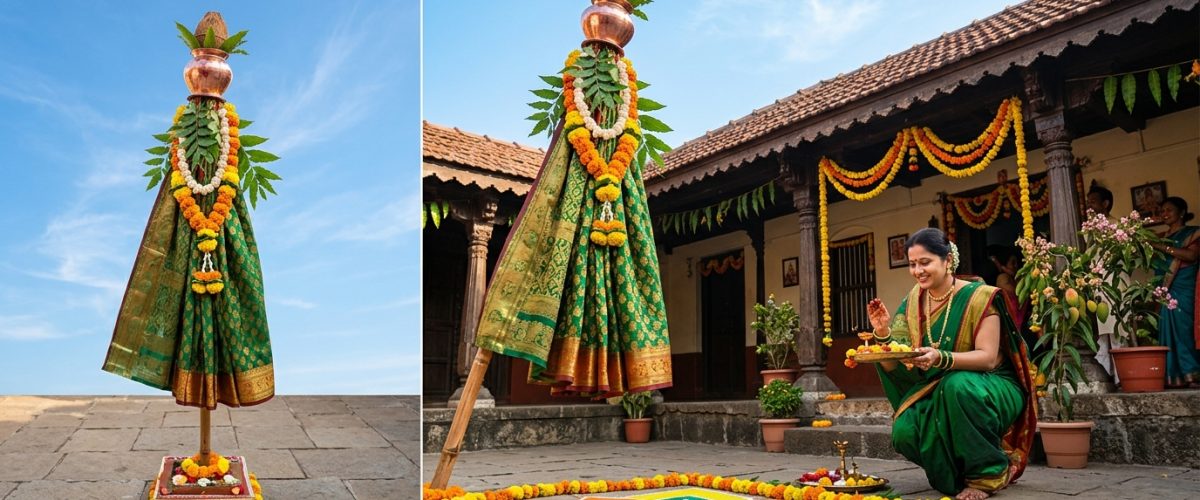
On the same day, Maharashtra celebrates Gudi Padwa with traditions that parallel Ugadi while carrying distinctively Maharashtrian character. The festival’s defining symbol is the Gudi — a bright cloth tied to a bamboo stick, topped with a brass or copper vessel and decorated with neem leaves, mango leaves, and a garland of flowers — erected at the entrance of homes as a symbol of victory, prosperity, and auspicious beginnings.
The Gudi’s visual presence transforms Maharashtrian streetscapes on Padwa morning. Rows of these festive poles projecting from balconies and windows create a distinctive urban aesthetic that has become one of the most photographed images of Indian festival culture. The tradition, which some scholars connect to ancient victory celebrations, carries a contemporary resonance as a public declaration of optimism and community identity.
Gudi Padwa 2026 celebrations include elaborate rangoli (decorative floor art), the preparation of Puran Poli (a sweet stuffed flatbread that is the festival’s signature dish), and cultural programmes that celebrate Marathi identity through music, theatre, and dance. In Mumbai and Pune, the festival has acquired additional dimensions — organised community processions, cultural festivals, and public celebrations that transform the cities’ streets into stages for collective expression.
Connected Celebrations Across India
The March new year cluster extends beyond Ugadi and Gudi Padwa. Sindhis celebrate Cheti Chand, marking the birth anniversary of their patron deity Jhulelal. Manipuris observe Sajibu Cheiraoba with traditional feasting and sports. The Kashmiri Pandit community marks Navreh with rituals that connect to their unique cultural heritage. In parts of Rajasthan and other northern states, the day is observed as Thapna, marking the commencement of Chaitra Navratri — nine nights dedicated to goddess Durga that culminate in Ram Navami.
This simultaneity of celebrations across India’s geography and cultural groups illustrates a fascinating aspect of Indian civilisation: the shared astronomical and calendrical framework that connects diverse communities through a common temporal rhythm, even as each community expresses the moment through its own distinctive rituals, foods, and cultural forms. The same celestial event — the new moon of Chaitra — is the occasion for celebrations that are both unified in their cosmic significance and diversified in their cultural expression.
The Festival Economy of March 2026
The cluster of March festivals generates significant economic activity across multiple sectors. The retail industry, already buoyed by Holi spending, experiences sustained demand through the month’s end as consumers purchase new clothing, household items, and gifts for new year celebrations. The food industry benefits from festival-specific demand for sweets, ingredients, and catering services. Real estate and automotive sectors traditionally see an uptick, as purchasing property or vehicles during the auspicious new year period is considered propitious.
Gold and jewellery purchases spike during this period, reflecting the deep cultural association between precious metals and auspicious beginnings. Jewellers report that the Ugadi-Gudi Padwa period is among their strongest sales seasons, rivalling Dhanteras and Diwali. This economic activity creates a virtuous cycle — festival spending supports businesses and employment, which in turn funds further celebration, creating a multiplier effect that makes March one of the most commercially significant months in the Indian calendar.
Tradition Meets Technology
Like all Indian festivals, the spring new year celebrations are evolving under the influence of technology and urbanisation. Video calls connect family members spread across cities and continents for collective celebrations that would have been impossible a generation ago. Food delivery platforms offer festival-special menus featuring traditional dishes, addressing the time constraints of urban professionals who value traditional food but lack the time for elaborate preparation.
Social media has amplified the festivals’ visibility, with users sharing celebration moments, traditional recipes, and cultural explanations that serve both as celebration and education. For younger Indians growing up in urban environments distant from their ancestral regions, social media content about regional festivals provides a connection to cultural roots that might otherwise attenuate across generations. The technology sector’s role in cultural preservation, while perhaps unintended, is significant — as noted in discussions about India’s evolving technology landscape at the AI Summit 2026.
Cultural Preservation and Living Tradition
The continued vitality of Ugadi, Gudi Padwa, and related festivals in 2026 represents a powerful counter-narrative to fears about cultural erosion in an era of globalisation. These celebrations endure not as museum pieces preserved out of obligation but as living traditions that evolve while maintaining their essential character. The specific dishes, rituals, and customs may be adapted to urban lifestyles and contemporary sensibilities, but the core functions — marking time, affirming community, expressing hope, connecting generations — remain as relevant as they have ever been.
Cultural organisations, recognising the festivals’ importance as carriers of regional identity, have invested in documentation and education programmes that ensure traditional knowledge is transmitted to younger generations. Academic institutions study these festivals as windows into India’s cultural history, social structures, and philosophical traditions. Artists and creatives draw on festival aesthetics and symbolism in contemporary work, maintaining the living dialogue between tradition and innovation that characterises Indian culture at its best — a dialogue visible across domains from Bollywood’s narrative evolution to the contemporary art scene’s engagement with heritage.
A Season of Beginnings
As March 2026 draws to a close, the constellation of new year festivals leaves India in a state of renewed energy and intention. The collective act of marking a new beginning — regardless of the specific cultural form it takes — creates a psychological reset that is both personally meaningful and socially cohesive. In a country of 1.4 billion people speaking dozens of languages and practising multiple faiths, the shared experience of welcoming a new year — each in their own way, yet all at the same time — represents one of Indian civilisation’s most beautiful and enduring achievements: unity expressed through diversity, tradition alive in the present, and hope renewed with each turning of the year.

- Mamaearth, boAt, and Noise: How India’s D2C Champions Are Chasing Profitability in 2026 - March 24, 2026
- India’s D2C Brands Bet Big on Offline Expansion as Quick Commerce Reshapes the Playbook - March 24, 2026
- Himalayan Trekking in 2026: Top Routes and New Trails for Adventure Seekers in India - March 24, 2026