How a Fake ‘War Lockdown’ PDF Went Viral on WhatsApp and Exposed India’s Misinformation Challenge

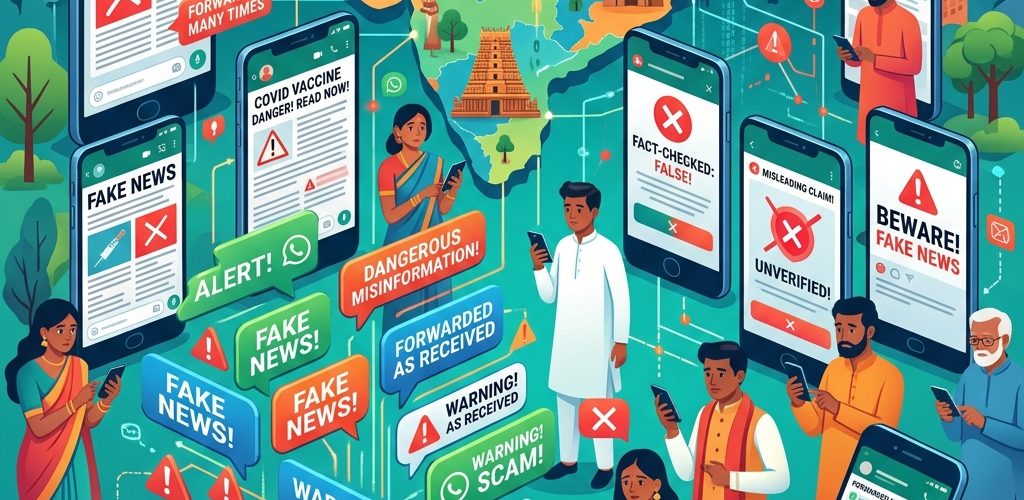
On 1 April 2026, a fabricated document titled “War Lockdown Notice” spread rapidly across WhatsApp and Telegram groups in India, claiming that the government was imposing a nationwide lockdown similar to the 2020 Covid-19 restrictions due to the ongoing Iran-linked conflict in West Asia. The hoax, which reached millions before being debunked, exposed the persistent vulnerability of India’s digital information ecosystem to coordinated misinformation campaigns.
The PDF, formatted to resemble an official government circular, claimed that all commercial activity would be suspended, borders closed and movement restricted across the country. It exploited the genuine anxiety that many Indians felt about the West Asia crisis, which has disrupted oil supply chains and pushed Brent crude prices above $100 per barrel. The timing — April Fools’ Day — initially made some recipients uncertain whether the document was a prank or a genuine warning.
Why the Hoax Spread So Fast
The speed at which the “war lockdown” message spread illustrates several characteristics of India’s misinformation landscape. The phrase “Lockdown in India 2026” surged on Google Trends after Prime Minister Narendra Modi’s recent address in Parliament, where he compared the West Asia crisis to the challenges posed by the Covid-19 pandemic and urged citizens to “stay prepared and united.” Some people misinterpreted his “Team India” language as hinting at another lockdown, and that misunderstanding was packaged into the viral hoax.
The document circulated primarily through family WhatsApp groups and neighbourhood Telegram channels — the same networks that had been used to share genuine Covid lockdown information in 2020. For families that still carried the trauma of that experience, the message triggered immediate panic. Reports emerged of people rushing to stock provisions, withdrawing cash and postponing travel plans before fact-checkers could intervene.
India has approximately 467 million active social media users, and WhatsApp remains the primary messaging platform with over 500 million users. The platform’s end-to-end encryption, while essential for privacy, makes it difficult to trace or contain viral misinformation once it begins spreading through forwarded messages.
The Government Response
The government moved quickly to debunk the hoax. Union Minister Hardeep Singh Puri clarified that the government was “focused on protecting energy security and economic stability, not on shutting down the country.” The Press Information Bureau’s fact-checking unit flagged the document as fabricated, and multiple state police departments issued social media advisories warning citizens against forwarding unverified messages.
Prime Minister Modi had chaired a high-level meeting with Chief Ministers and Lieutenant Governors to discuss India’s response to the West Asia crisis, but none of the discussions involved domestic lockdown measures. The RBI’s decision to hold rates steady and the government’s focus on energy diversification were the actual policy responses to the geopolitical situation.
India’s Misinformation Problem in Context
The “war lockdown” hoax is part of a broader pattern. India has experienced repeated waves of digital misinformation targeting religious, political and health-related topics. During the 2024 general elections, fact-checking organisations flagged thousands of false claims circulating on social media. The political landscape remains fertile ground for misinformation, particularly as West Bengal prepares for assembly elections in the coming weeks.
A 2025 study by the Internet and Mobile Association of India found that only 38 per cent of Indian internet users could correctly identify a fabricated news story when presented with both real and fake headlines. Rural users performed worse than urban users, and older age groups were significantly more susceptible to forwarded messages presented as breaking news.
The challenge is compounded by India’s linguistic diversity. Misinformation circulates in Hindi, Tamil, Bengali, Telugu and dozens of other languages, making it impossible for any single fact-checking organisation to monitor all channels. Regional-language misinformation often receives less attention from national media and technology platforms despite reaching millions of users.
What Can Be Done
Experts recommend a multi-layered approach. First, digital literacy education needs to be integrated into school curricula and community programmes, particularly in Tier 2 and Tier 3 cities where smartphone adoption is outpacing media literacy. Second, technology platforms need to invest more in regional-language fact-checking partnerships and reduce the friction of reporting false content.
WhatsApp has implemented forwarding limits and labels for frequently forwarded messages, but these measures have shown only modest effectiveness. Telegram’s larger group sizes and weaker content moderation tools make it an even more challenging platform to address.
Third, the government’s own communication infrastructure needs strengthening. When legitimate crises emerge — whether the Hormuz crisis or the food safety crackdowns — official information needs to reach citizens faster than rumours do. The PIB fact-check unit has improved its response time, but the gap between misinformation spread and official debunking often remains measured in hours, during which significant damage is done.
As India navigates a period of genuine geopolitical uncertainty, the ability of its citizens to distinguish fact from fabrication is not merely a media literacy issue. It is a matter of national resilience. The “war lockdown” hoax, while ultimately a prank amplified by fear, demonstrated how quickly social trust can be weaponised in the age of encrypted messaging and algorithmic distribution.
Lessons for the Months Ahead
With Bengal assembly elections approaching and the West Asia crisis showing no signs of resolution, the conditions that fuel misinformation will persist through the coming months. Political campaigns, economic anxiety and geopolitical tension each provide raw material for false narratives. Building a population that instinctively verifies before forwarding requires sustained investment in education, technology and institutional credibility. The cost of failing to do so, measured in panic, economic disruption and eroded public trust, grows with every viral hoax that reaches millions before the truth can catch up.

- Heatstroke Prevention and Summer Wellness: What Every Indian Needs to Know as Temperatures Soar in 2026 - April 12, 2026
- How a Fake ‘War Lockdown’ PDF Went Viral on WhatsApp and Exposed India’s Misinformation Challenge - April 12, 2026
- Masala Dosa Bites and the 500-Year-Old Samosa: India’s Hottest Food Trends This Week - April 11, 2026