Valve’s Steam Machine 2026 Announcement Excites Indian PC Gaming Community

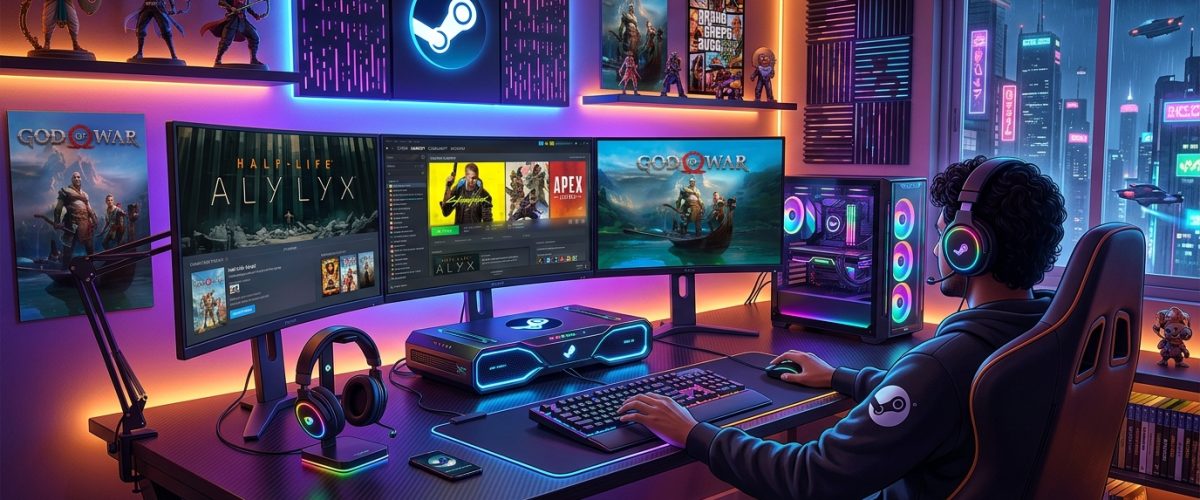
Valve Corporation’s surprise announcement that the Steam Machine is returning in 2026—rebuilt from the ground up with custom hardware and a refined SteamOS—has sent ripples through the global PC gaming community, and Indian gamers are paying particularly close attention. The original Steam Machine, launched in 2015, was widely regarded as a commercial failure that attempted to bridge the gap between PC and console gaming but fell short on execution. A decade later, Valve is trying again, armed with the lessons of the wildly successful Steam Deck and a fundamentally different market landscape.
What Valve Has Revealed
In a presentation at the Game Developers Conference (GDC) in March 2026, Valve president Gabe Newell confirmed that the new Steam Machine will be a compact, living-room-friendly device designed to run SteamOS—the company’s Linux-based operating system—with support for the full Steam library of over 80,000 games. Unlike the original Steam Machine, which relied on third-party manufacturers with inconsistent hardware specifications, the 2026 version will be a first-party Valve product with standardised hardware.
Specifications remain under wraps, but industry analysts expect the device to feature a custom AMD APU (likely based on the RDNA 4 architecture), 16-32 GB of unified memory, and a 1 TB NVMe SSD. Performance is expected to target 1080p/60fps gaming for AAA titles, with DLSS-equivalent upscaling through AMD’s FidelityFX Super Resolution to enable 4K output on compatible displays.
Also read: IPL 2026 Season Preview: Key Transfers, Injuries, and Franchise Strategies
Also read: AI Summit 2026: India Showcases Ambitions but Structural Gaps Exposed
Pricing: The Make-or-Break Factor for India
Valve has not announced pricing, but GDC attendees who spoke on background suggested a target range of $299-$399 for the base model. For India, this translates to approximately ₹25,000-₹33,500 before import duties and taxes. With GST and import levies, the Indian retail price could land between ₹32,000 and ₹42,000—squarely in the range of current-generation consoles.
This pricing would be significant for the Indian market because it undercuts the cost of building an equivalent gaming PC. A desktop capable of matching the expected Steam Machine performance typically costs ₹55,000-₹70,000 in India, when accounting for CPU, GPU, RAM, storage, and peripherals. If Valve can deliver comparable gaming performance in a compact, plug-and-play form factor at 40-50 per cent of the cost, it could attract a sizable segment of Indian gamers who aspire to PC gaming but find the hardware costs prohibitive.
The Steam Deck Effect
Valve’s confidence in revisiting the Steam Machine concept is directly linked to the Steam Deck’s success. The handheld PC, launched in 2022, has sold over 10 million units globally and demonstrated that a Valve-branded hardware product with tight software integration can succeed commercially. In India, the Steam Deck has developed a cult following despite never being officially launched in the country—grey market imports sell for ₹45,000-₹65,000, and dedicated Indian communities on Reddit and Discord regularly share compatibility guides and setup tips.
The Steam Deck’s success also validated SteamOS as a viable gaming platform. Proton, Valve’s compatibility layer that allows Windows games to run on Linux, now supports over 90 per cent of the top 1,000 Steam titles, effectively eliminating the software compatibility issues that plagued the original Steam Machine. For Indian gamers, who are among the most active Steam users in Asia, this means the Steam Machine should work with the vast majority of games they already own.
India’s PC Gaming Ecosystem
India has approximately 150 million PC gamers, though the majority play on modest hardware—integrated graphics laptops and older desktops that can run games like Valorant, CS2, and Dota 2 but struggle with AAA titles. The Steam Machine could serve as an upgrade path for these gamers, offering a significant performance leap without the complexity and cost of building or upgrading a gaming PC.
The device also aligns with a growing trend in India toward living-room gaming. As Indian households increasingly adopt large-screen smart TVs, the idea of a compact device that connects to a TV and runs Steam games has obvious appeal. This use case was premature in 2015 when the original Steam Machine launched, but in 2026—with 65-inch 4K TVs available for under ₹40,000 in India—the living-room PC gaming proposition is far more viable.
Competition and Challenges
Valve will face stiff competition in the Indian market. The PS5 Digital Edition (₹39,990), Xbox Series S (₹29,990), and the upcoming Nintendo Switch 2 all target the same price-conscious consumer. Additionally, cloud gaming services from Jio and Xbox are offering console-quality gaming without any hardware investment at all. For the Steam Machine to succeed in India, it will need to offer a compelling advantage over these alternatives—namely, access to Steam’s enormous library, frequent sales and discounts, and the flexibility of a PC-class operating system.
Distribution will also be critical. Valve has no direct retail presence in India and will need to partner with established electronics retailers like Croma, Reliance Digital, and Amazon India to ensure availability and after-sales support. The original Steam Machine’s failure in India was partly attributable to its complete absence from Indian retail channels, a mistake Valve cannot afford to repeat.
The Steam Machine 2026 represents Valve’s most significant hardware bet since the Steam Deck. For India’s 150 million PC gamers—many of whom are underserved by current hardware options—it could be the gateway to high-quality PC gaming that the market has been waiting for.

- India’s Fantasy Sports Market Marches Toward ₹50,000 Crore Valuation as Regulation Brings Clarity - March 24, 2026
- Dream11 and IPL 2026: Fantasy Cricket Platforms Reinvent Fan Engagement With AI-Powered Features - March 24, 2026
- India’s GPU Market Accelerates in 2026 as Affordable Graphics Cards Finally Reach Mainstream Buyers - March 24, 2026