India Allocates 2.2 Billion Dollars for Carbon Capture as Budget 2026 Ramps Up Climate and Renewable Push

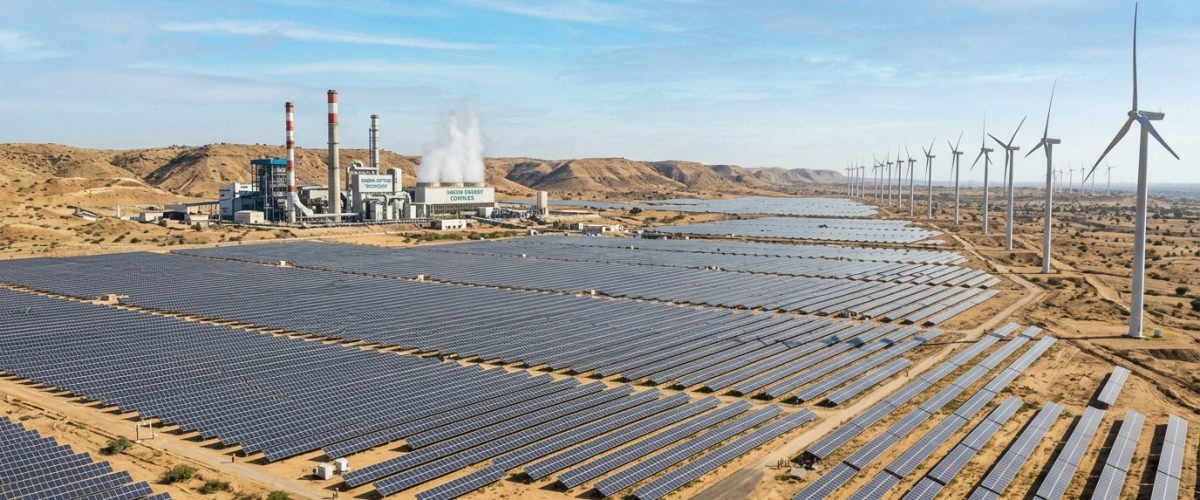
India’s Union Budget 2026-27 allocated $2.2 billion over five years for carbon capture, utilisation and storage technologies, marking the government’s most significant climate-focused investment to date. The announcement, made by Finance Minister Nirmala Sitharaman on 1 February, signals a strategic pivot towards large-scale decarbonisation alongside continued support for renewable energy and critical mineral development.
Carbon Capture Gets Landmark Funding
The $2.2 billion CCUS allocation is designed to support pilot projects across India’s heavy industrial sectors, including steel, cement and petrochemicals. These industries account for nearly 30 per cent of India’s total carbon emissions and have limited alternatives for deep decarbonisation without capture technologies.
The funding will be distributed through a competitive grant mechanism, with preference given to projects that demonstrate commercial viability within five years. NITI Aayog will oversee implementation in coordination with the Ministry of Environment, Forest and Climate Change.
Critical Minerals and Rare Earth Corridors
The budget also established “critical mineral corridors” to boost domestic mining and processing of lithium, cobalt and rare earth elements essential for electric vehicles, batteries and renewable energy infrastructure. India currently imports over 90 per cent of its critical mineral requirements, a dependency the government aims to reduce to 50 per cent by 2030.
Import duty exemptions on nuclear power equipment were another notable inclusion. India plans to triple its nuclear energy capacity to 22 GW by 2035, complementing its renewable energy targets. The budget supports both established nuclear technology and next-generation small modular reactors.
Renewable Energy Push Continues
Rooftop solar received dedicated support through expanded subsidies under the PM Surya Ghar scheme. The programme has already enrolled 10 million households since its 2024 launch and targets 30 million rooftop installations by 2027. India’s total installed renewable capacity crossed 200 GW in March 2026, with solar contributing over 100 GW.
The environmental policy landscape in India is evolving rapidly. Green hydrogen production, which received a separate Rs 19,744 crore allocation under the National Green Hydrogen Mission, is attracting significant private investment from Reliance Industries, Adani Green and NTPC.
Heatwave Concerns Underscore Climate Urgency
The budget’s climate investments arrive against a backdrop of intensifying extreme weather. IMD has warned of extended heatwave conditions across 15 states from April to June 2026, with above-normal temperatures expected to affect agriculture, public health and energy demand.
Delhi-NCR continues to face severe air quality challenges. The live AQI at IIT Delhi’s monitoring station recorded readings in the “Severe” and “Very Poor” categories through January 2026, with biomass burning contributing over 60 per cent of PM2.5 pollution. Urban transport and industrial emissions remain significant secondary sources.
What Is Missing
Climate adaptation measures were notably absent from the 2026 budget, a gap flagged by environmental organisations. Unlike previous years, there was no dedicated allocation for flood resilience, drought management or coastal protection. Carbon Brief’s analysis noted this omission could leave vulnerable communities exposed as extreme weather events intensify.
India’s climate strategy now sits at a crossroads. The government is betting heavily on mitigation technologies like CCUS and renewables, while the broader scientific community calls for a balanced approach that addresses both the causes and consequences of climate change.

- From Matka King to Toaster: India’s April 2026 OTT Lineup Stacks Up as One of the Year’s Strongest - April 12, 2026
- IPL 2026: Shreyas Iyer’s 33-Ball 69 Powers Punjab Kings to 6-Wicket Win Over Sunrisers Hyderabad - April 11, 2026
- ISRO Maps Out Its Busiest Year Yet With Gaganyaan G1 and Over 10 Missions Planned for 2026 - April 11, 2026