Gaganyaan’s Critical Year: Inside ISRO’s Uncrewed Test Flight That Will Decide India’s Human Spaceflight Future

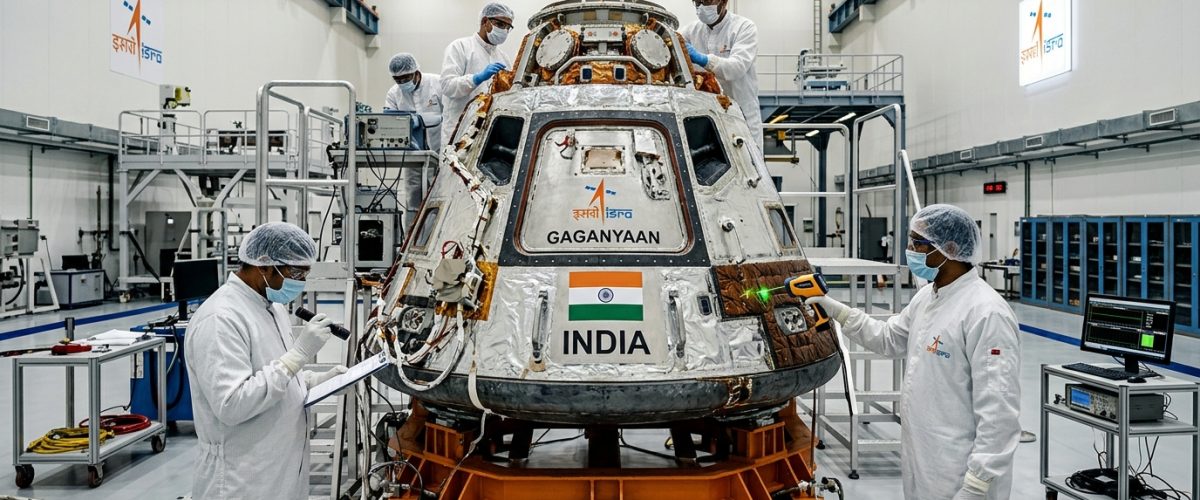
In the sprawling integration facility at Sriharikota’s Satish Dhawan Space Centre, a spacecraft that represents the culmination of over a decade of engineering ambition is taking its final form. The Gaganyaan orbital vehicle—India’s first human-rated spacecraft—is being prepared for its definitive uncrewed test flight, a mission that will validate every system required to safely carry Indian astronauts to orbit and bring them home. The year 2026 represents the most critical phase in the Gaganyaan programme’s history, with the success or failure of this test flight determining the timeline for India’s entry into an exclusive club of nations capable of independent human spaceflight.
The Stakes of the Uncrewed Mission
The upcoming uncrewed orbital test flight—designated G1 in ISRO’s mission nomenclature—is not merely a technology demonstration but a comprehensive end-to-end validation of India’s human spaceflight capability. The mission will test the complete Gaganyaan stack: the human-rated LVM3 launch vehicle, the crew module and service module in orbital configuration, the life support environmental control system, the thermal protection system for atmospheric re-entry, the parachute deployment sequence, and the splashdown recovery operations in the Bay of Bengal.
Unlike previous Gaganyaan test flights, which validated individual subsystems in isolation—crew escape demonstrations, parachute drop tests, and abort scenarios—the G1 mission will integrate all these elements into a single, fully representative mission profile. The crew module will carry a humanoid robot instrumented to measure the physiological stresses that future astronauts will experience, along with biological experiments that will assess the effects of microgravity and radiation on living organisms during the orbital phase.
The mission’s success criteria are stringent. Every system must perform within specified parameters, with particular attention to the crew module’s thermal protection system during re-entry—when temperatures on the spacecraft’s heat shield will exceed 1,600 degrees Celsius—and the parachute sequence that must decelerate the module from hypersonic speeds to a gentle splashdown velocity. Any anomaly in these critical systems would necessitate design modifications that could delay the crewed mission by years.
Engineering the Human-Rated LVM3
The launch vehicle for Gaganyaan is a human-rated variant of ISRO’s LVM3 (formerly GSLV Mark III), India’s most powerful operational rocket. Human-rating a launch vehicle is an extraordinarily demanding process that goes far beyond the reliability standards required for satellite launches. Every component, every subsystem, every interface must meet failure probability thresholds orders of magnitude more stringent than those applied to conventional missions.
ISRO’s approach to human-rating the LVM3 has involved extensive modifications to the vehicle’s guidance and control systems, propulsion subsystems, and structural elements. Redundant avionics—multiple independent computers cross-checking each other’s calculations in real-time—ensure that no single point of failure can compromise crew safety. The crew escape system, successfully tested in a dramatic pad abort demonstration, can extract the crew module from atop the launch vehicle within milliseconds if a catastrophic anomaly is detected during launch.
The solid propellant S200 strap-on boosters, liquid-fuelled L110 core stage, and cryogenic upper stage have each undergone qualification testing programmes that subject hardware to conditions more extreme than any expected during actual flight. This test-as-you-fly philosophy, adopted from international human spaceflight best practices, provides confidence that the vehicle will perform within its design envelope under all anticipated conditions. As ISRO’s ambitious 2026 mission calendar details, ISRO is simultaneously managing multiple missions in 2026, making the Gaganyaan timeline all the more remarkable in the context of the agency’s broader operational tempo.
Life Support: Engineering a Habitable Space
Creating a habitable environment within the Gaganyaan crew module—a pressurised volume of approximately 8 cubic metres that must sustain up to three astronauts for the mission’s duration—represents one of the programme’s most complex engineering challenges. The Environmental Control and Life Support System (ECLSS) must maintain atmospheric pressure, oxygen concentration, carbon dioxide removal, temperature, and humidity within narrow physiological ranges while operating in the vacuum and thermal extremes of space.
ISRO’s ECLSS design incorporates both consumable and regenerative systems. Oxygen is supplied from high-pressure storage tanks, while lithium hydroxide canisters absorb exhaled carbon dioxide. Thermal management relies on an active fluid loop system that transfers heat from the crew module’s interior to external radiator panels, maintaining a comfortable temperature despite the extreme thermal cycling between sunlight and shadow that occurs every 90 minutes in low Earth orbit.
The G1 uncrewed mission will be the first end-to-end test of the ECLSS in actual space conditions. While ground-based vacuum chamber testing has validated the system’s performance in simulated environments, the transition to genuine orbital conditions—with their unique combination of microgravity, radiation, and thermal factors—always introduces variables that cannot be perfectly replicated on the ground.
Recovery Operations: The Final Challenge
The mission’s conclusion—the re-entry, parachute deployment, and splashdown recovery of the crew module—may be its most challenging phase. Re-entry subjects the spacecraft to extreme heating, with the ablative heat shield experiencing temperatures that would melt most materials. The heat shield’s thermal protection system, developed by ISRO’s Vikram Sarabhai Space Centre, must protect the crew module’s interior while ablating in a controlled manner that dissipates re-entry energy safely.
Following re-entry, a complex parachute deployment sequence must decelerate the crew module from supersonic speeds to a splashdown velocity safe for human occupants. The sequence involves drogue parachutes to stabilise the module’s attitude and reduce initial velocity, followed by main parachutes that provide the final deceleration. The parachute system has been extensively tested through high-altitude drop tests and balloon-deployed demonstrations, but the G1 mission will be the first test following an actual orbital re-entry profile.
The Indian Navy has been closely involved in developing the splashdown recovery capability, with specialised vessels and diving teams trained to locate and recover the crew module in the Bay of Bengal. Recovery operations have been rehearsed repeatedly, with full-scale crew module mockups deployed in open ocean conditions to validate the operational procedures and equipment.
India’s Astronaut Corps: Ready and Waiting
While the G1 mission flies without human occupants, the Indian astronauts who will eventually ride the Gaganyaan spacecraft to orbit have been training for years. Selected from the Indian Air Force’s test pilot cadre and trained at multiple facilities including Russia’s Gagarin Cosmonaut Training Centre, India’s astronaut candidates have completed extensive programmes covering orbital mechanics, spacecraft systems operation, emergency procedures, and the physiological preparation required for spaceflight.
The astronaut training programme has also included mission simulation exercises at ISRO’s Mission Control Centre in Bengaluru, where the astronauts have practiced nominal and contingency mission profiles in full-fidelity simulators. This training infrastructure, much of it developed from scratch for the Gaganyaan programme, represents a national capability that will serve India’s human spaceflight ambitions for decades to come. The investment in human capital for space parallels India’s broader capacity-building efforts in advanced technology sectors, from the AI workforce development discussed at India’s AI Summit 2026 and the structural gaps it exposed to the expanding space science education through ISRO’s START programme.
Strategic Significance Beyond Prestige
India’s pursuit of human spaceflight capability is frequently characterised as a national prestige project, but this framing understates its strategic significance. Human spaceflight capability is increasingly recognised as a gateway technology that enables capabilities across a spectrum of space activities. The life support, spacecraft design, and mission operations expertise developed through Gaganyaan will directly support India’s ambitions for a national space station—announced as the Bharatiya Antariksh Station (BAS)—and participation in international lunar and deep space exploration programmes.
The programme has also catalysed India’s space industry in ways that extend well beyond ISRO. Over 500 Indian companies, including startups and established aerospace firms, have contributed to Gaganyaan’s development, creating an industrial base of human-rated space systems capability that has applications in both civil and defence sectors. This industrial ecosystem—from precision component manufacturers to software systems integrators—represents a durable strategic asset for India’s technology economy. As the NISAR Earth observation mission demonstrates, India’s space partnerships with nations including the United States are already yielding advanced technology capabilities that enhance both scientific understanding and strategic positioning.
As the G1 mission approaches its launch window, the anticipation within India’s scientific community and beyond is palpable. The outcome of this single mission will determine whether India’s human spaceflight dream advances toward realisation or faces the kind of programme delay that has historically afflicted ambitious space endeavours worldwide. For a nation that has consistently defied expectations in space—from Mangalyaan’s first-attempt Mars success to Chandrayaan-3’s lunar south pole landing—the weight of history provides reason for measured optimism.

- ISRO and AIIMS Sign Landmark MoU for Space Medicine Research Ahead of Gaganyaan Mission - March 25, 2026
- Rising Temperatures Reshape Wildlife Behaviour Across India as Scientists Sound Climate Alarm - March 25, 2026
- UPI Crosses 800 Million Daily Transactions as CRED Gets Payment Aggregator Licence From RBI - March 25, 2026