ISRO SpaDeX Mission: India Joins Elite Club of Nations With Satellite Docking Capability


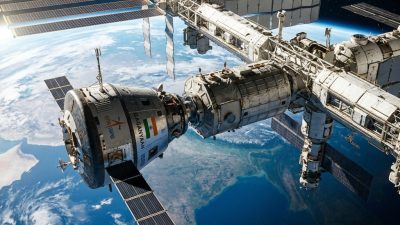
On a momentous day in early 2025, two small Indian satellites, designated SDX01 (the Chaser) and SDX02 (the Target), approached each other in low-Earth orbit with a precision that would have been unthinkable a decade ago. When they successfully locked together — a manoeuvre known as satellite docking — India became only the fourth nation in history, after the United States, Russia, and China, to independently demonstrate this critical space technology. The Space Docking Experiment, or SpaDeX, was not merely a technical triumph; it was a strategic leap that opens the door to India’s most ambitious space programmes.
Understanding the Significance of Space Docking
Space docking, at its core, is the process of bringing two independently orbiting spacecraft together and physically connecting them. While the concept sounds straightforward, the execution demands extraordinary precision. Two objects travelling at approximately 28,000 kilometres per hour must be manoeuvred into alignment with tolerances measured in centimetres. The slightest miscalculation could result in a collision that destroys both spacecraft, generating dangerous orbital debris.
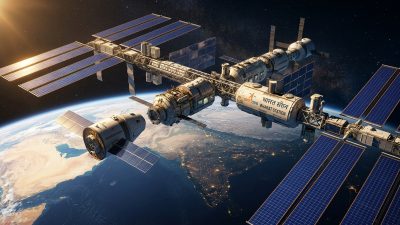
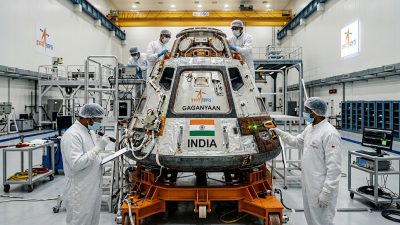
This technology is foundational to modern space exploration. Without docking capability, it is impossible to construct space stations, conduct crew transfers between spacecraft, refuel satellites in orbit, or assemble large structures in space. Every major spacefaring nation has had to master this skill before progressing to more complex missions. For ISRO, SpaDeX was the gateway technology that makes its entire future roadmap — from the Gaganyaan human spaceflight programme to the Bharatiya Antariksh Station — technically viable.
The Mission Architecture
SpaDeX was launched aboard ISRO’s workhorse PSLV-C60 rocket from the Satish Dhawan Space Centre in Sriharikota. The mission profile was deliberately designed to be incremental and cautious — a hallmark of ISRO’s approach to high-risk technologies. The two spacecraft, each weighing approximately 220 kilograms, were initially deployed into the same orbit at a safe separation distance.
Over the following days, ground controllers at the ISRO Telemetry, Tracking and Command Network (ISTRAC) in Bengaluru executed a series of phasing manoeuvres to gradually bring the satellites closer together. The process involved multiple hold points — predetermined distances at which the approach was paused, systems were verified, and go/no-go decisions were made. This methodical approach, borrowed from international best practices established during the Gemini and Apollo programmes, ensured that risk was managed at every stage.
The docking mechanism itself was an indigenous design, developed by ISRO’s Vikram Sarabhai Space Centre (VSSC) in Thiruvananthapuram. Unlike the larger International Docking Adapters used on the International Space Station, ISRO’s mechanism was miniaturised for small satellite applications, featuring an active “probe” on the Chaser and a passive “drogue” on the Target. The successful latching confirmed that the mechanism could handle the structural loads and maintain a secure connection in the microgravity environment.
Overcoming Technical Challenges
The path to successful docking was not without obstacles. During one approach sequence in January 2025, controllers noticed that the drift rate between the two satellites was higher than expected following a manoeuvre during a period when the satellites were out of ground station visibility. The docking attempt was postponed while engineers analysed the data and recalibrated the approach parameters. This cautious response, while it added days to the mission timeline, exemplified the risk-averse culture that has served ISRO well.
Another challenge was the reliance on relative navigation sensors — the cameras and LIDAR systems that allow one satellite to determine the position and orientation of the other without ground intervention. These sensors, many of which were developed in-house by ISRO, had to function accurately in the harsh radiation and thermal environment of space. The successful validation of these sensors has significant implications for India’s future autonomous rendezvous missions, including potential lunar and planetary applications.
Strategic Implications for India’s Space Programme
The successful demonstration of docking technology unlocks several critical capabilities for ISRO. First and foremost, it is a prerequisite for the construction of the Bharatiya Antariksh Station (BAS), India’s proposed space station. Unlike the International Space Station, which was assembled from large modules launched on heavy-lift rockets, India’s approach may involve launching smaller modules on existing launch vehicles and assembling them in orbit — a strategy that is only possible with reliable docking technology.
Second, docking capability enables in-orbit servicing and satellite life extension. As the space around Earth becomes increasingly congested with communication, navigation, and Earth observation satellites, the ability to service, refuel, or reposition ageing spacecraft has enormous commercial potential. India’s growing private space sector — already home to over 200 registered space startups — stands to benefit significantly from this capability.
Third, SpaDeX positions India for participation in international deep-space exploration missions. The Artemis Accords and bilateral agreements with space agencies including NASA, ESA, and JAXA increasingly emphasise cooperative missions that require docking and crew transfer capabilities. India’s demonstration of this technology strengthens its negotiating position and opens doors to partnerships that were previously inaccessible.
The Role of India’s Private Space Sector
While SpaDeX was primarily an ISRO mission, it benefited from contributions from India’s burgeoning private space ecosystem. Several startups provided components, software, and testing services that helped accelerate the development timeline. This collaboration reflects a broader trend in Indian space policy, catalysed by the establishment of the Indian National Space Promotion and Authorization Centre (IN-SPACe) in 2020, which has progressively opened the sector to private participation.
The success of SpaDeX has also energised discussions about commercial applications of docking technology. Companies are exploring concepts ranging from orbital debris removal — using chaser spacecraft to capture and de-orbit defunct satellites — to in-orbit manufacturing, where materials are processed in microgravity and returned to Earth. These applications, while still in early stages, represent potentially large markets in which India could establish a competitive position. India’s push into deep tech, including artificial intelligence and semiconductor manufacturing, creates natural synergies with advanced space technology development.
International Reactions and Context
The international space community responded positively to SpaDeX’s success. NASA Administrator praised India’s methodical approach, while the European Space Agency highlighted the potential for future cooperation. China’s CNSA, which demonstrated autonomous docking with its Tiangong space station programme, notably refrained from comment — a silence interpreted by analysts as recognition of India’s emergence as a genuine peer competitor in space technology.
For the broader Global South, India’s achievement carries particular symbolism. It demonstrates that advanced space capabilities are not the exclusive preserve of wealthy nations. ISRO’s famously frugal approach — the entire SpaDeX mission cost a fraction of comparable Western programmes — provides a model for other developing nations seeking to build their own space capabilities.
What Comes Next
With SpaDeX in the rear-view mirror, ISRO’s attention has shifted to applying the technology operationally. The next major test will come during the Gaganyaan programme, where docking capability may be demonstrated in a more complex mission profile. Further ahead, the agency is studying concepts for a robotic lunar sample return mission that would involve rendezvous and docking in lunar orbit — a capability that only China has demonstrated with its Chang’e-5 mission.
SpaDeX may have been a modest mission by the standards of its spacecraft size and budget, but its implications are anything but small. India has mastered a technology that serves as the connective tissue of modern space exploration. In doing so, it has not just joined an elite club — it has secured its ticket to the next era of humanity’s ventures beyond Earth.

- New Heavy Particle Discovered at CERN in 2026: What It Means for the Future of Physics - March 24, 2026
- Gaganyaan 2026: India’s Human Spaceflight Programme Enters Its Most Critical Phase - March 24, 2026
- India’s Semiconductor and AI Surge: How Research Labs Are Powering a Global Transformation - March 24, 2026