New Heavy Particle Discovered at CERN in 2026: What It Means for the Future of Physics

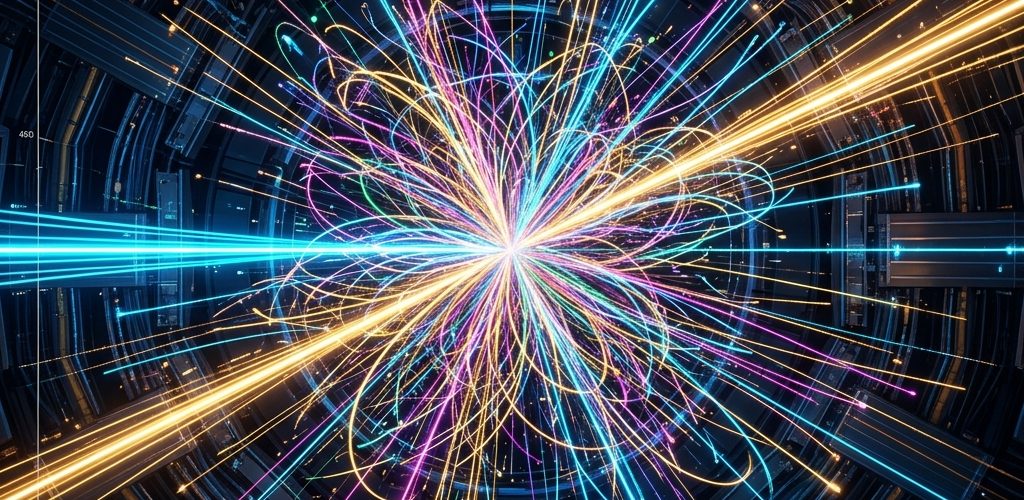
In March 2026, the physics community was electrified by an announcement from CERN, the European Organization for Nuclear Research: the Large Hadron Collider (LHC) had detected evidence of a new heavy particle — one that does not fit neatly into the Standard Model of particle physics. While the results are preliminary and require further verification, the discovery has the potential to open an entirely new chapter in our understanding of the fundamental forces governing the universe. For India, which has been a significant contributor to CERN’s research programmes, the implications are particularly profound.
What Was Discovered
The detection occurred during Run 3 of the LHC, which began in 2022 and has been operating at an unprecedented collision energy of 13.6 trillion electron volts (TeV). Physicists analysing data from the CMS (Compact Muon Solenoid) detector identified a statistical excess — a bump in the data — at an energy level of approximately 2.9 TeV. This excess, if confirmed, would indicate the existence of a particle with a mass roughly 3,000 times that of a proton.
The significance of this finding lies in what it is not. The Standard Model, developed over the second half of the 20th century and spectacularly confirmed by the discovery of the Higgs boson in 2012, accounts for 17 fundamental particles and three of the four known forces. It is one of the most successful theories in the history of science, yet physicists have long known it is incomplete. It does not explain dark matter, dark energy, the hierarchy problem (why gravity is so much weaker than other forces), or the matter-antimatter asymmetry of the universe.
A new heavy particle at 2.9 TeV could be evidence of physics beyond the Standard Model — specifically, it could be a manifestation of supersymmetry (SUSY), composite Higgs models, or extra spatial dimensions. Each of these theoretical frameworks predicts new particles at TeV-scale energies, and the CERN detection is the first potential experimental evidence in this range since the Higgs boson.
India’s Role at CERN
India has been an Associate Member of CERN since 2017, formalising a relationship that stretches back decades. Indian physicists and engineers have made substantial contributions to both the CMS and ALICE (A Large Ion Collider Experiment) detectors. The Tata Institute of Fundamental Research (TIFR) in Mumbai, the Institute of Mathematical Sciences (IMSc) in Chennai, and several IITs have had researchers embedded in CERN’s experimental and theoretical teams for years.
India’s contributions have been both intellectual and material. Indian industries manufactured precision components for the LHC’s detector systems, while Indian theorists have been at the forefront of developing the mathematical frameworks used to interpret collision data. Professor Rohini Godbole of the Indian Institute of Science (IISc) Bengaluru, one of India’s most distinguished particle physicists, has noted that Indian contributions to CERN represent one of the country’s most significant — yet least publicised — scientific achievements.
The current discovery is being analysed with significant input from Indian institutions. Teams at TIFR and IIT Bombay are working on the statistical analysis of the CMS data, applying sophisticated machine learning techniques to separate the potential signal from background noise. This work connects directly to India’s growing capabilities in artificial intelligence, where advanced algorithms are increasingly being applied to fundamental research problems.
The Theoretical Landscape
To understand what the new particle might be, it is necessary to appreciate the theoretical landscape that has been waiting — some would say impatiently — for experimental guidance. Since the discovery of the Higgs boson, particle physics has been in what some describe as a “desert” — a barren stretch of energy scales where no new particles have appeared, despite the Standard Model’s known deficiencies.
Supersymmetry (SUSY) remains the most popular extension of the Standard Model. It proposes that every known particle has a heavier “superpartner” — for example, the electron has a “selectron” and the quark has a “squark.” SUSY elegantly solves the hierarchy problem, provides a natural dark matter candidate (the lightest superpartner, or neutralino), and is required by string theory. However, the simplest versions of SUSY predicted superpartners at energy levels that the LHC has already explored without finding them, forcing theorists to consider more complex scenarios.
Composite Higgs models offer an alternative explanation. In these theories, the Higgs boson is not a fundamental particle but a composite object made of more fundamental constituents — analogous to how protons are made of quarks. A heavy particle at 2.9 TeV could be one of these constituents or a resonance associated with the binding force that holds the Higgs together.
Extra dimensions represent a third possibility. Some theories propose that gravity appears weak in our observable three dimensions of space because it “leaks” into additional dimensions that we cannot directly perceive. Particles at TeV energies could be Kaluza-Klein excitations — manifestations of known particles vibrating in these extra dimensions.
The Path to Confirmation
The physics community is exercising appropriate caution. The current statistical significance of the excess is approximately 3.5 sigma — well above random fluctuation but below the 5-sigma threshold that physicists require to claim a discovery. The history of particle physics includes several false alarms where promising signals evaporated with more data — most notably, the 750 GeV diphoton excess observed in 2015-16, which generated hundreds of theoretical papers before being confirmed as a statistical fluctuation.
To reach the 5-sigma level, the LHC will need to accumulate significantly more data. Run 3 is scheduled to continue through 2026, and the High-Luminosity LHC (HL-LHC) upgrade, expected to begin operations around 2029, will increase the collision rate by a factor of five to ten. If the signal is real, the HL-LHC should not only confirm it but also provide detailed measurements of the new particle’s properties — its spin, charge, and decay channels — that would allow physicists to determine which theoretical framework it supports.
Implications for India’s Physics Community
If confirmed, the discovery would have significant implications for India’s physics research ecosystem. The country’s National Quantum Mission, which is investing heavily in quantum computing and sensing technologies, intersects with fundamental physics in important ways. Quantum computers could eventually simulate particle physics processes that are intractable on classical machines, and India’s investment in this area positions it well to contribute to the theoretical analysis of new physics.
The discovery also reinforces the case for India’s proposed contribution to next-generation collider projects. The Future Circular Collider (FCC), a proposed 91-kilometre circumference machine that would succeed the LHC, has attracted expressions of interest from CERN member and associate member states. India’s participation in such a project would require significant financial commitment but would cement the country’s position at the frontier of fundamental research.
Indian universities have also seen a surge in student interest in particle physics, with applications to doctoral programmes in high-energy physics increasing markedly following the SpaDeX mission’s success and India’s raised profile at CERN. This enthusiasm, if channelled through adequate funding and infrastructure, could produce a generation of Indian physicists capable of leading the next era of discoveries.
A Moment of Scientific Promise
The potential discovery of a new heavy particle at CERN arrives at a moment when physics — and indeed science as a whole — needs a breakthrough. The Standard Model’s extraordinary success has been, paradoxically, a source of frustration, because it resists modification despite known gaps. A confirmed new particle would break the logjam, providing experimental evidence to guide theoretical development in ways that have been absent for over a decade.
For India, the moment is also one of opportunity. The country’s investments in fundamental research — from CERN participation to the India-based Neutrino Observatory (INO) project — are beginning to yield returns in the form of both scientific output and human capital development. As the LHC continues to gather data through 2026, Indian physicists will be among those scrutinising every collision event, searching for the signal that could reshape our understanding of the universe.

- New Heavy Particle Discovered at CERN in 2026: What It Means for the Future of Physics - March 24, 2026
- Gaganyaan 2026: India’s Human Spaceflight Programme Enters Its Most Critical Phase - March 24, 2026
- India’s Semiconductor and AI Surge: How Research Labs Are Powering a Global Transformation - March 24, 2026