India’s Semiconductor and AI Surge: How Research Labs Are Powering a Global Transformation

At the World Economic Forum in Davos in January 2026, a KPMG report made a declaration that would have seemed extraordinary a decade ago: India’s emergence as a pivotal force in semiconductors and artificial intelligence is powering a global economic transformation. The statement, while bold, is supported by a convergence of government policy, private investment, academic research, and demographic advantage that positions India uniquely in the global deep tech landscape. As of March 2026, the country’s semiconductor and AI programmes have moved from ambition to execution — though significant challenges remain on the path to true self-reliance.
The Semiconductor Story: From Design to Fabrication
India’s semiconductor journey began, paradoxically, not with chips but with chip designers. For decades, Indian engineers at companies including Intel, Qualcomm, Texas Instruments, and ARM designed processors and systems-on-chip (SoCs) that powered devices worldwide — but all fabrication occurred overseas, primarily in Taiwan, South Korea, and the United States. India was a semiconductor design powerhouse with zero manufacturing capability.
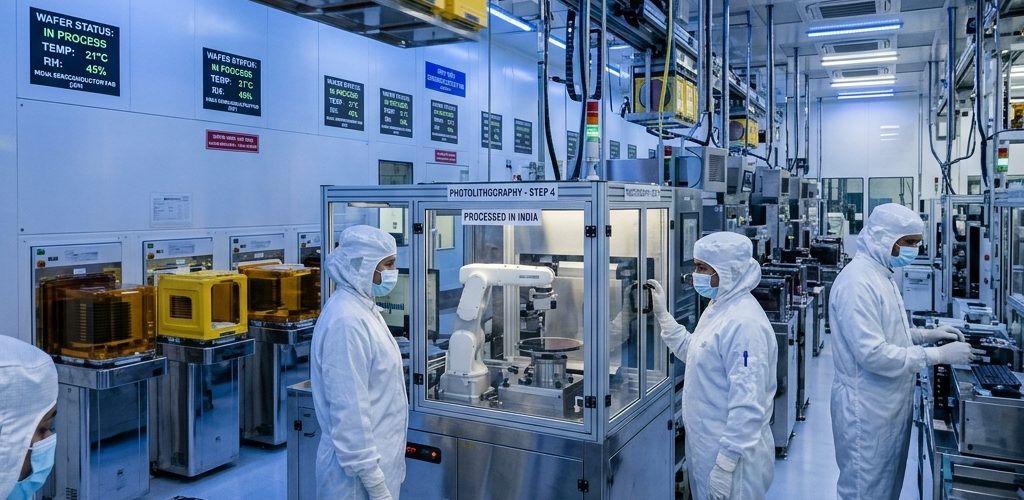
The India Semiconductor Mission (ISM), launched in 2021 with an initial outlay of ₹76,000 crore ($10 billion), aims to change this fundamentally. By 2026, the mission has catalysed several major investments. The Tata Electronics facility in Dholera, Gujarat — a joint venture with Taiwan’s Powerchip Semiconductor Manufacturing Corporation (PSMC) — is under construction and targeting initial production of 28-nanometre chips by late 2026. CG Power’s OSAT (Outsourced Semiconductor Assembly and Test) facility in Sanand, Gujarat, is nearing commissioning. Micron Technology’s $2.75 billion assembly and test plant in the same region is operational, marking the first time a major international chipmaker has established manufacturing in India.
These investments, while transformative, address the trailing edge of semiconductor manufacturing. The global cutting edge — production at 3-nanometre and below — remains concentrated in Taiwan (TSMC) and South Korea (Samsung). India’s current strategy, explicitly focused on mature-node production (28nm and above), is pragmatic rather than revolutionary: these nodes serve the vast majority of chips used in automobiles, industrial equipment, IoT devices, and defence systems, where state-of-the-art miniaturisation is less important than reliability and cost.
The AI Ecosystem: Scale and Speed
India’s AI development is occurring on a different but complementary trajectory. While semiconductor manufacturing requires massive capital investment and multi-year construction timelines, AI development leverages India’s existing strengths in software engineering, data science, and a young, tech-savvy population. The results have been remarkable in both scale and speed.
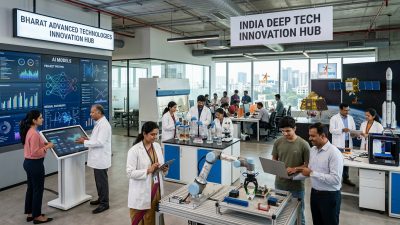
The government’s IndiaAI Mission, announced in 2024 with a budget of ₹10,372 crore, focuses on building AI compute infrastructure, developing indigenous large language models, and deploying AI applications across public services. By early 2026, the mission has established AI compute centres with over 10,000 GPUs across multiple locations, created datasets in 22 scheduled languages for training Indian-language AI models, and launched pilot projects in healthcare diagnostics, agricultural advisory services, and judicial document processing.
India’s private sector AI ecosystem has exploded in parallel. Over 3,000 AI startups now operate in the country, spanning applications from healthcare and finance to agriculture and education. Companies like Krutrim, founded by Ola’s Bhavish Aggarwal, have raised significant funding for developing India-focused AI models, while established IT services companies — TCS, Infosys, Wipro — have reoriented their offerings around AI consulting, implementation, and managed services. The recent AI Summit 2026 showcased these ambitions while also exposing the structural gaps that India must address.
The Research Engine
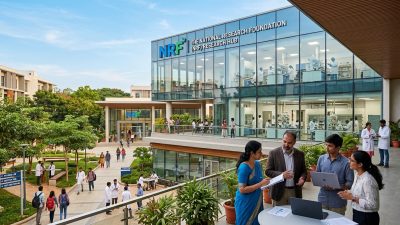
Underpinning both the semiconductor and AI efforts is a research base that is quietly but significantly strengthening. India produced approximately 14,000 AI-related research papers in 2025, placing it third globally behind only the United States and China. The quality of this output, measured by citations and impact, has improved notably, with several Indian papers appearing in top-tier venues including NeurIPS, ICML, and Nature Machine Intelligence.
Key research contributions in 2026 include IIT Delhi’s work on energy-efficient transformer architectures that reduce the computational cost of large language model inference by up to 40 per cent — a development with significant implications for deploying AI on edge devices in resource-constrained environments. IISc Bengaluru’s Centre for Brain Research has produced groundbreaking work on neuromorphic computing — computing systems inspired by the structure of the human brain — that could eventually replace conventional GPUs for certain AI workloads.
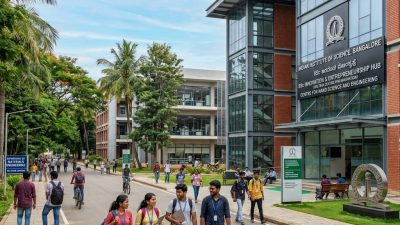
In semiconductors, the Indian Institute of Technology Bombay’s Centre of Excellence in Nanoelectronics has demonstrated fabrication capabilities that support India’s ambition to move beyond mere assembly into chip design and prototyping. The broader surge in university-led research is creating a pipeline of trained researchers and engineers that the semiconductor and AI industries urgently need.
The Talent Equation
India’s most significant competitive advantage in the semiconductor and AI race is its talent base. The country produces over 1.5 million engineering graduates annually, and its software development workforce exceeds 5 million — the largest in the world. However, the conversion of this raw talent into semiconductor-specific and AI-specific expertise requires significant investment in specialised education and training.
The ISM includes provisions for training 85,000 semiconductor professionals over five years through partnerships between industry and academia. IIT campuses have launched dedicated semiconductor programmes, and companies like Intel and Applied Materials have established training centres at Indian universities. In AI, the explosion of online learning platforms, corporate training programmes, and government-funded skilling initiatives has created a pipeline that, while imperfect, is producing AI practitioners at scale.
The challenge, however, is retention. India’s top AI and semiconductor talent is heavily recruited by companies in the United States, Singapore, and Europe, where salaries are multiples of Indian levels and research facilities are more advanced. Creating conditions that encourage the best and brightest to stay — through competitive compensation, world-class research environments, and a vibrant startup ecosystem — is essential for sustaining India’s momentum.
Geopolitical Dimensions
India’s semiconductor and AI surge occurs against a backdrop of intensifying geopolitical competition. The US-China technology rivalry has created both opportunities and risks for India. On the opportunity side, Western nations seeking to diversify their semiconductor supply chains away from East Asia see India as a natural partner. The CHIPS Act incentives in the US, combined with India’s ISM, create complementary frameworks for investment. India’s membership in the Quad and the Indo-Pacific Economic Framework provides additional diplomatic channels for technology cooperation.
On the risk side, India must navigate export control regimes, intellectual property concerns, and the possibility of technology denial if geopolitical dynamics shift. Building indigenous capabilities — in both semiconductor manufacturing and AI model development — is thus not just an economic goal but a strategic imperative. The National Quantum Mission’s investments in quantum computing represent another dimension of this technology sovereignty strategy, recognising that quantum technologies will eventually intersect with both semiconductor design and AI capabilities.
Challenges and Bottlenecks
Despite the momentum, India’s semiconductor and AI programmes face substantial challenges. Semiconductor fabrication requires reliable electricity, ultra-pure water, and chemical supply chains that India’s infrastructure does not yet consistently provide. The construction timelines for fabrication facilities typically extend to 3-5 years, meaning that investments made today will not yield production capacity until 2028-2030. The global semiconductor market is also cyclical, and there is a risk that facilities commissioned during a demand surge may face overcapacity when the cycle turns.
In AI, the challenges are more subtle but equally significant. India’s data infrastructure — the availability of high-quality, labelled datasets in Indian languages and domains — remains insufficient. AI model development requires not just compute power but also data that reflects the diversity and complexity of Indian society. Privacy regulations, particularly the Digital Personal Data Protection Act of 2023, create necessary constraints that must be navigated carefully.
A Defining Decade
The 2020s are shaping up to be the defining decade for India’s deep tech ambitions. The semiconductor and AI investments made today will determine whether India emerges as a self-reliant technology producer or remains dependent on foreign supply chains. The research engine is firing, the policy framework is in place, and the capital is flowing. The remaining variable is execution — the ability to translate plans into functioning factories, research papers into commercial products, and talent into a sustainable workforce. The KPMG assessment at Davos may have been aspirational, but the foundation it describes is real. What India builds on that foundation in the next five years will shape the global technology landscape for decades to come.

- New Heavy Particle Discovered at CERN in 2026: What It Means for the Future of Physics - March 24, 2026
- Gaganyaan 2026: India’s Human Spaceflight Programme Enters Its Most Critical Phase - March 24, 2026
- India’s Semiconductor and AI Surge: How Research Labs Are Powering a Global Transformation - March 24, 2026