India Targets Record Medal Haul at 2026 Asian Games as Neeraj Chopra Returns and New Sprint Stars Emerge

India’s athletics programme is gearing up for what could be its most successful Asian Games campaign in history as the 2026 edition in Nagoya, Japan approaches. With Olympic champion Neeraj Chopra confirming his return from a nagging adductor injury and a fresh wave of sprinting talent emerging from Sports Authority of India training centres, the Athletics Federation of India has set a target of 12 medals — doubling the haul from the 2022 Hangzhou Games.
The optimism is grounded in data. India’s track and field athletes have set 14 national records across various disciplines in the past 18 months, a frequency unprecedented in the country’s athletics history. As AFI setting high standards for India’s Asian Games athletics squad has shown, the federation is implementing world-class standards in athlete selection and preparation. The transformation extends across sprints, middle distance, throws and combined events.
Neeraj Chopra’s Comeback: From Surgery to Nagoya
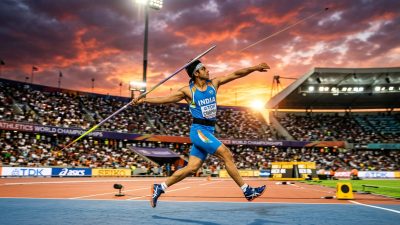
The centrepiece of India’s Asian Games athletics hopes remains Neeraj Chopra, whose javelin gold at the Tokyo 2020 Olympics transformed the sport’s profile in India overnight. After struggling with an adductor muscle injury that limited his 2025 season to just three competitions, Chopra underwent a minor surgical procedure in December 2025 at a sports medicine clinic in Munich.
His rehabilitation has been carefully managed by coach Klaus Bartonietz and biomechanics specialist Dr. Bartonietz. Training camp reports from Potchefstroom, South Africa, indicate that Chopra has been throwing consistently in the 87-to-89-metre range during practice sessions — distances that would be competitive at any global championship. As Neeraj Chopra’s comeback trail to the Diamond League and World Championships has detailed, Chopra’s return is the most closely watched storyline in Indian sport this year.
Chopra’s rivals in Asia are formidable. Pakistan’s Arshad Nadeem, who threw a world record 92.97 metres at the Paris 2024 Olympics, is the clear favourite. But Chopra’s technical precision and big-event temperament give him a legitimate shot at the podium. Indian athletics fans also hope that the rivalry will produce historically significant throws in Nagoya.
India’s Sprint Revolution: New Stars Break Through
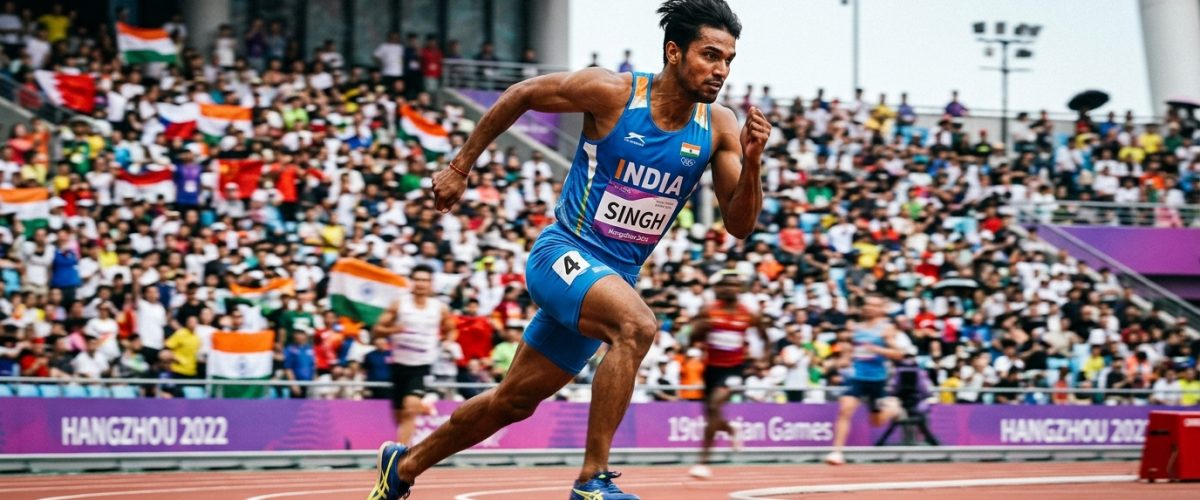
While Chopra dominates headlines, the real story of Indian athletics in 2026 may be the emergence of a genuine sprint culture. For decades, India was considered a non-factor in sprinting events. That narrative is changing rapidly.
In the India sports news and coverage, the story of Animesh Kujur has captivated followers. The 22-year-old from Jharkhand clocked 10.14 seconds in the 100 metres at the Indian Grand Prix in February 2026, the fastest time by an Indian sprinter in three years. His training partner, Amlan Borgohain from Assam, holds the national record at 10.25 seconds and is expected to compete in the 200 metres at Nagoya.
The women’s sprints have seen similar progress. Dutee Chand’s long-standing 100-metre national record of 11.17 seconds was broken by 20-year-old Priya Mohan, who clocked 11.12 seconds at the Federation Cup in March 2026. Mohan, who also runs the 200 and 400 metres, represents the kind of versatile talent that can contribute across relay events.
The 4x400m Relay: India’s Best Medal Prospect
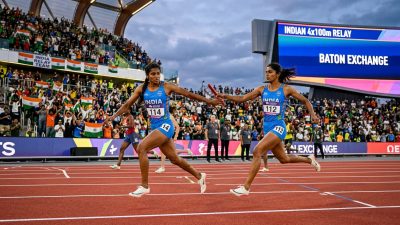
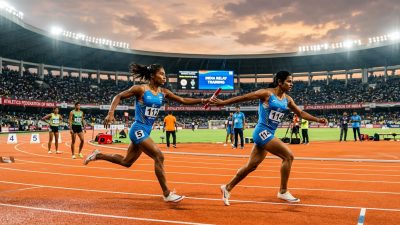
India’s strongest medal prospect in Nagoya may well be the mixed 4×400-metre relay, a relatively new event that plays to the country’s traditional strength in quarter-mile running. The Indian quartet of Rajesh Ramesh, Aishwarya Mishra, Amoj Jacob and Subha Venkatesan set a national record of 3:12.43 at the World Relays in Bahamas in April 2026.
Coach Galina Bukharina, a former Soviet Union sprinter who has coached Indian relay teams since 2019, describes the current squad as the most talented she has worked with. The baton exchange drills that plagued India at previous global events have been refined through hundreds of hours of practice, and the team now executes transitions that rival the best Asian squads.
The men’s 4×400-metre relay remains India’s flagship event. The team won gold at the 2018 Asian Games in Jakarta and is determined to defend that title. Muhammad Anas Yahiya, who has anchored the team for the past seven years, is expected to run his final major championship in Nagoya, adding emotional motivation to competitive ambition.
Field Events: Beyond Javelin
India’s medal prospects extend well beyond the javelin. Shot putter Tajinderpal Singh Toor, who set the Asian record of 21.49 metres at the 2021 Indian Grand Prix, has been training in Turkey and is throwing consistently above 20.50 metres. High jumper Tejaswin Shankar, who became the first Indian man to clear 2.29 metres in 2022, is targeting a 2.32-metre jump that would put him among Asia’s best.
Long jumper Murali Sreeshankar, who achieved a personal best of 8.36 metres before an ACL injury in 2023, is back in training and has jumped 8.10 metres in practice. His return adds depth to an Indian throws and jumps squad that already includes discus thrower Kamalpreet Kaur and triple jumper Abdulla Aboobacker.
The depth across field events mirrors India hockey’s surge fuelled by Olympic medal success, where institutional investment following Olympic success has created a pipeline of competitive athletes across multiple disciplines. Similarly, India’s badminton success story at BWF events has shown how sustained government and federation support can accelerate medal production in individual sports.
Infrastructure and Funding: The SAI Transformation
Behind the medal targets lies a significant infrastructure upgrade. The Sports Authority of India has invested Rs 400 crore in athletics-specific training facilities at its centres in Patiala, Bengaluru, Bhopal and Bhubaneswar since 2023. The Patiala centre now features a World Athletics-certified synthetic track, an indoor throwing cage and a high-altitude simulation chamber.
Funding for individual athletes has also improved. Under the Target Olympic Podium Scheme, top-tier Indian track and field athletes receive a monthly stipend of Rs 50,000 alongside fully funded overseas training stints and competition participation. Neeraj Chopra’s training budget alone is estimated at Rs 3 crore annually, covering coaching staff, travel, equipment and medical support.
As the Nagoya Asian Games approach in September 2026, India’s athletics team carries the weight of extraordinary expectations. The transformation from a one-medal-per-Games nation to a genuine multi-event contender has been years in the making. Whether Chopra defends his continental title and whether the sprinters deliver on their promise will determine whether Indian athletics has truly arrived at the top table of Asian sport.

- Indian Wrestling Rebuilds Under New WFI Leadership as Young Grapplers Eye 2026 Asian Games and 2028 Olympics Glory - March 29, 2026
- India Targets Record Medal Haul at 2026 Asian Games as Neeraj Chopra Returns and New Sprint Stars Emerge - March 29, 2026
- Pro Kabaddi League Season 12 Breaks Viewership Records as International Expansion Picks Up Pace in 2026 - March 28, 2026