Indian Startup Funding Drops 26 Per Cent to 2.3 Billion Dollars in Q1 2026 as Late-Stage Deals Dry Up and Seed Investments Surge

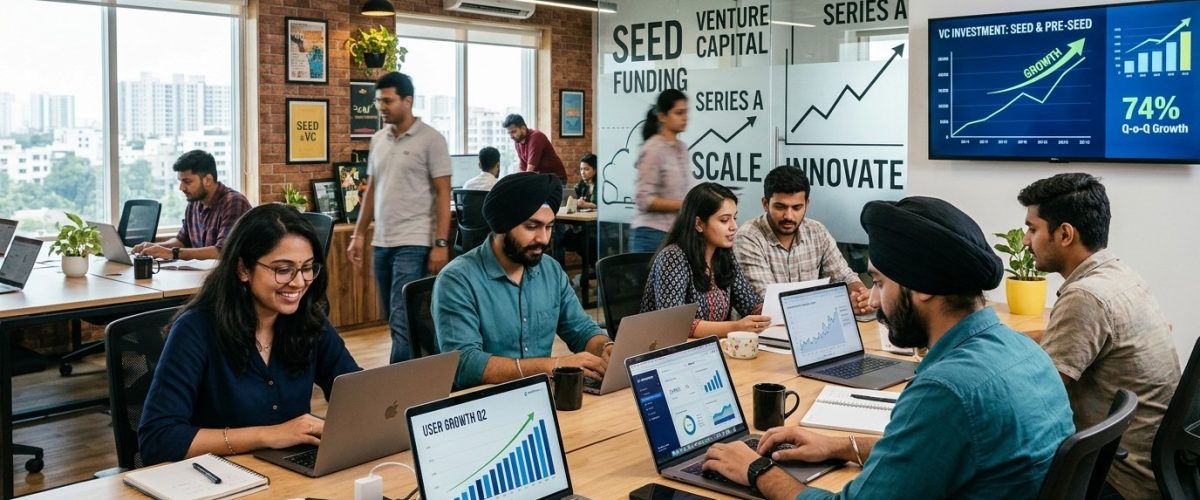
Indian startups raised 2.3 billion dollars in the first quarter of 2026, a 26 per cent decline from the 3.1 billion dollars secured in Q1 2025, as the funding environment continued to reflect investor caution around late-stage valuations and an absence of mega deals above 100 million dollars, according to Inc42’s Indian Tech Startup Funding Report for Q1 2026. The quarter marked a notable divergence: while late-stage capital contracted sharply, seed-stage funding surged 58 per cent year-on-year to 248 million dollars, signalling strong investor appetite for early-stage opportunities in emerging sectors.
The slowdown challenges the narrative of a full-blown funding recovery that had gained traction after a relatively stronger Q4 2025. However, the data also reveals a more disciplined and sustainable investment landscape, with the median deal size rising 17 per cent YoY to 3.3 million dollars — suggesting that investors are deploying capital more selectively rather than retreating entirely.
Where the Money Went
Growth-stage funding emerged as the largest contributor at 1.1 billion dollars, up 10 per cent YoY, indicating that investors are doubling down on relatively mature startups with proven unit economics and clear paths to profitability. Companies like India’s leading unicorns in quick commerce, healthtech, and fintech attracted the bulk of growth-stage capital.
Late-stage funding, in contrast, stood at 782 million dollars — a steep 56 per cent decline from Q1 2025. The absence of any deal above 100 million dollars was a sharp departure from previous quarters, where such transactions often drove overall volumes. Analysts attribute this to a global tightening of growth equity markets and Indian startups’ reluctance to accept down-rounds after the valuation excesses of 2021 to 2022.
Ecommerce emerged as the most-funded sector, attracting 536 million dollars across multiple deals. This reaffirms investor confidence in consumption-driven digital businesses despite broader market volatility. Fintech remained the second-most active sector, though deal sizes moderated compared to 2025’s first quarter.
Seed-Stage Surge Signals Future Pipeline
The 58 per cent YoY surge in seed-stage funding to 248 million dollars is perhaps the most telling data point from Q1 2026. It indicates that institutional investors and angel networks remain bullish on India’s entrepreneurial pipeline, even as they exercise caution at later stages.
Key sectors attracting seed capital include climate tech, defence technology, semiconductor design, and AI infrastructure — areas that align with government policy priorities and global demand shifts. This echoes a broader pattern observed in India’s startup ecosystem, where women founders and first-time entrepreneurs are increasingly securing early-stage backing.
Notable seed and pre-seed deals during Q1 2026 included Flo Mobility (2.5 million dollars for EV and robotics), Coulomb Litech (2.2 million dollars in energy storage), and Mojro Technologies (3 million dollars for logistics AI). The breadth of sectors receiving seed capital suggests the next wave of Indian unicorns may emerge from hardware, deep-tech, and sustainability rather than the consumer internet playbook that dominated the 2015 to 2022 era.
The Elephant in the Room: No Mega Deals
Q1 2026’s most conspicuous absence was the lack of any deal exceeding 100 million dollars. In previous quarters, a single mega-round — such as PhonePe’s 100 million dollar raise or Zepto’s 250 million dollar round — could significantly skew total funding figures. Without such outliers, the headline number appears more muted than the underlying health of the ecosystem might suggest.
Venture capital firms note that several large deals are in advanced negotiations but have slipped into Q2 due to extended due diligence and valuation discussions. If these close in the current quarter, the first-half 2026 numbers could look substantially more positive. The Indian startup landscape as a whole remains resilient despite the headline funding decline.
What Q1 2026 Tells Us About the Year Ahead
The funding data points to an ecosystem that is maturing rather than declining. The combination of rising median deal sizes, surging seed activity, and steady growth-stage investment suggests a “quality over quantity” shift that many industry observers have long called for.
India’s startup ecosystem added an estimated 1,400 new startups in Q1 2026, according to DPIIT data, maintaining the country’s position as the world’s third-largest startup hub. However, the path to profitability — not just growth — has become the dominant narrative, with investors increasingly demanding clear timelines for cash-flow positivity before writing cheques.
The performance of EV startups like Euler Motors and others in the climate-tech space suggests that sector-specific opportunities remain robust, even within a broader funding slowdown. For founders, the Q1 data reinforces that while capital is available, the bar for securing it has risen — a dynamic that could ultimately produce stronger, more sustainable businesses.
Source: Inc42

- Indian Startup Funding Drops 26 Per Cent to 2.3 Billion Dollars in Q1 2026 as Late-Stage Deals Dry Up and Seed Investments Surge - April 4, 2026
- India’s Fine Dining Revolution Reaches Tier 2 Cities as 12 Indian Restaurants Enter Asia’s 50 Best List in 2026 - March 29, 2026
- India’s Millet Recipe Revolution Reaches Peak as Government Push Meets Social Media Creativity in 2026 - March 28, 2026