Jio and Airtel Pull Ahead: How 5G Adoption and Broadband Expansion Are Reshaping India’s Telecom Duopoly

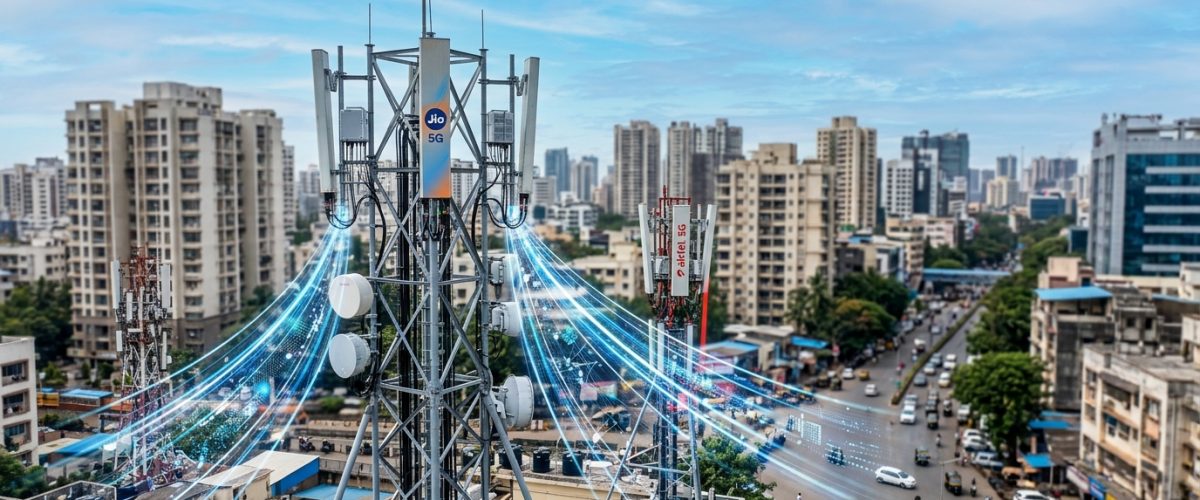
India’s telecommunications landscape has never been more sharply divided. As the country enters the second quarter of 2026, the dominance of Reliance Jio and Bharti Airtel has hardened into what industry analysts increasingly describe as a structural duopoly — with the two giants commanding a combined market share exceeding 75 per cent of subscribers and over 85 per cent of industry revenue. The engine driving this consolidation is the aggressive rollout of 5G networks and the parallel expansion into fixed broadband, where both companies are betting billions on capturing India’s next wave of digital connectivity.
For India’s 1.2 billion mobile subscribers, this competitive dynamic is delivering faster networks, improving coverage, and gradually declining data costs. But for the industry’s remaining players — particularly the beleaguered Vodafone Idea (Vi) and the state-owned BSNL — the relentless advance of Jio and Airtel is creating an existential squeeze that raises fundamental questions about market diversity and competitive balance in a sector critical to India’s digital future.
5G Adoption: The Numbers Tell the Story
India’s 5G journey, which began with the commercial launch in October 2022, has reached a critical mass that is fundamentally altering consumption patterns and revenue trajectories. As of March 2026, India has approximately 350 million 5G subscribers — making it the world’s second-largest 5G market after China. Jio leads with approximately 200 million 5G users, while Airtel claims roughly 140 million, reflecting their respective investments in spectrum and infrastructure.
The adoption curve has exceeded even the most optimistic industry projections. Average data consumption per 5G user has crossed 30 GB per month, compared to approximately 18 GB for 4G users — a 67 per cent increase that is driving both network utilisation and revenue growth. More importantly, 5G users demonstrate significantly higher average revenue per user (ARPU), with Jio reporting a 5G ARPU of approximately ₹220 compared to ₹155 for its overall subscriber base.
Both operators have invested heavily in 5G infrastructure, with Jio deploying its standalone 5G network across all 22 telecom circles using a mix of sub-6 GHz and millimetre wave spectrum. Airtel, which adopted a non-standalone architecture that leverages existing 4G infrastructure, has achieved 5G coverage in over 5,000 cities and towns. The speed and scale of India’s 5G deployment is remarkable by global standards, particularly given the country’s geographic diversity and the complexity of building network infrastructure across dense urban, suburban, and rural environments.
The Broadband Battle: From Mobile-Only to Connected Homes
While 5G has captured the headlines, the quiet but strategically significant battle for India’s fixed broadband market may have even greater long-term implications. India’s fixed broadband penetration remains strikingly low at approximately 12 per cent of households — compared to 60-80 per cent in developed nations and 40-50 per cent in China. This massive untapped opportunity has attracted aggressive investment from both Jio and Airtel.
JioFiber, launched as a fibre-to-the-home (FTTH) service, has expanded to cover over 1,800 cities and towns, offering speeds of up to 1 Gbps at price points that have disrupted the traditional broadband market. The service has crossed 15 million subscribers, making Jio the largest fixed broadband provider in India within just five years of launch — a remarkable feat that mirrors the disruptive impact of Jio’s mobile entry in 2016.
Airtel Xstream Fiber, the company’s competing FTTH product, has adopted a quality-first strategy, focusing on reliable high-speed connectivity and bundled entertainment offerings. With approximately 8 million broadband subscribers, Airtel has maintained its position as a strong second player, leveraging its brand reputation for network quality and customer service to attract premium customers willing to pay higher tariffs.
The broadband expansion has been facilitated by the government’s BharatNet programme, which aims to connect all 2.5 lakh gram panchayats with optical fibre. While BharatNet’s execution has faced delays, the backbone infrastructure it has created provides a foundation for last-mile broadband deployments by private operators in semi-urban and rural areas.
Vi’s Survival Battle and Market Diversity Concerns
The flip side of the Jio-Airtel ascendancy is the continuing decline of Vodafone Idea, India’s third-largest private telecom operator. Vi’s subscriber base has been eroding steadily, with the company losing approximately 2-3 million subscribers per month as customers migrate to Jio and Airtel for better network quality and 5G access. The company’s debt burden, which stood at approximately ₹2 lakh crore, has constrained its ability to invest in network upgrades, creating a vicious cycle of deteriorating service quality and accelerating customer churn.
Vi’s predicament raises important regulatory and policy questions. A vibrant telecom market requires at least three competitive players to ensure pricing discipline, service quality, and innovation. The collapse of Vi into a Jio-Airtel duopoly would reduce competitive pressure and could lead to higher prices for consumers — a concern that the Telecom Regulatory Authority of India (TRAI) has acknowledged in its policy discussions.
The government, which holds an approximately 33 per cent equity stake in Vi following the conversion of adjusted gross revenue dues into equity, faces a difficult choice between allowing market forces to take their course and intervening to preserve competitive balance. Any further financial support for Vi would come at a fiscal cost, while inaction risks the effective creation of a private duopoly in a critical infrastructure sector.
BSNL’s 4G Ambitions: Late but Not Lost?
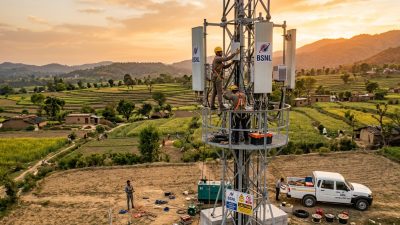
State-owned Bharat Sanchar Nigam Limited is pursuing its own network modernisation programme, having deployed approximately 98,000 4G sites across the country through a TCS-led consortium using indigenous technology. The government is now considering an additional expansion of 22,000 new 4G sites, with BSNL’s CMD Robert Ravi confirming that 4G network expansion will continue into FY2026-27.
BSNL’s deployment is notable for its reliance on Indian-designed technology, with the TCS consortium incorporating equipment from Tejas Networks (now a Tata Group company). This represents a significant achievement in building domestic telecom manufacturing capability and reduces India’s dependence on foreign equipment vendors such as Ericsson, Nokia, and Huawei.
However, BSNL faces a fundamental competitive challenge: by the time its 4G network reaches nationwide coverage, the private operators will have established comprehensive 5G networks, potentially making BSNL’s 4G offering obsolete in the eyes of increasingly demanding consumers. The company’s strategy for eventual 5G deployment — and whether it can leverage indigenous technology for this upgrade — will be critical to its long-term relevance.
Enterprise and Industrial 5G: The Next Revenue Frontier
Beyond consumer connectivity, both Jio and Airtel are aggressively pursuing enterprise 5G opportunities. Private 5G networks for manufacturing plants, logistics hubs, and smart city applications represent a revenue stream that could transform telecom from a consumer utility into an enterprise technology platform.
Jio has launched its 5G private network solution for enterprises, targeting sectors such as manufacturing, healthcare, and education. The company’s partnership with Qualcomm for 5G industrial IoT solutions and its investments in edge computing infrastructure position it to capture a significant share of the enterprise connectivity market.
Airtel has adopted a similar strategy, partnering with global technology firms including Cisco, Nokia, and Tech Mahindra to offer managed 5G enterprise solutions. The company’s Airtel Business division has reported strong growth in enterprise revenue, driven by demand for dedicated connectivity, cloud services, and cybersecurity solutions — services that reflect India’s broader economic transformation, including the growing adoption of AI across Indian industries.
Looking Ahead: Spectrum, Tariffs, and Industry Evolution
The trajectory of India’s telecom sector in the remainder of 2026 will be shaped by several key factors. TRAI’s recommendations on tariff revision, expected in the coming months, could provide a framework for sustainable pricing that balances consumer affordability with operator viability. The upcoming spectrum auctions, particularly for additional 5G bands, will influence competitive dynamics and investment commitments.
For consumers, the outlook is largely positive. Network quality and speeds are improving, coverage is expanding, and the competitive tension between Jio and Airtel ensures continued innovation in products and services. The rapid growth of India’s digital economy — from food delivery to fintech — is both enabled by and dependent on robust telecom infrastructure.
As India’s digital ambitions continue to expand, the telecom sector’s role as the enabler of everything from digital financial transactions to entertainment streaming to industrial automation makes it arguably the most critical infrastructure sector in the country. The Jio-Airtel duopoly, for all its competitive dynamism, carries the responsibility of ensuring that India’s digital future is built on a foundation that is accessible, affordable, and resilient.

- New Heavy Particle Discovered at CERN in 2026: What It Means for the Future of Physics - March 24, 2026
- Gaganyaan 2026: India’s Human Spaceflight Programme Enters Its Most Critical Phase - March 24, 2026
- India’s Semiconductor and AI Surge: How Research Labs Are Powering a Global Transformation - March 24, 2026