Southeast Asia on a Budget: Why Vietnam and Laos Are 2026’s Hottest Picks for Indian Travellers

For Indian travellers seeking international adventure without breaking the bank, 2026 has delivered two standout destinations that are rapidly climbing the popularity charts: Vietnam and Laos. While Thailand, Bali, and Malaysia have long dominated the Southeast Asian itineraries of Indian tourists, these two neighbouring nations on the Indochinese Peninsula are emerging as compelling alternatives — offering extraordinary cultural richness, stunning natural landscapes, world-class cuisine, and costs that make even budget-conscious Indian travellers feel affluent. The combination of improved visa access, new flight connectivity, and a favourable rupee-to-local-currency exchange rate is driving a remarkable surge in Indian arrivals to both countries in 2026.
Vietnam: From Hidden Gem to Mainstream Magnet
Vietnam has been quietly building its reputation among Indian travellers for several years, but 2026 marks its definitive breakout moment. The Vietnamese government’s extension of its e-visa programme — which now allows Indian citizens a 90-day stay with multiple entries — has removed the primary bureaucratic barrier to visitation. Simultaneously, IndiGo’s launch of direct flights from Delhi and Mumbai to Hanoi and Ho Chi Minh City in late 2025, with fares frequently available below Rs 12,000 one way, has slashed travel costs and journey times.
The results are dramatic. The Vietnam National Administration of Tourism reports that Indian arrivals increased by 78 per cent year-on-year in the January-February 2026 period, making India one of the top five source markets for Vietnamese tourism. The growth is concentrated among young professionals, couples, and small friend groups in the 25-40 age bracket — the demographic that values experiential travel, Instagrammable moments, and value for money.
What Makes Vietnam Irresistible
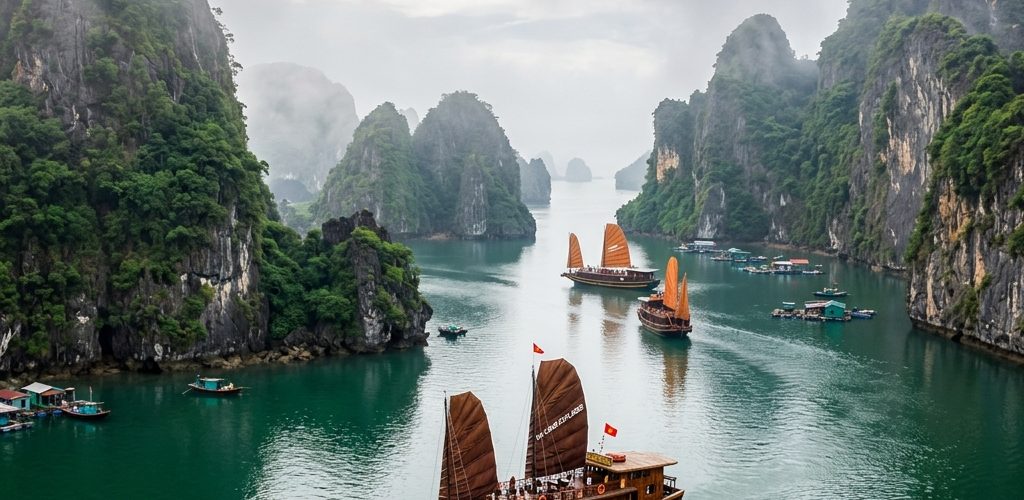
Vietnam’s appeal to Indian travellers rests on several pillars. First, its natural beauty is staggering in its diversity. Ha Long Bay, with its 1,600 limestone karsts rising from emerald waters, offers a landscape unlike anything in the Indian subcontinent. The terraced rice paddies of Sapa in the northern highlands, the lantern-lit ancient town of Hoi An, the vast cave systems of Phong Nha-Ke Bang National Park, and the bustling energy of Ho Chi Minh City’s District 1 provide a range of experiences that reward multi-week itineraries.
Second, Vietnam is extraordinarily affordable. A quality meal at a local restaurant costs between Rs 150 and Rs 400, a comfortable hotel room in a major city averages Rs 2,000-3,500 per night, and internal flights between Hanoi and Ho Chi Minh City can be booked for under Rs 3,000. For Indian travellers accustomed to paying similar or higher prices domestically, Vietnam delivers premium experiences at a fraction of the expected cost.
Third, the cuisine is a revelation. Vietnam’s food culture — built on fresh herbs, rice noodles, grilled meats, and complex broths — resonates strongly with Indian palates. Phở (beef noodle soup), bánh mì (stuffed baguettes), bún chả (grilled pork with noodles), and Vietnamese coffee are experiences that Indian food enthusiasts find deeply satisfying. For those who love exploring food traditions, the parallels with India’s own street food culture going global make the comparison all the more fascinating.
Laos: The Road Less Travelled
If Vietnam is Southeast Asia’s emerging star, Laos is its best-kept secret — and Indian travellers are beginning to discover it. The landlocked nation of seven million people, sandwiched between Vietnam, Thailand, Cambodia, China, and Myanmar, offers a pace of life and a depth of cultural authenticity that has become increasingly rare in the region. In 2026, Laos is attracting Indian visitors who have already ticked off Thailand and Bali and are seeking something more contemplative, less commercialised, and genuinely transformative.
Laos does not yet offer direct flights from India, but the December 2025 completion of the Laos-China Railway — which connects Vientiane to Kunming via Luang Prabang in just six hours — has created an exciting new overland route for adventurous travellers who fly into Bangkok or Hanoi and cross into Laos by rail or bus. The Lao government has introduced a straightforward e-visa for Indian nationals with 30-day validity, further simplifying access.
Luang Prabang: Southeast Asia’s Most Enchanting Town
The centrepiece of any Laos itinerary is Luang Prabang, a UNESCO World Heritage town at the confluence of the Mekong and Khan rivers. The town’s streets are lined with gilded Buddhist temples, French colonial architecture, and a night market that ranks among the finest in Asia. The daily dawn procession of saffron-robed monks collecting alms — the Tak Bat ceremony — is one of Southeast Asia’s most profoundly moving cultural experiences, offering a window into a Buddhist practice that has continued unbroken for centuries.
Beyond Luang Prabang, Laos offers the Kuang Si waterfalls (a cascade of turquoise pools surrounded by jungle), the mysterious Plain of Jars (an archaeological landscape of ancient megalithic vessels), the 4,000 Islands region of the lower Mekong (where Irrawaddy dolphins swim in the river’s quieter reaches), and Vang Vieng (a riverside town that has reinvented itself from backpacker party destination to adventure sports hub with kayaking, rock climbing, and hot-air ballooning).
Budget Breakdown: What India to Vietnam to Laos Actually Costs
For Indian travellers, the financial arithmetic of a Vietnam-Laos trip in 2026 is remarkably favourable. A two-week itinerary covering Hanoi, Ha Long Bay, Hoi An, Ho Chi Minh City, Luang Prabang, and Vang Vieng can be accomplished for approximately Rs 80,000-1,20,000 per person inclusive of international flights, internal transport, accommodation, food, activities, and visa fees. This positions the region as significantly more affordable than comparable trips to Europe, Japan, or even popular Indian domestic circuits during peak season.
Daily budgets in both countries are remarkably low by Indian standards. In Vietnam, a comfortable daily spend covering accommodation, three meals, local transport, and one activity averages Rs 3,000-4,500. In Laos, where costs are even lower, Rs 2,500-3,500 per day provides a comfortable experience. For those opting for homestays, overnight trains, and street food, these figures can be reduced by 30-40 per cent without significant sacrifice in experience quality.
Cultural Connections: India’s Deep Links to Indochina
Indian travellers in Vietnam and Laos often discover unexpected cultural connections. The Cham temples of central Vietnam — particularly the ruins at My Son — reflect centuries of Indian cultural influence, with Hindu iconography and Sanskrit inscriptions that feel startlingly familiar. In Laos, the Ramayana tradition lives on as the Phra Lak Phra Ram, a Lao adaptation of the epic that is depicted in temple murals throughout the country. The Buddhist heritage that pervades both nations creates a spiritual resonance for Indian visitors, making the journey feel less like a foreign adventure and more like a visit to a cultural cousin.
Practical Tips for Indian Travellers
Travellers from India should note several practical considerations. Vietnam’s e-visa can be obtained online within three working days at a cost of approximately USD 25. The best time to visit northern Vietnam (Hanoi, Ha Long Bay, Sapa) is October to April, while central and southern Vietnam are pleasant year-round. Laos is best visited between November and February, when dry weather and cool temperatures prevail. Travel insurance is strongly recommended for both countries, and understanding current visa regulations before departure ensures a smooth journey. Combining the Indochina experience with India’s own heritage rail journeys upon return makes for a culturally enriching multi-chapter travel story.
The Next Frontier for Indian Travel
Vietnam and Laos represent the next frontier for Indian outbound tourism — destinations that offer extraordinary value, profound cultural experiences, and the thrill of discovering places that have not yet been overrun by mass tourism. As direct connectivity improves, visa processes simplify, and word-of-mouth recommendations multiply, these two nations are poised to become permanent fixtures on the Indian traveller’s world map. In 2026, the smart money — and the smart traveller — is heading east.

- Himalayan Adventure Tourism Booms in Spring 2026 But Overtourism and Climate Risks Sound Alarm - March 27, 2026
- India Adds New UNESCO World Heritage Nominations as Cultural Preservation Gets a Digital Makeover in 2026 - March 27, 2026
- South India Travel 2026: Hampi, Alleppey and Coorg Top Domestic Search Charts This Spring - March 26, 2026