ISL 2026: Mohun Bagan Super Giant Dominate as Indian Football Eyes FIFA 2027 Qualifiers

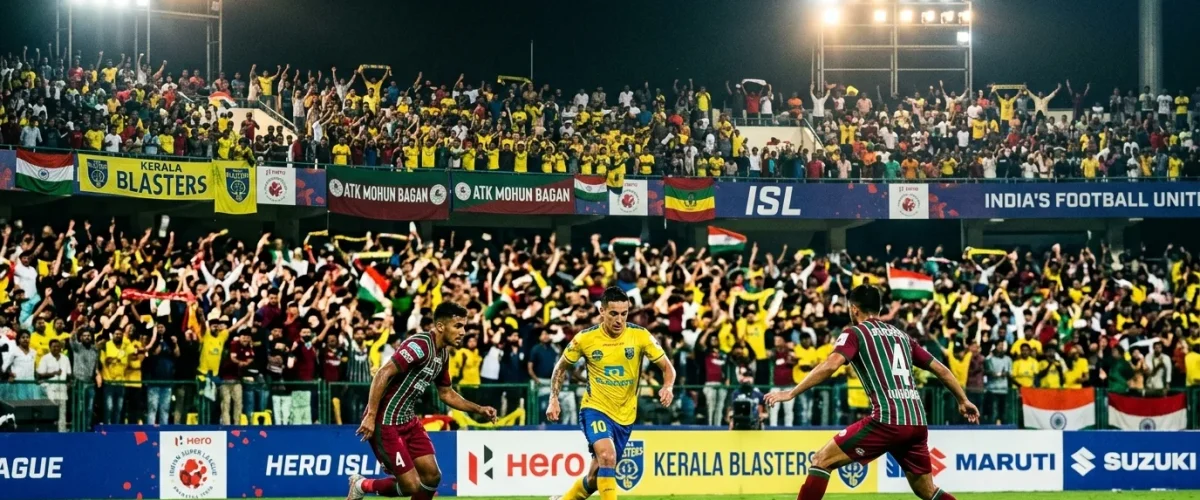
The Indian Super League (ISL) 2025-26 season has delivered a campaign defined by tactical sophistication, record attendance figures, and the unmistakable dominance of Mohun Bagan Super Giant. As the league enters its concluding phase in March 2026, Indian football finds itself at a pivotal moment — domestic competition is stronger than ever, and the national team’s FIFA World Cup 2027 qualifying campaign is generating optimism not seen since the sport’s restructuring began a decade ago.
ISL 2026 Indian Football: Mohun Bagan’s Commanding Season
Mohun Bagan Super Giant have been the standout team of the season, sitting comfortably atop the ISL table with a defensive record that has conceded fewer goals than any team in the league’s history at this stage. Coach Antonio López Habas has built a side that blends experienced Indian internationals with astute foreign signings, creating a squad that can control possession and transition rapidly on the counter-attack.
The club’s marquee signing, Brazilian midfielder Lucas Silva, has been instrumental. His ability to dictate tempo from deep midfield has transformed Mohun Bagan’s build-up play and drawn comparisons with the best foreign players in ISL history. Indian forwards Liston Colaco and Manvir Singh have contributed 23 goals between them, demonstrating that domestic talent can thrive alongside quality imports when given the right tactical structure.
East Bengal, Mohun Bagan’s historic rivals, have also improved significantly under their new ownership structure, with the Kolkata derby attracting a record 67,000 spectators at Salt Lake Stadium. The passion that drives Indian sport is unmistakable in these fixtures, and the growing attendance figures suggest that football’s cultural footprint is expanding beyond its traditional strongholds in Kolkata, Goa, and Kerala.
Attendance Records and Commercial Growth
The ISL’s commercial trajectory in 2025-26 has been equally impressive. Average attendance across the league has risen 18 per cent year-on-year, with several clubs reporting sold-out home matches for the first time. Kerala Blasters continue to lead in atmosphere and fan engagement, regularly filling the Jawaharlal Nehru Stadium in Kochi to its 40,000 capacity.
Broadcasting revenue has grown following a restructured deal with JioStar, which provides extensive coverage across linear television and streaming platforms. Sponsorship income at the club level has increased as Indian and international brands recognise football’s appeal to younger, urban demographics that are difficult to reach through cricket alone.
The introduction of a reserve league for under-21 players has added a development dimension to the ISL ecosystem. Clubs are now required to maintain youth academies and field reserve teams, creating a pathway from grassroots football to the professional game that was largely absent before the ISL’s inception in 2014.
FIFA World Cup 2027 Qualifiers: India’s Toughest Test
Beyond domestic competition, the Indian men’s national team faces its most significant challenge in years. The FIFA World Cup 2027 qualifying campaign, which uses an expanded format following the decision to increase the tournament to 48 teams, has given India a realistic — if narrow — path to qualification for the first time.
India are placed in a qualifying group that includes Qatar, Oman, and Afghanistan. Results so far have been mixed: a creditable draw against Qatar in Doha was followed by a narrow home victory over Afghanistan. The remaining fixtures against Oman and the return matches will determine whether India can finish in the top two of their group and progress to the next round.
Head coach Igor Štimac has emphasised defensive organisation and set-piece efficiency as India’s primary tactical weapons. The team’s strength lies in its discipline and collective effort rather than individual brilliance, although the emergence of young forwards from ISL academies has added a creative dimension that previous national squads lacked.
Youth Development: The Long-Term Investment
India’s football future ultimately depends on its youth development infrastructure, and 2026 has brought encouraging signs. The All India Football Federation (AIFF) has partnered with La Liga’s grassroots programme to establish coaching centres in 15 states. The initiative provides UEFA-licensed coaching education to Indian coaches working at district and state levels.
The Indian Arrows project — AIFF’s developmental team competing in the I-League — continues to produce players who graduate to ISL clubs. Five Arrows alumni are currently in ISL starting elevens, a modest but growing pipeline. The Reliance Foundation Young Champs academy and Bengaluru FC’s youth setup have been particularly productive, with graduates representing India at under-17 and under-20 levels.
Women’s football has also seen investment growth. The Indian Women’s League expanded to 12 teams in 2025-26, with improved broadcast coverage and the first dedicated sponsorship deals for women’s clubs. The broader sporting ecosystem in India increasingly recognises that women’s football represents both a development priority and a commercial opportunity.
Challenges Remain: Governance, Infrastructure, and Investment
Despite the positive momentum, Indian football faces persistent structural challenges. Stadium infrastructure outside the ISL’s showcase venues remains poor, with many I-League and state league matches played on substandard pitches. The gap between ISL clubs, which operate with budgets of Rs 50-100 crore, and I-League clubs, many of which survive on a fraction of that, creates a two-tier system that limits competitive depth.
Governance issues at the AIFF have improved following the Supreme Court’s intervention in 2022, but the federation’s relationship with FIFA remains subject to scrutiny. Ensuring that India’s football governance meets international standards is essential for the country’s ambitions to host major tournaments and participate fully in global competitions.
Private investment is growing but remains concentrated in a handful of clubs backed by major corporate groups. For football to achieve genuinely national reach, investment must extend to tier-2 and tier-3 cities where the sport’s grassroots potential is greatest. Community-based clubs, modelled on successful examples in Germany and Japan, offer a sustainable path forward that complements the franchise model of the ISL.
The Road Ahead for Indian Football
The ISL 2025-26 season has demonstrated that Indian club football can deliver compelling competition, growing audiences, and commercial viability. The World Cup qualifying campaign offers a rare opportunity to capture national attention in a way that domestic leagues alone cannot. Whether India can sustain this momentum depends on continued investment in youth development, improved governance, and the willingness of stakeholders to think in decades rather than seasons. The foundation is being laid — now comes the harder work of building upon it.

- India’s Startup Funding Crosses $7.2 Billion in H1 2026 - July 1, 2026
- After Ireland Shock, India’s T20I Side Faces Bigger Test - July 1, 2026
- Ireland Stun World Champions India 2-0 in Belfast, Sooryavanshi Debate Rages On - June 29, 2026