Nitish Kumar Resigns as Bihar Chief Minister After Two Decades as BJP Prepares to Lead the State for First Time

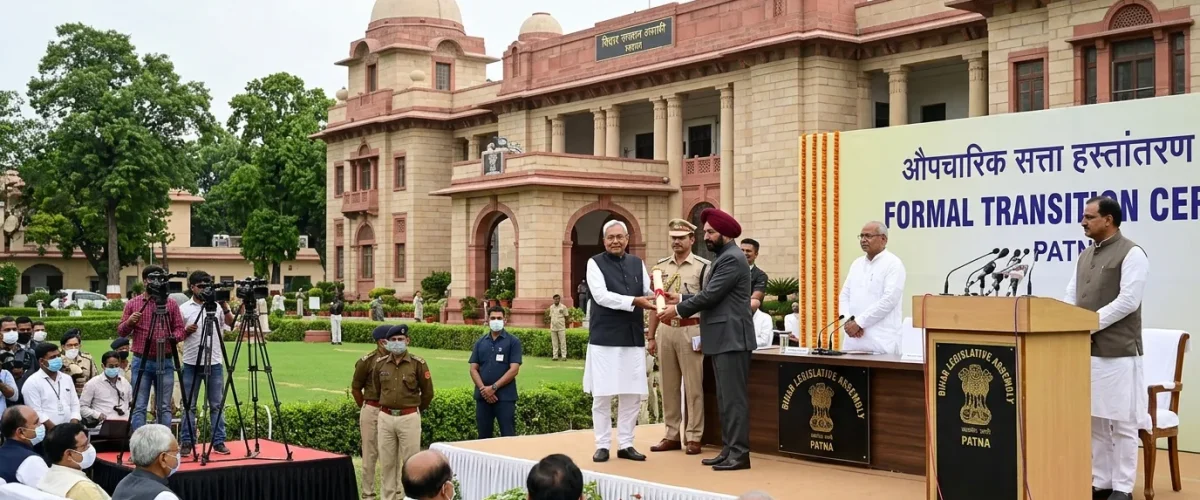
Nitish Kumar on Tuesday submitted his resignation as the Chief Minister of Bihar to Governor Arif Mohammed Khan at Lok Bhavan in Patna, bringing to a close a two-decade-long political era that defined the state’s modern trajectory. The 75-year-old Janata Dal (United) leader, who first took charge as chief minister in 2005, is expected to be succeeded by a BJP leader, marking the first time the Bharatiya Janata Party will hold the top post in Bihar on its own.
Why 14 April Was Chosen for the Resignation
The date of Nitish Kumar’s resignation carries significant political and cultural symbolism. 14 April marks the birth anniversary of Dr B R Ambedkar, the principal architect of the Indian Constitution and a towering icon of the social justice movement in India. In a state where caste dynamics have historically shaped political allegiances, the decision to step down on Ambedkar Jayanti is widely seen as a deliberate move to frame the transition within a narrative of constitutional respect and social progress.
Additionally, the Hindu calendar played a role. The period of Kharmas, a roughly one-month window considered inauspicious for major decisions in Bihar, Jharkhand, and eastern Uttar Pradesh, ended on 14 April. While no senior leader publicly confirmed the astrological reasoning, local media outlets noted the convergence of the favourable date with the national holiday as key factors in the timing.
Nitish Kumar’s Legacy as Bihar’s Longest-Serving CM
Nitish Kumar’s political career stretches back to 1985. Over four decades, he built a reputation as a development-focused leader who ended what he famously called the RJD’s “jungle raj” period. His tenure is credited with transforming Bihar’s infrastructure, improving road connectivity, and advancing law and order. Under his leadership, Bihar’s GDP growth rate repeatedly outpaced the national average during key periods, and the state saw significant improvements in literacy rates and women’s safety indicators.
However, his political journey was also marked by frequent alliance shifts. He partnered with the BJP, broke away to ally with Lalu Prasad Yadav’s Rashtriya Janata Dal, and then returned to the NDA fold. These switches, while pragmatic, drew criticism from opponents who labelled him opportunistic. His supporters, on the other hand, argued that each move was driven by the need to ensure stability in a state that celebrates its diverse cultural identity and demands inclusive governance.
The Road to Resignation
Kumar’s decision to step down became increasingly apparent after the 2024 Lok Sabha elections, in which the NDA retained power at the Centre. Having secured a Rajya Sabha seat as part of a broader political arrangement, Kumar took his oath as a member of the Upper House on 10 April. Earlier that day, he chaired his last cabinet meeting and informed his colleagues about his decision to dissolve the council of ministers, a constitutional prerequisite before submitting the resignation to the governor.
Sources within the JD(U) have confirmed that Kumar will remain based in Patna and travel to Delhi for parliamentary sessions. His decision to stay in the state capital is seen as a signal that he intends to retain influence over JD(U) affairs and Bihar politics even after vacating the chief minister’s chair.
BJP Set to Lead Bihar for the First Time
With Kumar’s resignation, the BJP is poised to name its first chief minister in Bihar. The party holds a significant number of seats in the state assembly as part of the ruling NDA coalition. While the frontrunner for the post has not been officially announced, names such as Samrat Choudhary and Vijay Kumar Sinha have been discussed in political circles. The final decision is expected to come from the BJP’s central leadership in New Delhi.
The BJP’s rise to the top post in Bihar represents a major shift in the state’s political landscape. For over two decades, the chief ministership was either held by Nitish Kumar or, before him, by Lalu Prasad Yadav and Rabri Devi of the RJD. A BJP-led government would signal a new chapter, with implications for caste equations, development policy, and the state’s relationship with the Centre.
Political Reactions Across Party Lines
The resignation drew mixed reactions from across the political spectrum. BJP leaders praised Kumar’s contribution to Bihar’s development and framed the transition as a natural evolution of the NDA alliance. Congress leaders, meanwhile, questioned the circumstances of the handover, suggesting it was a pre-arranged deal that prioritised political convenience over democratic accountability.
The RJD, led by Tejashwi Yadav, called for fresh elections, arguing that the people of Bihar had voted for an NDA government led by Nitish Kumar and that any change in leadership should require a fresh mandate. Political analysts, however, noted that the constitutional mechanism allows for such transitions without elections, provided the new leader commands a majority in the assembly.
As India watched rapidly evolving political developments across several states, the Bihar transition stood out for its scale and historical significance.
What Lies Ahead for Bihar
The incoming chief minister will inherit a state that has made progress but still faces significant challenges. Bihar remains one of India’s poorest states by per capita income, and issues such as flood management along the Kosi and Gandak rivers, unemployment among the youth, and industrial development require urgent attention. The new government will also need to navigate the complex cultural and social dynamics of the state, where caste, religion, and regional identity continue to shape political outcomes.
Bihar’s next assembly elections are due in 2025, meaning the new chief minister will have limited time to establish a governance record before facing the electorate. How the BJP handles this transition, and whether it can retain the JD(U)’s voter base while expanding its own, will be closely watched by political observers across India.
A Transition of National Significance
Nitish Kumar’s resignation is not just a Bihar story. It has national implications for the NDA’s coalition strategy, the BJP’s expansion into eastern India, and the broader dynamics of Indian federalism. As the state prepares for its first BJP chief minister, the coming weeks will reveal whether this transition is a smooth handover or the beginning of a new phase of political uncertainty in one of India’s most politically active states. For now, Bihar stands at the threshold of a new era, bidding farewell to a leader who, for better or worse, defined its politics for an entire generation.

- Fentanyl Vaccine Breakthrough: Scripps Research Develops Shot That Blocks Deadly Overdoses Before They Reach the Brain - June 13, 2026
- Nipah Virus Returns to Kerala — First Case of 2026 Confirmed, State Declares High Alert - June 12, 2026
- Jill Biden Reveals She Wanted to Keep PM Modi’s 7.5-Carat Diamond Gift but Returned It After State Department Valued It at $20,000 - June 8, 2026