Earth Day 2026: How India Is Fighting Climate Change With 900 Million Trees, River Cleanups, and Green Energy Push

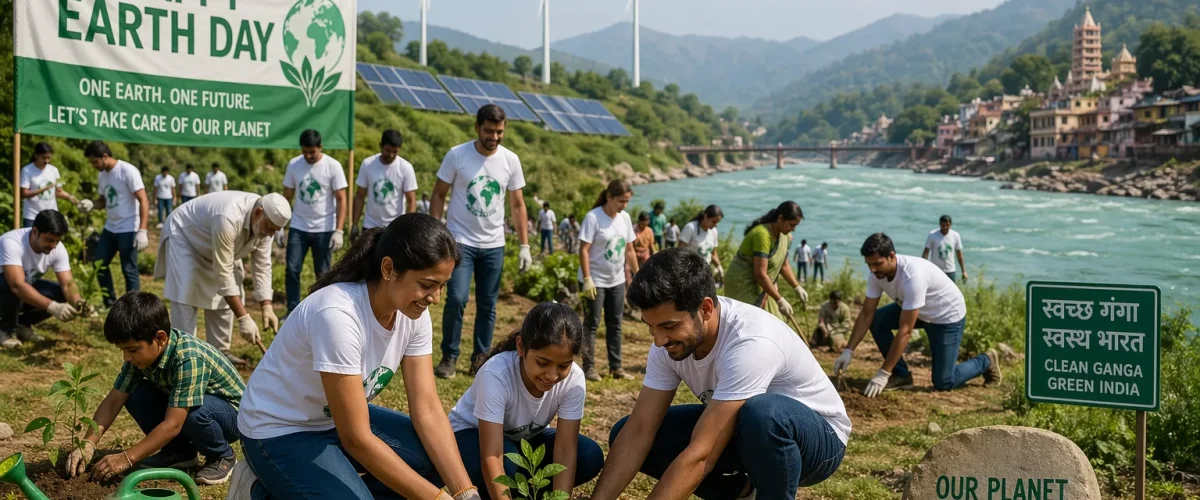
As the world marks Earth Day 2026 on April 22 under the rallying theme “Our Power, Our Planet,” India stands out as one of the most ambitious developing nations leading the global fight against climate change. From planting hundreds of millions of trees and rejuvenating the sacred Ganga to building the world’s third-largest renewable energy infrastructure, India’s environmental transformation in recent years has been nothing short of remarkable. For the latest environmental news and updates, India’s green journey offers both inspiration and a blueprint for climate action in the Global South.
Earth Day 2026: “Our Power, Our Planet” Calls for Collective Action
This year’s Earth Day theme, announced by EARTHDAY.ORG in January 2026, positions people-powered action as the catalyst for building a just, healthy, and thriving world. The campaign calls on individuals, communities, schools, faith groups, and organizations to take a stand for clean air, clean water, renewable energy, and protected natural resources.
Activities spanning from April 18 through Earth Week include peaceful demonstrations, voter registration drives, community cleanups, tree planting drives, teach-ins, and town hall meetings with government officials. Over one billion people across the globe are expected to participate, making it the largest civic engagement event on the planet.
India, which represents 17 percent of the world’s population but accounts for only about five percent of global emissions, has emerged as a key voice in global climate diplomacy. As the country battles India’s first major heatwave of 2026, the urgency of environmental action has never been felt more acutely.
India’s Massive Reforestation Drive: Millions of Hectares Under Green Cover
India’s National Mission for a Green India (GIM), launched as one of the eight missions under the National Action Plan on Climate Change, has facilitated tree plantation and afforestation across a staggering 11.22 million hectares between 2015-16 and 2020-21. The mission’s goal is to increase forest and tree cover on five million hectares of forest and non-forest land while improving the quality of forest cover on another five million hectares.
Under the Twenty Point Programme alone, India set annual seedling planting targets of over 940 million seedlings per year, with billions of seedlings planted across the country since 2016 through various central and state schemes. The Green India Mission, in collaboration with state forest departments, has afforested 33,024 hectares along the main stem of the River Ganga at a cost of approximately ₹414 crore.
The revised Green India Mission roadmap, released in June 2025, has set even more ambitious targets. India aims to expand forest and tree cover to 24.7 million hectares, which could generate a carbon sink of 3.39 billion tonnes of CO₂ by 2030 — exceeding India’s climate targets under the Paris Agreement. Between 2005 and 2021, India had already created an additional carbon sink of 2.29 billion tonnes of CO₂ equivalent.
The Aravalli Green Wall project, with an estimated cost of ₹16,053 crore, targets 6.45 million hectares across 29 districts and four states, aiming to rejuvenate forests, water systems, and grasslands to curb sandstorm intrusions and pollution in the NCR and Punjab regions.
Namami Gange: Cleaning India’s Holiest River
The Namami Gange Programme, India’s flagship river cleanup initiative launched in 2014, has disbursed over ₹21,340 crore to implementing agencies as of March 2026. Under this programme, 524 projects have been sanctioned, of which 355 projects (68 percent) have been completed.
The programme’s most significant achievements include the completion of 76 sewerage infrastructure projects with a combined treatment capacity of 3,200 million litres per day (MLD) in the last five years alone. An additional 71 new projects worth ₹12,641 crore are underway, targeting an additional treatment capacity of 2,210 MLD.
Water quality monitoring at 112 locations across five Ganga main-stem states shows notable improvement. In Uttarakhand, previously polluted stretches have been completely cleaned, with no polluted river stretches recorded in the 2025 assessment. Conditions in West Bengal and parts of Uttar Pradesh have also shown improvement. Over 203 lakh Indian Major Carp fingerlings have been ranched in the Ganga to conserve fish biodiversity, and dolphin populations along the river have reportedly doubled since 2009.
However, challenges remain. Critics point to gaps in execution, particularly regarding industrial waste discharges and sewage treatment capacity, highlighting the need for continued vigilance and investment. The latest latest scientific research underscores the importance of evidence-based approaches to river conservation.
India’s Renewable Energy Revolution: Record-Breaking Growth
India’s clean energy transformation has been nothing short of historic. In 2025, the country added a record 44.5 GW of renewable energy capacity — nearly double the 24.72 GW installed during the same period the previous year — backed by investments of approximately ₹2 lakh crore.
Solar power has led the charge, with capacity additions of 34.98 GW in 2025 alone. India’s total solar installed capacity reached 132.85 GW by November 2025, crossing the landmark 100 GW mark in January 2025 — a 41 percent increase over the previous year. Wind energy capacity also surged, crossing the 50 GW milestone in March 2025 and reaching 53.99 GW by November.
As of late 2025, India’s total non-fossil fuel installed power capacity stood at 262.74 GW, accounting for 51.5 percent of the country’s total installed electricity capacity of 509.64 GW. This milestone — achieving 50 percent non-fossil capacity — was reached nearly five years ahead of the 2030 target under the Paris Agreement. According to IRENA, India now ranks third globally in solar power capacity, fourth in wind power, and fourth in total renewable energy capacity.
Just as ISRO’s zero-debris space mission targets showcase India’s commitment to sustainability beyond Earth, the country’s renewable energy push is proving that developing nations can lead the global green transition.
Net Zero by 2070: India’s Climate Commitments and Policy Framework
Prime Minister Narendra Modi’s historic “Panchamrit” pledge at COP26 in Glasgow set five ambitious climate targets for India: reaching 500 GW of non-fossil energy capacity by 2030, fulfilling 50 percent of energy requirements from renewables by 2030, reducing total projected carbon emissions by one billion tonnes by 2030, cutting carbon intensity of the economy by 45 percent by 2030, and achieving net-zero emissions by 2070.
India has already achieved or exceeded several of these targets ahead of schedule. The country’s emissions intensity declined by 36 percent between 2005 and 2020, and as of February 2026, non-fossil fuel sources account for over 52.57 percent of installed electricity capacity.
In March 2026, the Union Cabinet approved India’s updated Nationally Determined Contribution (NDC) for 2031-2035, setting targets to reduce emissions intensity by 47 percent from 2005 levels by 2035, increase non-fossil fuel capacity to 60 percent, and create a carbon sink of 3.5 to 4.0 billion tonnes of CO₂ equivalent through forest and tree cover.
Green Hydrogen, Carbon Markets, and the Road Ahead
India’s National Green Hydrogen Mission has set a target of producing five million tonnes of green hydrogen annually by 2030, aiming to decarbonize hard-to-abate sectors including refineries and fertilizer production. The country is also preparing to launch its national compliance carbon market by mid-2026 under the Carbon Credit Trading Scheme, covering 490 obligated entities across emission-intensive industries.
The Union Budget 2026-27 allocated ₹20,000 crore over five years for Carbon Capture, Utilisation and Storage (CCUS) across emission-intensive sectors. Indigenous solar module manufacturing capacity has reached approximately 144 GW per annum, with about 81 GW added in 2025 alone — a 99 percent year-on-year increase.
These initiatives, combined with biotech breakthroughs redefining Indian science, paint a picture of a nation that is leveraging technology and innovation to address one of humanity’s greatest challenges.
What Earth Day 2026 Means for India
As communities across India participate in Earth Day 2026 activities — from tree planting drives in the Western Ghats to river cleanups along the Yamuna to solar energy awareness campaigns in rural villages — the country’s environmental story is one of both significant progress and remaining challenges.
India’s continued reliance on coal, which still accounts for over three-quarters of electricity generation, remains a concern. The absence of a clear coal phase-out strategy, insufficient battery storage development, and growing energy needs driven by climate impacts constrain deeper decarbonization efforts. Yet the pace of India’s renewable energy expansion, its massive reforestation programmes, and its strengthening environmental policy framework demonstrate that meaningful change is underway.
This Earth Day, India’s message to the world is clear: a nation of 1.4 billion people can be both a developing economic powerhouse and a climate action leader. The scale of India’s green ambitions — from 500 GW of clean energy to net-zero by 2070 — shows that when “Our Power” meets “Our Planet,” transformation is not just possible but already happening.