Mumbai Garib Nagar Demolition Drive Turns Violent as Over 400 Structures Razed Near Bandra Station for Rail Expansion and Bullet Train Access

Bombay High Court-Ordered Drive Displaces Hundreds of Families
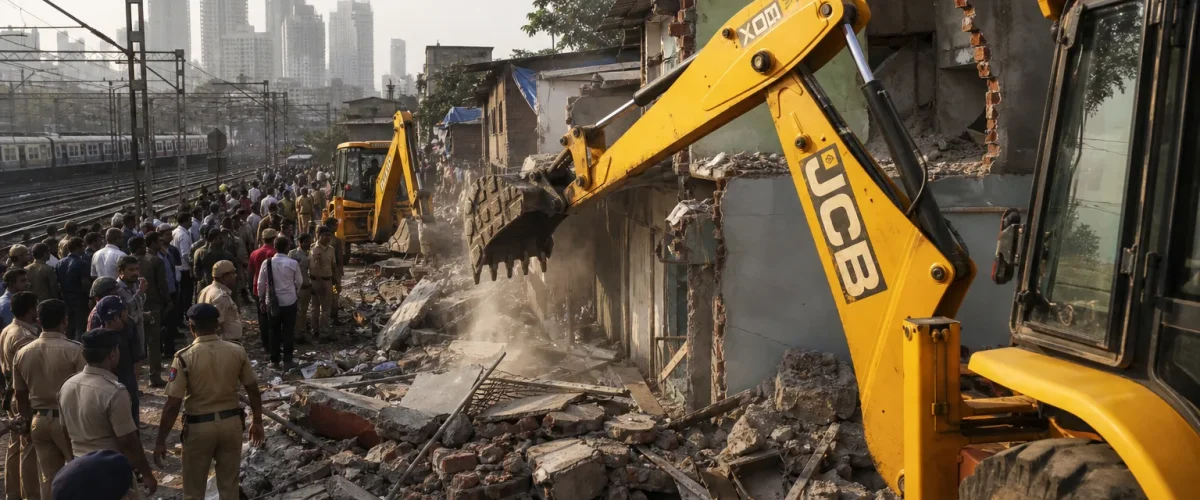
One of Mumbai’s largest anti-encroachment operations in recent years has turned violent as Western Railway’s demolition drive at Garib Nagar, a sprawling slum settlement in Bandra East, entered its third day on 21 May 2026. The operation, backed by Bombay High Court orders, has seen bulldozers raze over 400 unauthorised structures along a 500-metre stretch of railway land near Bandra station, displacing hundreds of families just days before Eid and weeks ahead of the monsoon season.
On 20 May, violent clashes erupted when residents pelted stones at officials and police personnel carrying out the demolition. Police responded with a lathi charge to disperse the crowd, and several arrests were made. Emotional scenes unfolded throughout the day as families scrambled to salvage belongings while heavy machinery flattened their homes, leaving people sitting in the open with bags, mattresses, utensils, and pets amid the rubble.
Why the Demolition Is Happening Now
The demolition drive is part of a critical infrastructure expansion project that has been pending for years. Western Railway plans to expand the fifth and sixth railway lines on the Santacruz-Mumbai Central corridor, a long-delayed project aimed at easing severe congestion on Mumbai’s overcrowded suburban local train network. The expansion is expected to enable 50 new originating trains from Mumbai, dramatically improving commuter capacity on one of the busiest urban rail systems in the world.
Equally important, the cleared land will improve access to the upcoming Mumbai-Ahmedabad Bullet Train station at Bandra-Kurla Complex, the financial hub that is being transformed into a multi-modal transport node. The bullet train project, India’s first high-speed rail corridor, requires unobstructed connectivity between Bandra station and the BKC terminal, and the encroachments along the railway corridor have been a persistent obstacle.
The Bombay High Court had previously ordered the removal of illegal encroachments on railway property while directing authorities to protect the rights of eligible residents identified through baseline surveys. According to railway officials and court records, only about 100 inhabitants identified as eligible in surveys conducted on 10 and 11 August 2021 qualify for rehabilitation and alternative accommodation.
Residents Allege Inadequate Rehabilitation
Many residents have challenged the characterisation of their homes as illegal encroachments, claiming they have lived in Garib Nagar for decades and were either excluded from or unaware of the 2021 rehabilitation surveys. Community leaders say that the settlement has existed since the 1970s and that multiple generations of families have built their lives around the area, with many working as domestic helpers, construction labourers, and street vendors in the affluent Bandra neighbourhood.
The timing of the demolition has added to the anguish. With Eid-ul-Adha approaching in late May, many families had been preparing for the festival, and the sudden escalation of the drive has left celebrations in disarray. Residents have also expressed fear about the approaching monsoon, noting that families left without shelter face dangerous exposure to heavy rains that typically begin in June.
Social activists and opposition politicians have criticised the operation’s execution, arguing that even court-ordered demolitions should be carried out with adequate notice, humane treatment, and robust rehabilitation measures. Several have demanded an independent audit of the survey data to ensure that all eligible families receive proper alternative accommodation before their homes are demolished.
Western Railway’s Defence and the Bigger Picture
Western Railway has defended the operation as essential for Mumbai’s transport future. Railway officials point out that the encroachments sit on government-owned railway land and have been built without any legal authorisation. The structures, many of them two and three-storey buildings with commercial establishments on the ground floor, have progressively encroached on land required for critical infrastructure projects.
The Mumbai-Ahmedabad corridor is one of India’s most ambitious infrastructure projects, and delays caused by land acquisition and encroachment clearance have been cited as major factors in the project’s extended timeline. The Western Railway has argued that the current drive, while painful for affected residents, is necessary to prevent further delays to projects that will benefit millions of Mumbai commuters.
This drive follows a similar massive anti-encroachment operation at Howrah Railway Station in West Bengal earlier in May, where authorities demolished illegal structures as part of a nationwide push to reclaim railway land for infrastructure modernisation.
Legal and Humanitarian Dimensions
The Garib Nagar demolition raises complex questions about urban development, social justice, and the rights of informal settlers that are relevant far beyond Mumbai. India’s rapid urbanisation has created vast slum settlements in every major city, often on government or railway land, where families live for decades without formal legal title. Court-ordered clearances inevitably pit development imperatives against the welfare of vulnerable communities.
Legal experts note that the Supreme Court of India has established principles requiring adequate notice and rehabilitation before large-scale evictions, but the implementation of these principles varies widely across states and agencies. The Garib Nagar case is likely to generate legal challenges that could reach the higher courts, particularly if residents can demonstrate that the 2021 survey was insufficiently comprehensive.
What Comes Next for Bandra East
The demolition drive is expected to continue for at least one more day, with railway authorities aiming to clear the remaining structures by the end of the week. Police presence has been significantly increased following the stone-pelting incident, and the area has been placed under heightened security.
Once cleared, the land will be handed over to construction teams working on the fifth and sixth line expansion project. Railway officials estimate that the cleared corridor will also provide a direct access road to the BKC bullet train terminal, reducing travel time between Bandra station and the high-speed rail hub. For the displaced families, the path forward remains uncertain, with only a fraction qualifying for formal rehabilitation while the majority face the daunting prospect of finding new shelter in one of the world’s most expensive real estate markets.
Explore more: Culture & Lifestyle | Social Trends