NCERT Adds 1975 Emergency to Class 9 Curriculum on Its 51st Anniversary

The new social science textbook describes the 21-month period as one of the gravest challenges to Indian democracy — the first time the topic has appeared at this grade level.
Fifty-one years after Indira Gandhi’s government imposed a National Emergency on India, the episode has found its way into the country’s Class 9 social science curriculum — and the timing is anything but coincidental.
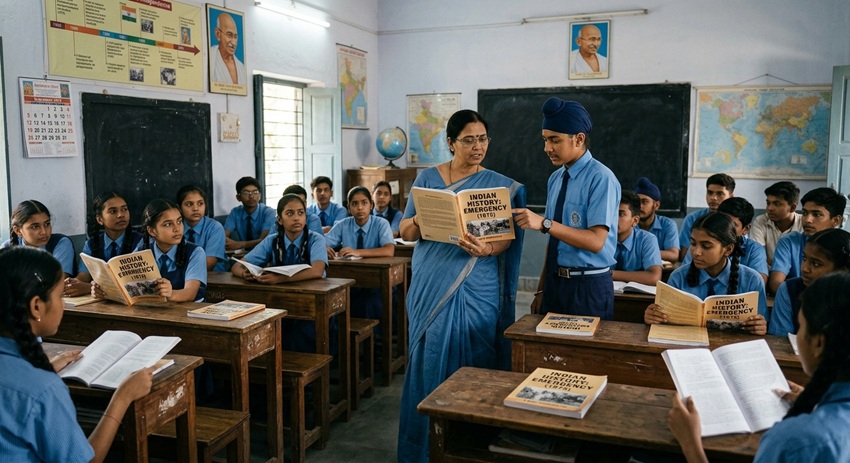
The National Council of Educational Research and Training (NCERT) has introduced a detailed section on the 1975–77 Emergency in its newly revised Class 9 textbook, Understanding Society: India and Beyond, marking the first time the subject has been formally taught at this grade level. The chapter describes the period as “one of the major challenges to democracy in India,” covering the suspension of fundamental rights, mass arrests of political opponents, press censorship, and the constitutional stress placed on Indian institutions during those 21 months.
An NCERT official confirmed the inclusion is new. Previously, the Emergency featured only in Class 12 political science materials, limiting its reach to students who took that elective stream. By moving it to Class 9 — a core, mandatory subject — the council is ensuring the episode reaches virtually every student in the Central Board of Secondary Education system.
June 25 is observed each year as Emergency Day, marking the night in 1975 when then-President Fakhruddin Ali Ahmed proclaimed a National Emergency under Article 352 of the Constitution, acting on the recommendation of then-Prime Minister Indira Gandhi. The proclamation followed the Allahabad High Court ruling that found Gandhi guilty of electoral malpractice, which threatened her position in power.
Union Education Minister Dharmendra Pradhan, speaking at a function in Chandigarh on 25 June to mark the anniversary, defended the NCERT decision firmly. He said future generations must understand the period’s history to ensure such circumstances do not recur. PM Narendra Modi, in his own remarks on the occasion, characterised the Emergency as “a direct assault on the Constitution.”
The Congress party has pushed back. Senior leaders K.C. Venugopal and CPI(M)’s John Brittas have raised concerns about what they describe as selective historical framing — arguing that the new curriculum represents political motivation rather than a neutral educational exercise. Critics have also drawn comparisons to what they see as the current government’s own record on press freedom and civil liberties, though those arguments remain contested.
What is not contested is the historical record itself. The Emergency lasted from June 1975 until March 1977, when Gandhi called general elections — and lost decisively to the Janata coalition. The period saw thousands of activists, journalists, and political figures detained without trial, with civil liberties effectively suspended under extraordinary executive powers.
For educators, the new chapter presents both an opportunity and a responsibility. Teaching the Emergency to 14 and 15-year-olds requires contextual care — the textbook will need to present the facts of the period without reducing a complex political moment to a partisan lesson. Whether NCERT has achieved that balance will become clearer once teachers and parents get their hands on the full material.