India’s Startup Funding Crosses $7.2 Billion in H1 2026

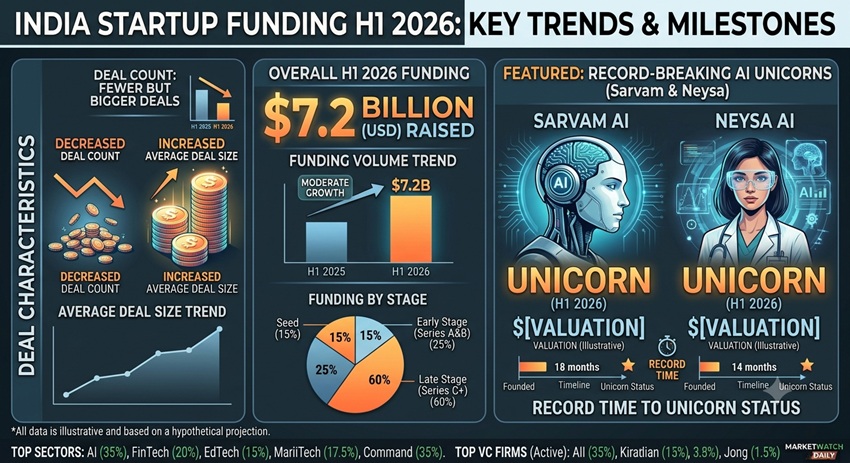
The Indian startup ecosystem closed the first half of 2026 with more capital raised but far fewer deals struck, a pattern that’s reshaping how founders need to think about fundraising in the second half of the year.
According to a report from market intelligence platform Tracxn, India’s technology startups pulled in $7.2 billion in funding between 1 January and 24 June 2026, marking a 12% increase over the same period last year. But that headline number masks a sharper underlying trend: the total number of funding rounds fell 43% to just 652, the steepest such decline in recent years. In plain terms, investors are writing fewer cheques — but much larger ones — to companies they have high conviction in.
That concentration is stark at the top of the table. The three largest funding rounds of H1 2026 — CRED’s $900 million raise, data-centre operator Nxtra’s $710 million round, and AI infrastructure company Neysa’s $600 million round — together accounted for roughly $2.2 billion, or nearly a third of all capital raised in the half-year period.
AI startups are reaching unicorn status faster than ever
Five Indian companies crossed the $1 billion valuation mark during H1 2026, and the contrast between them is telling. AI-native startups Neysa and Sarvam AI both achieved unicorn status in under three years from founding — an extraordinarily compressed timeline by historical standards. By comparison, the other three new unicorns of the half — fintech lender KreditBee, private space company Skyroot, and real estate platform Square Yards — took between eight and twelve years to reach the same milestone.
Sarvam AI’s own trajectory illustrates the momentum behind homegrown artificial intelligence. The company closed a $234 million round in mid-June led by HCLTech, with participation from Bessemer Venture Partners, Khosla Ventures and Peak XV Partners, pushing it firmly into unicorn territory and giving India’s domestic AI model-building efforts a high-profile win.
Fintech, meanwhile, dominated by sheer capital volume, almost entirely on the back of CRED’s mega-round. According to weekly tracker data, Indian startups raised over $1 billion in the final week of June alone — a 164% jump from the week before — with fintech deals like CRED’s leading the surge alongside continued momentum in AI-powered development platforms.
Exits are happening faster too
The funding story isn’t the only sign of a maturing ecosystem. India recorded 13 initial public offerings in H1 2026, up slightly from 12 a year earlier. Among the standout listings were enterprise AI firm Fractal Analytics, which debuted with a market capitalisation of $1.7 billion, followed by ad-tech company Amagi at $858 million and quick-commerce logistics player Shadowfax at $782 million.
Perhaps the most telling statistic for founders and investors alike: the average time it now takes a startup to go from its first funding round to an IPO has dropped sharply, from roughly 14.5 years to just 8.1 years. That compression suggests both that companies are scaling faster and that public markets have become a more viable, near-term exit option than they were even a few years ago.
Beyond the marquee AI and fintech deals, capital also continued flowing into less glamorous but steadily growing categories — rooftop solar, pet care, clean-label nutrition, and circular-economy businesses among them — signalling that investor appetite hasn’t narrowed entirely to deep tech, even as the big-ticket headlines get dominated by AI.
For founders heading into the second half of 2026, the message from the data is fairly direct: investors are rewarding category clarity, defensible unit economics, and a clear milestone that a funding round is designed to unlock — rather than spreading smaller bets more widely, as was common in previous cycles.

- India’s Startup Funding Crosses $7.2 Billion in H1 2026 - July 1, 2026
- After Ireland Shock, India’s T20I Side Faces Bigger Test - July 1, 2026
- Ireland Stun World Champions India 2-0 in Belfast, Sooryavanshi Debate Rages On - June 29, 2026