India’s Outbound Travel Boom: Japan, South Korea, and Southeast Asia See Surge in Indian Tourist Arrivals

India’s outbound travel market is experiencing a boom of historic proportions, with countries across the Asia-Pacific region — and increasingly beyond — scrambling to attract and accommodate the rapidly growing wave of Indian tourists. Japan, South Korea, Singapore, Thailand, and Australia have all reported significant increases in Indian arrivals, and are deploying targeted strategies to capture a larger share of what has become one of the world’s most dynamic outbound travel markets.
The Numbers: India’s Travel Boom in Context
More than 28 million Indians travelled abroad in 2025, a figure that represents a 22 per cent increase over 2024 and a near-doubling from the pre-pandemic baseline. Projections for 2026 suggest continued growth of 18-20 per cent, potentially taking the outbound figure above 33 million — a number that would make India one of the top five source markets for international tourism globally.
The growth is being driven by demographic and economic fundamentals that show no signs of abating: India’s expanding middle class, now estimated at over 400 million people; rising disposable incomes, particularly in tier-2 and tier-3 cities; improved access to international air travel through the expansion of direct flight networks; and the normalisation of international travel as an aspirational middle-class activity, amplified by social media exposure to global destinations.
“India is where China was in the early 2010s — at the beginning of an outbound travel explosion that will reshape global tourism patterns for decades,” observed Zurab Pololikashvili, Secretary-General of the United Nations World Tourism Organisation. “Every tourism ministry in the world has India on its radar, and those that move quickly to capture Indian travellers’ loyalty will benefit enormously.”
Japan: The New Favourite
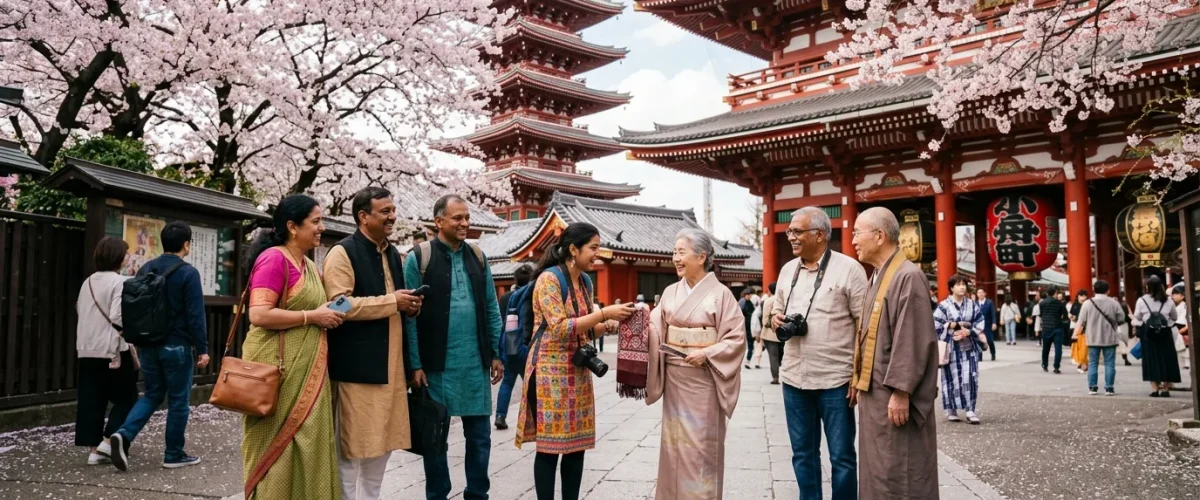
Japan has emerged as one of the most significant beneficiaries of India’s outbound travel surge. Indian arrivals in Japan exceeded 350,000 in 2025, a 45 per cent increase over the previous year, making India one of Japan’s fastest-growing source markets. The trend has accelerated in early 2026, with January-February figures suggesting the year could see over 500,000 Indian visitors.
The appeal of Japan for Indian travellers is multifaceted: the country’s reputation for cleanliness, safety, and efficiency; its extraordinary food culture (with vegetarian-friendly options increasingly available); the cherry blossom season, which has become a social media phenomenon among Indian travellers; and the cultural resonance of Japanese aesthetics, technology, and popular culture among younger Indians.
The Japan National Tourism Organisation (JNTO) has responded to the Indian market’s growth with dedicated Hindi-language marketing campaigns, partnerships with Indian travel operators, and the deployment of Indian-origin staff at major tourist information centres. Several Japanese cities, including Osaka and Fukuoka, have introduced multilingual signage and Indian food options at popular tourist sites.
South Korea: The K-Culture Connection
South Korea’s emergence as a top destination for Indian travellers is closely linked to the phenomenon of the Korean Wave (Hallyu) — the global spread of Korean popular culture through K-pop music, Korean dramas, and Korean cuisine. More than 187,000 Indians visited South Korea between January and September 2025, and the trajectory suggests a significant further increase in 2026.
The Korean Tourism Organisation has identified Indian millennials and Gen Z travellers as a priority demographic, investing in marketing campaigns that leverage K-pop fandom, Korean beauty culture, and the filming locations of popular Korean dramas. The development of “K-Culture Experience” packages — combining concerts, drama set visits, Korean cooking classes, and K-beauty shopping — has proven particularly effective in converting cultural interest into actual travel.
Visa facilitation has played a crucial role: South Korea’s introduction of an e-visa system for Indian nationals, combined with streamlined processing times, has significantly reduced the friction of planning a Korean holiday. Several Indian travel platforms now offer dedicated South Korea packages that handle visa processing as part of a seamless booking experience.
Southeast Asia: The Accessible Exotic
Southeast Asia remains the dominant destination region for Indian outbound travellers, with Thailand, Singapore, Malaysia, Vietnam, and Bali (Indonesia) accounting for the largest share of Indian overseas trips. The region’s combination of proximity, affordability, visa accessibility, and cultural familiarity makes it the natural first international destination for India’s expanding class of first-time overseas travellers.
Thailand, India’s single most popular international destination, welcomed over 2 million Indian visitors in 2025 and is targeting a further 15 per cent increase in 2026. The country’s tourism authority has intensified its engagement with the Indian wedding tourism market, which has become a significant revenue source as affluent Indian families choose Thai beach resorts and luxury hotels for destination weddings.
Vietnam has emerged as the surprise performer in the Southeast Asian market, with Indian arrivals increasing by over 60 per cent in 2025 following the introduction of an extended e-visa programme and the launch of direct flights from several Indian cities. The country’s combination of dramatic landscapes, rich history, and exceptionally affordable prices has resonated with Indian travellers seeking value without compromising on experience quality.
Visa-Free and Visa-on-Arrival Access
Indian passport holders now have visa-free or visa-on-arrival access to 56 countries and territories — a figure that, while modest compared to Western passports, has improved significantly in recent years. Several countries have liberalised their visa policies specifically to attract Indian travellers, recognising the market’s growth potential. Sri Lanka, Maldives, Mauritius, Thailand (partial), and several Central Asian nations now offer visa-free or simplified entry for Indian citizens.
The diplomatic dimension of visa facilitation reflects India’s growing economic weight and the strategic value that destination countries assign to the Indian tourism market. India’s own efforts to improve passport processing — including the expansion of the Passport Seva network and the introduction of chip-enabled passports — have contributed to the growth in outbound travel by making international travel documentation more accessible to a broader population.
The Indian Traveller Profile
The profile of the Indian outbound traveller is evolving rapidly. While family holidays and honeymoon trips remain significant segments, the market is diversifying to include solo travellers, adventure seekers, gastronomy tourists, and experiential travellers who prioritise unique and immersive experiences over conventional sightseeing.
The growth of India’s domestic travel infrastructure — including the wellness and adventure tourism boom in Uttarakhand — has cultivated a generation of experienced travellers who bring higher expectations and more sophisticated preferences to their international trips. Destination countries that fail to understand and cater to these preferences risk losing market share to more responsive competitors.
Challenges and Opportunities
The outbound boom presents both opportunities and challenges for India itself. From a foreign exchange perspective, the increasing outflow of tourism spending — estimated at over $25 billion in 2025 — places pressure on the current account balance. The government’s “Visit India” campaign, aimed at encouraging inbound tourism and domestic travel, is partly motivated by the desire to offset this outflow by attracting more foreign tourists to India.
However, the outbound travel boom also generates positive externalities. Indian travellers serve as cultural ambassadors, building people-to-people connections that strengthen diplomatic relationships. The exposure to international tourism standards raises expectations that drive improvements in India’s own tourism infrastructure. And the airline connectivity developed to serve outbound demand also facilitates inbound travel, creating a two-way flow that benefits India’s tourism economy.
India’s growing international travel presence complements the country’s expanding global footprint in scientific innovation and technology development, collectively reflecting a nation that is increasingly engaged with the world across every dimension — cultural, economic, and intellectual.