Vande Bharat Express 2026: India’s High-Speed Rail Revolution Gathers New Momentum

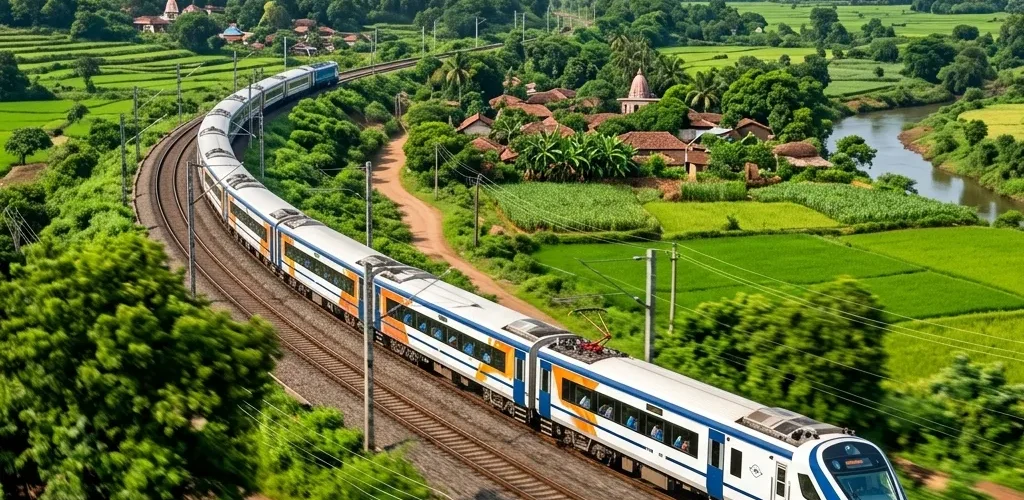
India’s railway system, the fourth-largest in the world by route length and arguably the most socially significant transport network in any country, is undergoing its most ambitious transformation since independence. At the heart of this transformation is the Vande Bharat Express — a family of indigenously designed, semi-high-speed trains that have become symbols of India’s manufacturing capability, infrastructure ambition, and the promise of modern, comfortable rail travel for hundreds of millions of citizens. By March 2026, with over 100 Vande Bharat services operational or in various stages of deployment across the country, the programme has crossed a threshold from flagship project to systemic change agent.
The Vande Bharat Story
The first Vande Bharat Express (originally called Train 18) was launched in February 2019 on the New Delhi-Varanasi route, and it represented a break from convention in almost every respect. Designed and manufactured at the Integral Coach Factory (ICF) in Chennai — the same facility that has produced India’s railway coaches for decades — the train was a self-propelled Electric Multiple Unit (EMU) rather than a locomotive-hauled formation. This design allows for faster acceleration, better energy efficiency, and higher operating speeds.
The technical specifications were, by Indian standards, revolutionary. Maximum speeds of 160-180 km/h (with design capability up to 200 km/h), fully air-conditioned coaches with aircraft-style seating, automatic doors, onboard Wi-Fi, GPS-based passenger information systems, and bio-vacuum toilets — amenities that are standard on European and Japanese trains but were unprecedented on Indian Railways. The trains also featured a distinctive aerodynamic nose design that became instantly recognisable and served as a symbol of India’s Make in India manufacturing initiative.
Scaling Up: The 2026 Network
The transformation from a single showcase service to a national network has been dramatic. The Indian Railways placed orders for over 400 Vande Bharat train sets, manufactured across multiple facilities including ICF Chennai, the Rail Coach Factory (RCF) in Kapurthala, and new production lines established with private sector participation. By early 2026, services connect major city pairs across the country, significantly reducing travel times on routes that millions of Indians use regularly.
Key routes include Delhi-Jaipur (approximately 3.5 hours, down from 5+), Delhi-Agra (under 2 hours), Mumbai-Ahmedabad (approximately 5 hours), Chennai-Bengaluru (approximately 3.5 hours), and Howrah-New Jalpaiguri (connecting Kolkata to North Bengal and Sikkim). The Varanasi and Lucknow routes, among the earliest, continue to see strong demand, reflecting the massive growth in travel to spiritual and cultural destinations across North India.
The most recent iterations — sometimes referred to as Vande Bharat 2.0 and Vande Bharat Sleeper — address specific market needs. The 2.0 version includes improved suspension for a smoother ride at higher speeds, enhanced safety features including a Kavach anti-collision system, and redesigned interiors. The Sleeper variant, currently in advanced testing, will enable overnight journeys on longer routes, potentially replacing aging Rajdhani Express services — one of Indian Railways’ most iconic brands.
Impact on Travel and Tourism
The Vande Bharat network has had a tangible impact on domestic tourism patterns. By reducing travel times between cities, the trains have made day trips and short breaks feasible on routes that previously required overnight stays. The Delhi-Agra service, for example, has enabled a same-day Taj Mahal visit that was previously impractical by train, boosting tourist numbers while reducing the need for overnight accommodation in Agra.
The trains have also democratised comfort. While Vande Bharat fares are higher than standard chair car services, they are significantly lower than business-class air travel on comparable routes — and competitive with economy air fares when door-to-door travel time and airport transfer costs are factored in. For families, the ability to travel comfortably with luggage, enjoy meals at their seats, and arrive in city centres rather than airports represents a compelling value proposition.
Tourism boards in states connected by new Vande Bharat services have reported measurable increases in visitor arrivals. The best North India destinations, many of which are now connected by Vande Bharat services, have seen particularly strong growth in weekend and short-break tourism — a segment that barely existed in Indian rail travel before 2019.
Technical Achievements and Challenges
The Vande Bharat programme represents a genuine achievement in indigenous railway technology. The train’s propulsion system, bogies, braking system, and control electronics are designed and manufactured in India, with progressively decreasing reliance on imported components. The self-propelled design eliminates the need for a separate locomotive, reducing turnaround times at terminals and enabling more efficient use of platform capacity.
The integration of the Kavach (Train Collision Avoidance System) into newer Vande Bharat trains is a significant safety milestone. Kavach, developed by the Research Design and Standards Organisation (RDSO), uses GPS, radio communication, and onboard computers to automatically apply brakes if two trains are detected on a collision course. While deployment across the entire Indian railway network will take years, its installation on Vande Bharat services demonstrates commitment to safety on the country’s premium trains.
However, the programme has not been without challenges. Delays in manufacturing timelines, quality control issues with early production batches, and the logistics of maintaining a fleet operating across India’s diverse climatic conditions have all required attention. The integration of new high-speed services into a network that simultaneously handles slow freight trains and aging passenger services creates scheduling complexities that limit the speeds Vande Bharat trains can actually achieve in regular operation — often well below their design maximum.
The Bullet Train Horizon
Beyond Vande Bharat, India’s high-speed rail ambitions extend to true bullet train service. The Mumbai-Ahmedabad High Speed Rail (MAHSR) project, a collaboration with Japan using Shinkansen technology, remains India’s flagship high-speed rail project. The 508-kilometre line, designed for speeds up to 320 km/h, has faced construction delays but continues to progress. When operational, it will reduce the Mumbai-Ahmedabad journey from the current 6-7 hours to approximately 2 hours — a transformation comparable to the Shinkansen’s impact on the Tokyo-Osaka corridor.
The MAHSR project and the Vande Bharat programme serve different market segments but share a common vision: a railway system that is modern, efficient, and capable of supporting India’s economic growth and social connectivity. Together, they represent the most significant investment in Indian railway infrastructure since the network’s expansion in the decades following independence.
The Passenger Experience
Travelling on a Vande Bharat Express is, for many Indian passengers, their first experience of rail travel that approaches international standards. The chairs are comfortable, the air conditioning works, the toilets are clean, and meals are served at seats. These might seem like basic expectations, but for anyone who has travelled on India’s older rolling stock — with its cramped seating, unreliable cooling, and often challenging sanitary facilities — the difference is transformative.
The trains have also become social media sensations. Passengers routinely post photos and videos of their Vande Bharat journeys, generating organic publicity that no advertising campaign could replicate. The distinctive exterior design — the white-and-blue livery with the aerodynamic nose — has become iconic, and the trains are frequently cited in discussions about India’s modernisation trajectory.
What Lies Ahead
The Vande Bharat programme’s next phase includes the introduction of the sleeper variant, expansion to routes in the Northeast (connecting Guwahati with major cities), and potential export — with several countries expressing interest in the design for their own railway modernisation programmes. The programme has also spurred competition, with private operators exploring entry into passenger rail services under Indian Railways’ liberalisation framework.
India’s railway transformation is not merely a transportation story — it is an economic, social, and aspirational one. The Vande Bharat Express, in its unpretentious way, is telling Indians and the world that the country can design, build, and operate modern infrastructure at scale. Each departure from a platform, each arrival under two hours that used to take five, is a small but tangible proof point. The revolution is on the rails — and it is gathering speed.