India Electric Vehicle Sales Surge 40 Per Cent in Early 2026 as Tata Motors and Mahindra Lead the Charge

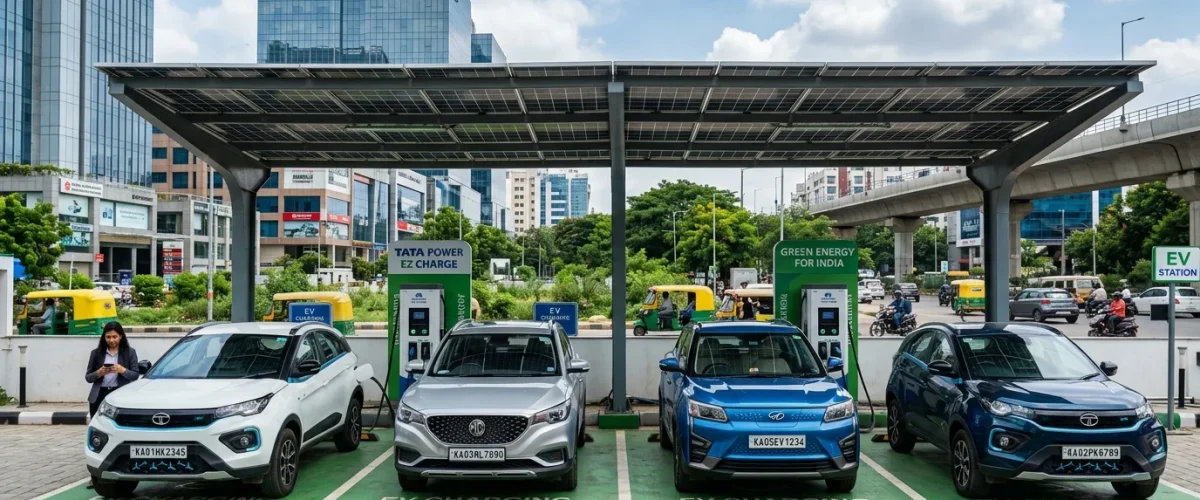
India’s electric vehicle market recorded a remarkable 40 per cent year-on-year growth in retail sales for February 2026, according to data released by the Federation of Automobile Dealers Associations. Tata Motors continued to dominate the electric passenger vehicle segment with over 5,500 units sold, while TVS Motor Company maintained its lead in the electric two-wheeler space. The figures confirm that India’s transition toward electric mobility is accelerating despite global economic headwinds and fluctuating commodity prices.
Electric Passenger Vehicle Sales: Tata Motors Leads, Mahindra Surges
Total electric car retail sales reached 13,733 units in February 2026, representing a robust 44.48 per cent increase compared to the 9,505 units sold during the same month in 2025. While the monthly figure dipped from January’s high of 18,470 units, the annual trajectory remains firmly upward, reflecting sustained consumer interest in electric mobility.
Tata Motors retained its position as the undisputed leader in the electric passenger vehicle segment, retailing 5,568 units for a year-on-year growth of 38.51 per cent. The company’s Nexon EV, Tiago EV, and Punch EV continue to account for the majority of electric car sales in India, supported by an expanding charging network and competitive pricing strategy. Tata’s dominance in the segment has been a key factor in the overall growth of India’s EV market, with the company holding approximately 40 per cent market share.
JSW MG Motor India secured the second position with 3,312 units sold, driven by the popularity of its Comet EV and the refreshed ZS EV. However, the standout performer was Mahindra, which climbed to third place with 2,913 units, a massive jump from just 508 units in February 2025. The success of Mahindra’s BE and XEV lineups, launched in late 2025, has positioned the company as a serious challenger in the premium electric SUV segment. The Indian automotive industry continues to navigate trade policy changes while investing heavily in electrification.
New entrants such as VinFast, the Vietnamese automaker, registered 384 units in its early months of Indian operations, while BYD from China sold 306 units. The presence of international players is intensifying competition and accelerating the introduction of new models across price segments.
Electric Two-Wheelers: TVS Holds the Crown
The electric two-wheeler segment reported total sales of 1,11,709 units in February 2026, a 45.6 per cent increase over the same period in 2025. Despite a month-on-month decline from January’s 1.22 lakh units, the year-on-year growth demonstrates that electric scooters and motorcycles are becoming mainstream transportation choices for Indian consumers, particularly in urban areas.
TVS Motor Company retained the top spot in the segment, leveraging the strong performance of its iQube electric scooter range. The company’s extensive dealer network and brand trust have given it an edge over pure-play EV startups. Bajaj Auto, with its Chetak electric scooter, has also consolidated its position, while Ather Energy continues to grow through its expanding presence in tier 2 and tier 3 cities.
Ola Electric, which dominated headlines during its early launch phase, has seen its market share erode as established two-wheeler manufacturers scaled up their EV offerings. Quality concerns and service network challenges have weighed on the Bengaluru-based startup’s performance, though it remains a significant player in terms of overall volumes.
Government Policies Driving Adoption
India’s EV growth story is underpinned by a supportive policy framework at both central and state levels. The FAME II subsidy scheme, which was succeeded by the PM E-DRIVE scheme in 2024, provides direct financial incentives to buyers of electric vehicles. States such as Gujarat, Maharashtra, Delhi, and Karnataka offer additional subsidies, road tax exemptions, and registration fee waivers that further reduce the cost of ownership.
The government’s Production Linked Incentive scheme for the automotive sector has also attracted significant investment in domestic EV and battery manufacturing. Companies including Tata, Mahindra, Hyundai, and Suzuki have announced multi-billion-dollar investments in EV manufacturing plants across India. The broader Indian business landscape reflects this shift as auto companies restructure their portfolios toward electric platforms.
Charging Infrastructure Expansion
One of the biggest challenges for EV adoption in India has been the availability of charging infrastructure. However, this gap is narrowing rapidly. As of early 2026, India has over 15,000 public charging stations operational across the country, with plans to add another 10,000 by the end of the financial year. Companies such as Tata Power, Adani Electricity, and ChargeZone are leading the build-out, supported by government mandates that require new commercial and residential buildings to include EV charging provisions.
Battery swapping networks are also gaining traction, particularly for two-wheelers and three-wheelers used in last-mile delivery. Companies such as Battery Smart and SUN Mobility have partnered with e-commerce and food delivery platforms to deploy swapping stations in high-demand urban areas, addressing range anxiety among commercial EV users.
Challenges and Road Ahead
Despite the impressive growth figures, India’s EV market faces several challenges that could affect the pace of adoption in coming years. The rising oil prices and the weak rupee have paradoxically both helped EV adoption by making petrol vehicles more expensive to run, and hurt it by increasing the cost of imported battery components. Lithium-ion battery prices, which account for approximately 35 to 40 per cent of an electric vehicle’s total cost, remain sensitive to global supply chain dynamics.
The lack of a robust domestic battery cell manufacturing ecosystem is another concern. While the government has approved PLI incentives for battery cell production, commercial-scale manufacturing is still in its early stages. India currently imports the majority of its lithium-ion cells from China, South Korea, and Japan, creating a dependency that policymakers are keen to reduce.
EV Market Outlook for FY27
Industry analysts project that India’s electric vehicle market will continue growing at 35 to 40 per cent annually over the next three years, driven by new model launches, declining battery costs, expanding charging infrastructure, and sustained government support. The entry of established global automakers such as Hyundai, Kia, Toyota, and Volkswagen into the Indian EV space is expected to further diversify the market and bring premium electric vehicles to a wider consumer base. The Indian technology and innovation sector continues to support the transition through AI-driven battery management and connected vehicle platforms.
With over 13,000 electric cars and more than 1.1 lakh electric two-wheelers sold in a single month, the February 2026 data makes one thing clear: India’s electric vehicle revolution is no longer a future promise. It is a present reality that is reshaping the country’s automotive industry, energy landscape, and urban mobility patterns.