Rapido Takes on Swiggy and Zomato: Inside India’s Newest Food Delivery Battleground

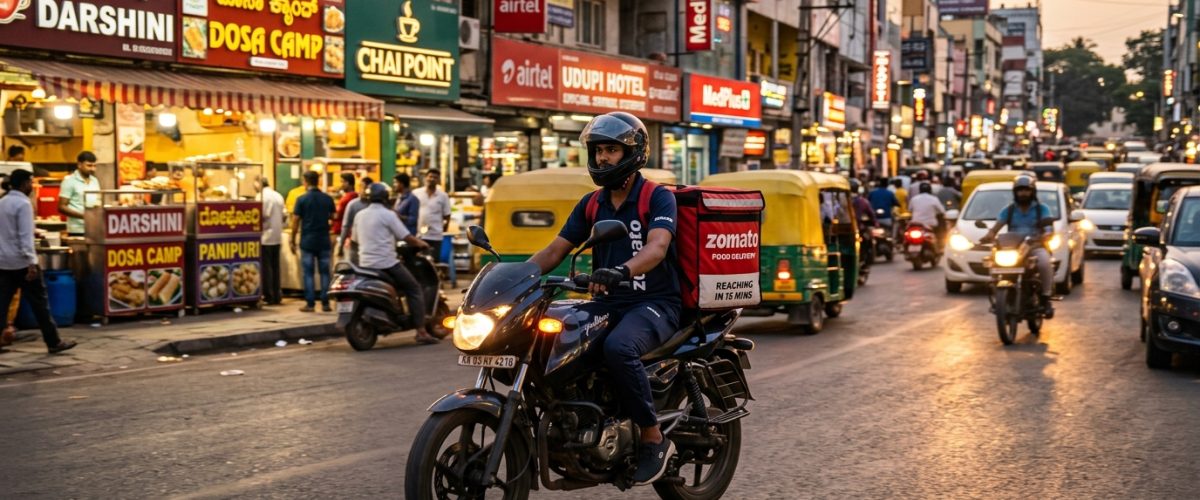
India’s fiercely competitive food delivery market is about to get even more crowded. Rapido, the Bengaluru-based ride-hailing platform that has carved out a dominant position in India’s bike-taxi and auto-rickshaw segment, is making its most ambitious strategic move yet — a full-scale entry into food delivery that threatens to upend the Swiggy-Zomato duopoly that has defined the industry for nearly a decade.
After months of quiet beta testing across select neighbourhoods in Bengaluru, Rapido has officially begun scaling its food delivery operations, leveraging its vast network of gig delivery partners and a disruptive commission structure that could fundamentally alter the economics of the Indian food delivery ecosystem. The move has sent ripples through the startup and restaurant communities, with industry participants debating whether Rapido can succeed where several well-funded challengers have previously failed.
The Rapido Advantage: Leveraging an Existing Network
Unlike previous entrants who attempted to build food delivery operations from scratch, Rapido brings a formidable pre-existing infrastructure to the table. The company claims to have over 2.5 million registered driver-partners across more than 200 Indian cities, primarily serving its ride-hailing business. This network provides a ready-made delivery fleet that can be redeployed for food orders with minimal incremental investment.
The strategic logic is compelling. Rapido’s driver-partners, who typically experience idle time between ride requests, can now utilise those gaps to fulfil food delivery orders — creating a more efficient utilisation of the platform’s human capital and generating additional earning opportunities for its gig workers. The company estimates that this multi-modal approach can reduce delivery costs by 25-30 per cent compared to dedicated food delivery fleets.
Moreover, Rapido’s technology platform, built to handle real-time ride matching, route optimisation, and demand-supply balancing at scale, is inherently suited to the operational requirements of food delivery. The company has invested heavily in AI-driven dispatch algorithms that can simultaneously optimise for ride-hailing and delivery assignments, maximising fleet utilisation and minimising delivery times.
Commission Wars: A Challenge to Established Players
Perhaps the most disruptive element of Rapido’s food delivery strategy is its commission structure. Industry sources indicate that Rapido is offering restaurants a commission rate of 10-15 per cent — roughly half the 25-35 per cent commission charged by Swiggy and Zomato. For restaurants, particularly small and medium-sized establishments that have long chafed under the high take-rates of existing platforms, this represents a potentially game-changing value proposition.
The National Restaurant Association of India (NRAI), which has been vocal in its criticism of aggregator commission practices, has cautiously welcomed the new competition. “Any development that gives restaurants more choice and negotiating leverage is positive for the industry,” an NRAI spokesperson commented. “The current commission structure is unsustainable for many restaurants, particularly in the mid-market segment.”
Swiggy and Zomato, for their part, have downplayed the threat. Both companies emphasise their deep experience in food delivery logistics, established restaurant partnerships, consumer brand loyalty, and significant investments in quick-commerce and adjacent verticals. Zomato, which recently crossed $1 billion in annualised revenue, has highlighted its Hyperpure supply chain business and Blinkit quick-commerce operations as competitive moats that a new entrant cannot easily replicate.
The Bengaluru Testing Ground
Rapido’s choice of Bengaluru as its testing ground is strategic. The city is India’s third-largest food delivery market by order volume, with a tech-savvy population that is typically open to trying new platforms. Bengaluru also happens to be Rapido’s hometown and a market where it enjoys strong brand recognition and driver-partner density from its ride-hailing operations.
Early reports from the beta testing phase suggest encouraging metrics. Restaurants on Rapido’s platform have reported delivery times comparable to Swiggy and Zomato, with the added advantage of lower commission costs. Customer-facing features, including order tracking, customer support, and payment options, appear to be on par with established competitors, though the menu breadth and restaurant coverage remain significantly narrower during the initial phase.
Challenges on the Plate
Despite its structural advantages, Rapido faces formidable challenges in scaling its food delivery ambitions. The first and most obvious is the depth of entrenchment of Swiggy and Zomato. Both platforms have spent years building consumer habits, restaurant relationships, and operational capabilities that represent substantial switching costs.
The customer acquisition challenge is particularly daunting. In a market where food delivery consumers show limited platform loyalty and frequently use multiple apps simultaneously, Rapido will need to invest heavily in discounts and promotions to build initial order volume — a strategy that could strain the company’s finances and delay the path to profitability in the food delivery vertical.
There are also questions about whether Rapido’s multi-modal fleet model can deliver the consistency and specialisation that food delivery demands. Managing hot food delivery requires specific handling protocols, insulated bags, and time-sensitive logistics that differ meaningfully from passenger transportation. The company will need to invest in training and equipment to ensure that food quality is maintained during delivery.
Regulatory and Labour Implications
Rapido’s entry into food delivery also raises broader questions about gig economy regulation in India. The company’s model of utilising ride-hailing partners for food delivery effectively expands the scope of gig work without necessarily expanding worker protections or benefits. Labour advocates have expressed concern that the intensification of multi-modal gig work could increase worker fatigue and accident risks.
The government’s draft social security framework for gig and platform workers, which has been under discussion since 2024, becomes more relevant in this context. Any regulatory intervention that increases the cost of gig labour could disproportionately impact the viability of Rapido’s lower-commission model, which depends partly on cost efficiencies derived from multi-purpose deployment of workers.
The Bigger Picture: India’s Internet Economy
Rapido’s food delivery gambit is emblematic of a broader trend in India’s internet economy — the convergence of previously distinct service categories into integrated super-app platforms. From Paytm’s expansion into e-commerce to Ola’s venture into financial services and AI through its Krutrim subsidiary, India’s leading technology platforms are increasingly seeking growth through adjacencies.
This convergence is driven by the economics of customer acquisition in India’s price-sensitive market, where the cost of acquiring and retaining a user across a single service vertical is often prohibitively high. By offering multiple services — rides, deliveries, financial products — within a single platform, companies can amortise customer acquisition costs and increase lifetime value.
For consumers, the outcome could be positive if increased competition leads to lower prices, better service quality, and more choice. For the restaurant industry, Rapido’s entry provides a much-needed alternative to the Swiggy-Zomato duopoly and could catalyse a broader reassessment of commission structures across the platform. The implications for India’s broader digital economy are significant, as the Indian stock market closely tracks developments in the tech sector.
As Rapido prepares to scale its food delivery operations beyond Bengaluru — with reports suggesting launches in Hyderabad, Chennai, and Delhi-NCR in the coming months — the battle for India’s ₹75,000 crore food delivery market is entering its most dynamic phase yet. Whether Rapido can translate its ride-hailing success into food delivery dominance amidst India’s evolving consumer landscape remains to be seen, but the impact on industry structure and competitive dynamics is already unmistakable.

- Startup India at 10: A Decade of Disruption and the Founders Who Shaped the Ecosystem - March 24, 2026
- From Side Hustles to Success: Five Indian Founders Who Turned Adversity Into Billion-Dollar Ventures - March 24, 2026
- Healthtech Funding Shifts Toward Integrated Care Models as Investors Eye Sustainable Growth in India - March 24, 2026