RBI Holds Repo Rate at 5.25% and Raises FY26 GDP Forecast to 7.4%: What It Means for India

Monetary Policy Committee Signals Confidence in India’s Growth Trajectory
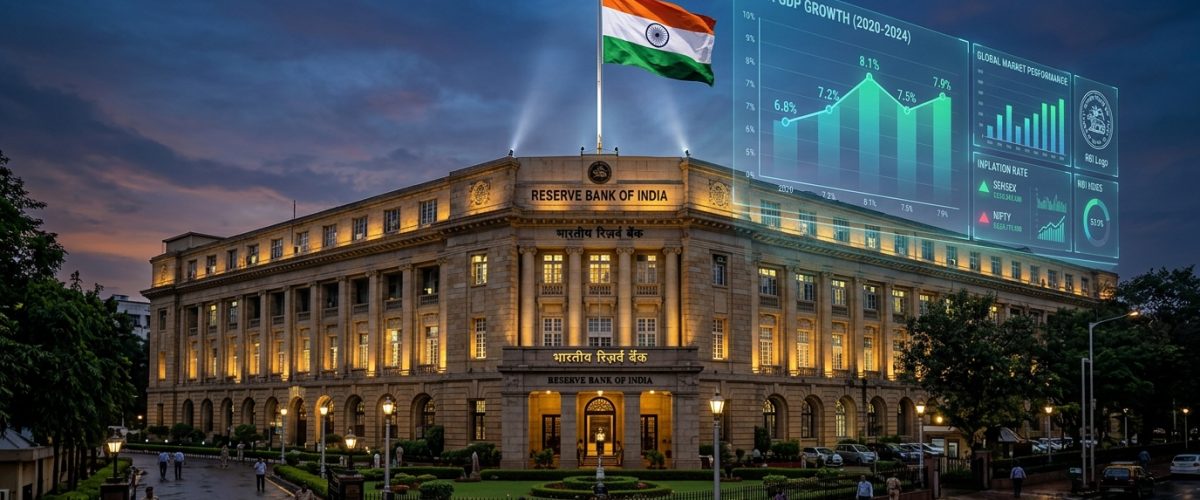
The Reserve Bank of India’s Monetary Policy Committee (MPC), in its February 2026 policy review, voted unanimously to hold the benchmark repo rate steady at 5.25 per cent while simultaneously revising the GDP growth forecast for FY26 upward to 7.4 per cent from the earlier estimate of 7.0 per cent. The decision, announced by RBI Governor Sanjay Malhotra on February 6, 2026, reflects a carefully calibrated approach that balances growth support with inflation vigilance in an increasingly complex global environment.
This marks the fourth consecutive policy meeting at which the MPC has maintained the status quo on rates, following the 50 basis point cumulative reduction between August and December 2025 that brought the repo rate down from 5.75 per cent. The pause signals that the committee believes the current rate level is appropriate for sustaining growth momentum while keeping inflation within its target corridor.
GDP Growth: Why 7.4% and What’s Driving It
The upward revision to 7.4 per cent represents a meaningful upgrade and positions India as the fastest-growing major economy in the world for the third consecutive year. The RBI attributed the revision to several converging factors: a robust agricultural season following well-distributed monsoon rainfall, sustained momentum in the services sector, and a pickup in private capital expenditure that has been absent for much of the post-pandemic period.
High-frequency indicators support this optimistic assessment. The Purchasing Managers’ Index (PMI) for manufacturing has remained above the expansionary threshold of 50 for 18 consecutive months, while the services PMI registered 59.2 in January 2026—one of its highest readings in a decade. GST collections, a reliable proxy for economic activity, exceeded ₹1.85 lakh crore in January 2026, reflecting strong consumption and business activity. The government’s capital expenditure programme, with an outlay exceeding ₹11 lakh crore in the Union Budget 2026-27, provides additional fiscal support to the growth engine.
Inflation: Comfortable but Not Complacent
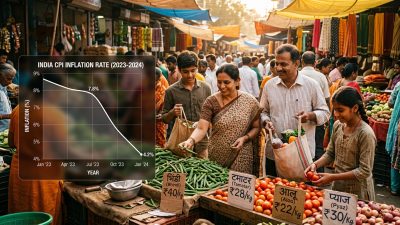
Consumer price inflation moderated to 4.3 per cent in January 2026, comfortably within the RBI’s 2-6 per cent target band and close to the 4 per cent medium-term target. Food inflation, which had been a persistent concern through much of 2025 due to erratic weather patterns and supply chain disruptions, eased significantly in the January-February period as rabi crop arrivals improved and vegetable prices normalised after the winter spike.
However, the MPC’s statement carried explicit cautionary notes about emerging risks. Global crude oil prices, which had been relatively benign through most of 2025, have begun creeping upward on the back of geopolitical tensions in the Middle East. Core inflation, while well-behaved at 3.8 per cent, could face upward pressure if input costs in manufacturing rise. The committee also flagged the potential impact of the government’s minimum support price (MSP) revisions for the upcoming kharif season on food prices in the second half of the year.
Implications for the Financial Sector and Credit Growth
The rate pause, combined with the upgraded growth outlook, has significant implications for India’s banking sector. Credit growth, which moderated from 16 per cent in FY24 to approximately 12 per cent in FY25 following RBI’s targeted macroprudential measures, is expected to reaccelerate to 14-15 per cent in FY26. The central bank’s decision to ease certain risk weight norms on consumer credit and NBFC lending in its December 2025 review has already begun reflecting in improved loan disbursement data.
For borrowers, the current interest rate environment—with lending rates ranging from 8.5 to 9.5 per cent for home loans—represents a relatively favourable borrowing window. However, the RBI has indicated that future rate actions will be “data dependent,” leaving open the possibility of further rate cuts if inflation remains benign, or a pause extension if commodity prices spike. This monetary policy environment is also relevant for understanding how technology investments are shaping India’s financial infrastructure, as discussed in our analysis of India’s AI Summit 2026 and its structural challenges.
Global Context: How India Compares
India’s monetary policy stance contrasts sharply with several major economies. The US Federal Reserve, grappling with persistent inflation above 3 per cent, has kept the federal funds rate at 4.50-4.75 per cent, with markets uncertain about the timing of cuts. The European Central Bank has been more aggressive in easing, with two rate cuts in late 2025, while the Bank of Japan continues its cautious normalisation from decades of ultra-loose policy.
Among emerging markets, India’s position is particularly strong. Brazil’s central bank has been forced to hike rates aggressively to combat inflation, while Turkey and Argentina continue to deal with macroeconomic instability. China, facing deflationary pressures and a prolonged property sector downturn, has cut rates to historic lows but struggles to stimulate demand. India’s combination of strong growth, moderate inflation, and a stable policy framework makes it an attractive destination for global capital, explaining the recent return of FII flows to Indian markets.
The Road Ahead: Rate Cuts on the Horizon?
The consensus among economists and market participants is that the RBI is likely to deliver one or two more rate cuts of 25 basis points each before the end of FY26, bringing the repo rate to 4.75-5.00 per cent. This view is predicated on inflation remaining within target, the monsoon delivering normal rainfall, and global commodity prices not experiencing a sustained spike.
The RBI has also been proactive in managing liquidity conditions. Open market operations (OMOs) and variable rate repo auctions have been deployed to ensure that the banking system has adequate liquidity to support credit growth without creating excessive speculative activity. The introduction of the secured overnight financing rate (SOFR)-linked instruments and the continued development of the corporate bond market are gradually improving the transmission of policy rate changes to actual borrowing costs across the economy.
As India navigates the final quarter of FY26, the RBI’s upgraded GDP forecast serves as both a validation of the economy’s resilience and a challenge. Achieving 7.4 per cent growth would require sustained momentum in investment, consumption, and exports—a trifecta that depends as much on global conditions as on domestic policy execution. Even as the nation looks forward to the cultural celebrations of the season and events like IPL 2026 season preview and franchise strategies, the economic narrative remains firmly grounded in fundamentals that promise cautious optimism for the year ahead.

- Kiran Mani Joins OpenAI to Lead Asia-Pacific Growth After JioStar Exit - March 25, 2026
- Euler Motors Raises Rs 437 Crore as India’s Commercial EV Startup Ecosystem Accelerates in 2026 - March 25, 2026
- Startup India at 10: A Decade of Disruption and the Founders Who Shaped the Ecosystem - March 24, 2026