Nasdaq Crashes 5 Percent as AI Bubble Fears Intensify — Could FPI Outflows From US Reverse Back to India

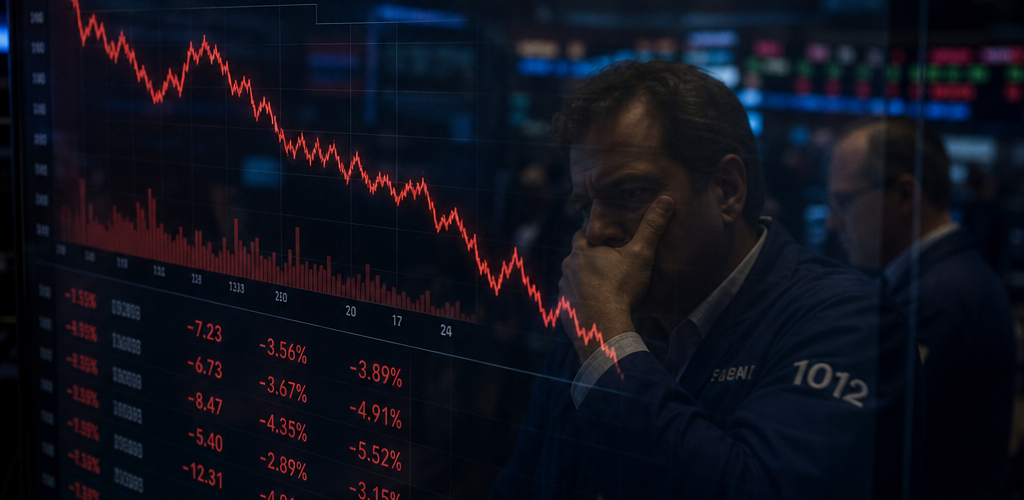
The Nasdaq Composite index has fallen approximately 5 per cent in a sharp sell-off that analysts are calling the most significant AI-driven correction of the year. The decline, concentrated in mega-cap technology stocks with heavy artificial intelligence exposure, has triggered a provocative question in Indian financial circles: could the cooling of the global AI trade finally reverse the massive foreign portfolio investor outflows that have drained Indian markets in 2026?
The AI Trade Unravels
The sell-off in US tech stocks has been broad-based, hitting AI-heavy names across the semiconductor, cloud computing, and enterprise software sectors. The correction comes amid growing concerns that the returns on massive AI infrastructure investments may take far longer to materialise than the market has been pricing in.
For months, a handful of AI-related stocks — led by NVIDIA, Microsoft, Alphabet, and a cluster of data centre and chip companies — have accounted for a disproportionate share of global equity market gains. The concentration of capital in these names created what many fund managers privately described as an unsustainable positioning, even as they continued to add exposure for fear of underperforming benchmarks.
That dynamic appears to be shifting. The 5 per cent Nasdaq decline is not merely a technical correction — it reflects a reassessment of AI monetisation timelines. When companies like Microsoft cancel AI-related software licences and Uber burns through its entire annual AI budget in four months, it signals that the cost side of the AI equation is running ahead of the revenue side.
India’s FPI Drought
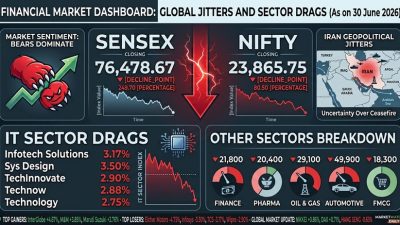
The potential Indian market impact is significant because of the scale of FPI outflows the country has endured. In May 2026 alone, foreign institutional investors pulled out Rs 32,963 crore. The first week of June saw another Rs 42,926 crore in FPI selling. For the year as a whole, FPIs have withdrawn approximately Rs 2,83,662 crore from Indian equities — a staggering capital drain that has weighed on the Sensex, which closed at around 74,243 on Friday.
A meaningful portion of these outflows has been driven by foreign funds rotating capital from emerging markets into US tech stocks to capture AI-driven returns. If that trade reverses — if AI stocks continue to decline and the relative attractiveness of Indian equities improves — a portion of that capital could flow back.
Why India Stands to Benefit
Several factors make India a plausible destination for reallocated capital. The RBI’s decision to hold the repo rate at 5.25 per cent with a neutral stance removes near-term rate-hike risk. The government’s ordinance exempting FIIs from capital gains tax on government securities has already improved the fixed-income attractiveness of Indian markets. The 10-year G-Sec yield at around 6.8-7 per cent is now among the highest investment-grade government bond yields globally, fully accessible to foreign investors on a post-tax basis.
India’s inclusion in JP Morgan’s GBI-EM and Bloomberg Global Aggregate bond indices adds passive flow support. And the rupee, which had weakened to an all-time low of 96.96 per dollar, recovered to 94.94 on June 5 — a move that suggests some capital flow reversal may already be underway.
The Contrarian View
Not all analysts are convinced the reversal will be substantial. The Nasdaq’s 5 per cent decline, while sharp, represents a modest correction relative to the index’s 40-plus per cent gains over the past 18 months. A genuine AI bubble burst would likely be accompanied by credit stress and corporate earnings misses — neither of which is evident yet.
Moreover, India’s own challenges — a below-normal monsoon forecast at 90 per cent of the long-period average, elevated inflation at 5.1 per cent, and slowing GDP growth revised down to 6.6 per cent — limit its appeal as a safe-haven destination. Foreign investors may reduce US tech exposure without necessarily redirecting that capital to emerging markets.
For Indian retail investors, the practical takeaway is nuanced. A reversal of FPI outflows would be positive for market sentiment and could support a rally in beaten-down large-cap stocks, particularly in financials and consumption. But betting on a complete unwinding of the AI trade is premature. The more likely scenario is a gradual rebalancing over several quarters, not a sudden flood of foreign capital back into Dalal Street.
The Structural Shift in AI Sentiment
What distinguishes the current Nasdaq correction from routine market volatility is the underlying narrative shift. For the past 18 months, the dominant investment thesis in global equities has been that artificial intelligence will transform every industry, justify enormous capital expenditure, and generate returns that warrant historically elevated valuations for AI-adjacent companies.
That thesis is not necessarily wrong, but the timeline is being questioned. Corporate earnings calls in Q1 2026 revealed a pattern: companies are spending aggressively on AI infrastructure — data centres, GPU clusters, model training, and enterprise AI tools — but revenue from AI-specific products and services is growing more slowly than the capital expenditure required to build them. The gap between AI spending and AI revenue is widening, not narrowing.
When Microsoft recently cancelled certain AI-related software licences to manage costs, it sent a signal that even the most well-resourced companies are beginning to optimise their AI spending rather than pursuing growth at any cost. For smaller companies further down the AI value chain, the implications are more severe — their entire investment case depends on the assumption that AI spending by large enterprises will continue accelerating.
What Indian Investors Should Watch
For Indian investors, the key indicators to monitor are FPI flow data released by NSDL and CDSL, the rupee-dollar exchange rate as a proxy for capital flow direction, and the relative performance of Indian IT services companies, which occupy an unusual position — they benefit from corporate digital transformation spending but face margin pressure from AI automation of lower-value services.
The RBI’s recent measures to attract dollar inflows — including extending forex swap facilities, relaxing NRI investment limits, and making longer-tenure government bonds fully accessible to foreign investors — suggest the central bank is actively preparing for a potential shift in capital flow dynamics. If the Nasdaq correction deepens and the AI trade continues to cool, these measures could prove well-timed in capturing reallocated global capital.

- India’s Startup Funding Crosses $7.2 Billion in H1 2026 - July 1, 2026
- After Ireland Shock, India’s T20I Side Faces Bigger Test - July 1, 2026
- Ireland Stun World Champions India 2-0 in Belfast, Sooryavanshi Debate Rages On - June 29, 2026