Oil Price Surge and Global Uncertainty Test Indian Market Resilience in Q1 2026

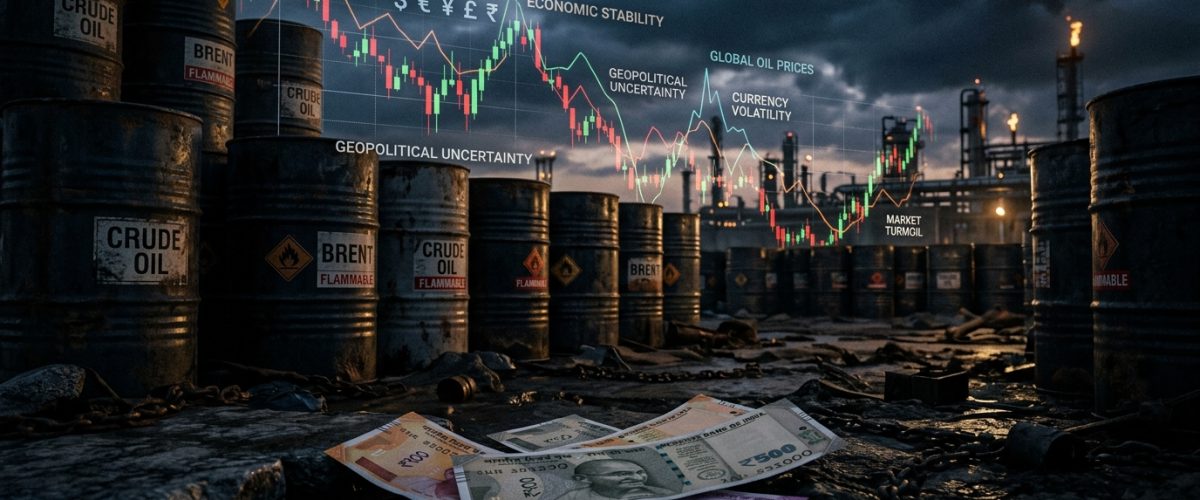
Crude Oil Crosses $82 as Geopolitical Tensions Escalate
The first quarter of 2026 has presented Indian financial markets with a familiar yet increasingly complex challenge: rising global crude oil prices amid heightened geopolitical uncertainty. Brent crude oil, the international benchmark, breached the $82 per barrel mark in mid-March 2026, driven primarily by escalating tensions between the United States and Iran in the Persian Gulf region. For India, the world’s third-largest oil importer, this price surge carries significant implications for inflation, the current account deficit, and corporate profitability.
The timing of this oil price rally is particularly inconvenient. Indian markets had just begun recovering from a prolonged correction that saw the Sensex shed over 10 per cent between October 2025 and February 2026. The recovery, fuelled by returning FII flows and strong domestic fundamentals, now faces a stress test that could determine whether the rally has legs or is merely a bear market bounce.
India’s Oil Import Bill and Macroeconomic Impact
India imports approximately 85 per cent of its crude oil requirements, making it exceptionally vulnerable to global price fluctuations. At current consumption levels of roughly 5.5 million barrels per day, every $10 per barrel increase in oil prices adds approximately $20 billion annually to India’s import bill. This translates to increased pressure on the current account deficit, which the Reserve Bank of India had projected to remain within a manageable 1.2 per cent of GDP for FY26.
The cascading effects of higher oil prices are already visible. Petrol and diesel prices, which had been relatively stable since the government’s excise duty adjustments in late 2025, are under upward pressure. State-owned oil marketing companies—Indian Oil Corporation, Bharat Petroleum, and Hindustan Petroleum—face the dilemma of absorbing losses or passing on costs to consumers. Any significant fuel price increase would directly impact transportation costs, and by extension, food and consumer goods inflation.
RBI’s Balancing Act Between Growth and Price Stability
The Reserve Bank of India finds itself in an increasingly delicate position. Having recently revised the FY26 GDP growth forecast upward to 7.4 per cent and held the repo rate steady at 5.25 per cent, the central bank was signalling confidence in the economy’s trajectory. However, an oil-driven inflation spike could complicate the anticipated rate-cutting cycle that markets have been pricing in for the second half of 2026.
RBI Governor Sanjay Malhotra, in his latest monetary policy statement, acknowledged the “external risks posed by commodity price volatility” while maintaining that India’s inflation trajectory remains broadly within the target band. Consumer price inflation stood at 4.3 per cent in February 2026, comfortably within the RBI’s 2-6 per cent target range. However, economists warn that a sustained oil price above $85 per barrel could push headline inflation back above 5 per cent by the June-July period, as explored in broader economic analyses on the implications for India’s AI Summit 2026 and its structural challenges.
Sectoral Winners and Losers in an Oil Price Rally
The impact of rising oil prices on Indian equities is not uniform. While the broader market faces headwinds, certain sectors stand to benefit directly or indirectly from the commodity price environment.
Oil and gas exploration companies such as ONGC and Oil India Limited are clear beneficiaries, as higher realisations improve their profitability. Reliance Industries, with its integrated oil-to-chemicals value chain, typically demonstrates resilience during oil price rallies. The company’s gross refining margins have already improved to $9.5 per barrel in Q3 FY26, and a further uptick in crude prices could push margins higher, provided the crack spreads remain favourable.
Conversely, sectors with high energy cost exposure face margin compression. Aviation stocks—IndiGo, Air India, and SpiceJet—are among the worst affected, as aviation turbine fuel constitutes approximately 40 per cent of airline operating costs. Paint companies like Asian Paints and Berger Paints, which rely on crude oil derivatives for raw materials, also face input cost pressure. The automobile sector confronts a dual challenge: higher fuel costs dampening consumer sentiment and rising raw material costs squeezing manufacturer margins.
India’s Strategic Response and Energy Diversification
India’s response to oil price volatility in 2026 reflects a more sophisticated approach than in previous cycles. The government has been actively diversifying its crude oil import sources, reducing dependence on the volatile Middle East corridor. Russian oil, which accounted for a negligible share of Indian imports before 2022, now constitutes approximately 35 per cent of total crude imports, often at discounted prices relative to Brent benchmarks.
The strategic petroleum reserves, expanded to approximately 12 days of consumption following the completion of the Chandikhol facility in Odisha, provide an additional buffer against short-term supply disruptions. The government’s push toward renewable energy—with solar and wind capacity additions exceeding 25 GW in FY26—is gradually reducing the economy’s overall energy import dependence, though the transition remains a long-term endeavour.
Market Strategy in an Uncertain Environment
For investors navigating this environment, portfolio construction becomes critical. Market strategists recommend a barbell approach: combining defensive holdings in sectors like pharmaceuticals, FMCG, and IT (which benefit from a weaker rupee) with selective exposure to domestic cyclicals that can weather short-term commodity price pressures.
Gold, traditionally a safe haven during geopolitical uncertainty, has rallied to ₹92,000 per 10 grams in domestic markets, reflecting the flight-to-safety trade. Sovereign gold bonds and gold ETFs have seen record inflows in March, as investors seek portfolio diversification. Meanwhile, the entertainment industry, including Bollywood’s bold March 2026 releases, continues to provide cultural resilience even as economic uncertainty mounts.
The bond market, meanwhile, presents selective opportunities. The yield on the benchmark 10-year government security has risen to 6.95 per cent from 6.70 per cent at the start of the year, reflecting inflation concerns. However, this rise in yields makes government bonds relatively more attractive for long-term investors, particularly as real interest rates remain positive.
As Q1 2026 draws to a close, the Indian market’s ability to navigate the oil price challenge will be a defining narrative. History suggests that Indian markets have demonstrated remarkable resilience in the face of commodity shocks, aided by structural reforms, growing domestic consumption, and a deepening financial market. Whether this resilience holds will depend on the interplay of geopolitical developments, policy responses, and the fundamental strength of corporate India.

- Euler Motors Raises Rs 437 Crore as India’s Commercial EV Startup Ecosystem Accelerates in 2026 - March 25, 2026
- Startup India at 10: A Decade of Disruption and the Founders Who Shaped the Ecosystem - March 24, 2026
- From Side Hustles to Success: Five Indian Founders Who Turned Adversity Into Billion-Dollar Ventures - March 24, 2026