Luxury Housing and Commercial Real Estate Surge as India’s Property Market Enters a Transformative Phase

India’s Real Estate Market Reaches New Heights in 2026
India’s real estate sector is experiencing a transformative phase in 2026, characterised by surging demand for luxury residential properties and a commercial real estate boom that has attracted global institutional investors at unprecedented scales. According to Cushman & Wakefield’s India Outlook 2026 report, the Indian real estate market stands “at the cusp of transformative growth, driven by resilience, innovation, and opportunity.” This assessment is supported by transaction data showing that total real estate investment volumes in calendar year 2025 exceeded $8 billion—a record figure that underscores India’s emergence as a top-tier destination for real estate capital.
The transformation is multidimensional. On the residential front, the luxury segment has decoupled from the broader market, driven by wealth creation among India’s high-net-worth individuals and a fundamental shift in housing aspirations. On the commercial side, office absorption has reached pre-pandemic levels, warehousing demand has exploded on the back of e-commerce and quick commerce growth, and the data centre sector has emerged as an entirely new real estate asset class. Together, these trends are reshaping India’s urban landscape and creating investment opportunities that span risk profiles and time horizons.
The Luxury Residential Boom: Beyond Square Footage
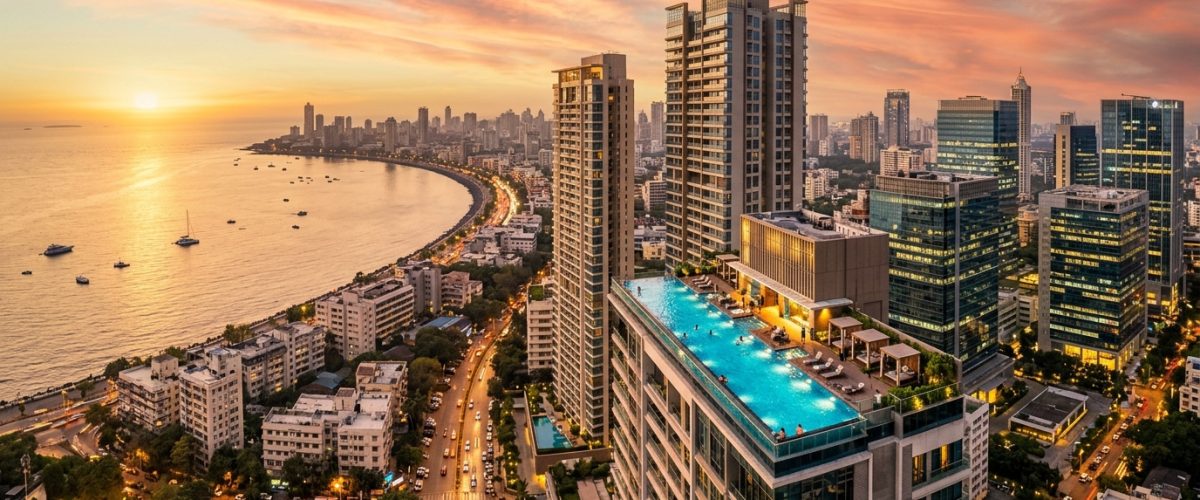
Luxury housing sales in India’s top seven cities crossed ₹1.5 lakh crore in calendar year 2025, representing a 25 per cent increase over the previous year. Mumbai alone accounted for over 40 per cent of luxury transactions, with the city’s premium micro-markets—Worli, Bandra, Lower Parel, and the emerging Bandra-Kurla Complex residential corridor—setting new benchmark prices. A prominent industrialist’s purchase of a ₹240 crore penthouse in Worli in January 2026 captured headlines, but the more significant trend is the broadening of luxury demand beyond the ultra-rich to affluent professionals, successful entrepreneurs, and NRIs.
What defines luxury housing in India in 2026 goes well beyond price points and square footage. Today’s luxury buyer expects holistic lifestyle integration: private elevators, temperature-controlled wine cellars, dedicated EV charging infrastructure, air purification systems, smart home automation, concierge services, and wellness amenities including yoga studios, meditation rooms, and rooftop infinity pools. Developers who understand this shift—firms like Lodha (Macrotech), Prestige Group, Godrej Properties, and DLF—are investing heavily in product differentiation to justify premium pricing.
The branded residence phenomenon has gained significant traction. Projects developed in collaboration with international luxury brands—Ritz-Carlton Residences in Pune, Four Seasons Private Residences in Bengaluru, and the Armani-branded development in Delhi—command 30-50 per cent premiums over comparable unbranded properties. For wealthy Indian buyers accustomed to international luxury standards, these projects offer a lifestyle proposition that extends beyond the physical asset to encompass status, exclusivity, and service quality.
Commercial Office Space: The Return to Physical Workplaces
India’s commercial office market has completed its post-pandemic recovery, with gross leasing volumes reaching 72 million square feet in calendar year 2025—surpassing the pre-pandemic peak of 67 million square feet recorded in 2019. Bengaluru remains the largest office market, accounting for approximately 28 per cent of national absorption, followed by Hyderabad (18 per cent), Mumbai (15 per cent), and Delhi-NCR (14 per cent). Pune, Chennai, and Kolkata have also seen healthy leasing activity, reflecting the geographic diversification of India’s services sector.
The return to office has been driven by the convergence of employer mandates and the evolving nature of knowledge work. While hybrid working arrangements remain prevalent, most major employers—including TCS, Infosys, Wipro, and the Indian operations of global tech companies—now require three to four days of physical office presence per week. This has translated into stable demand for quality office space, particularly Grade A buildings with modern amenities, sustainability certifications, and flexible floor plates that accommodate hybrid working patterns. This technological transformation in workspaces aligns with broader themes explored in our analysis of India’s AI Summit 2026 and its structural challenges.
Warehousing and Logistics: The E-Commerce Effect
Perhaps the most dramatic growth story in Indian commercial real estate is the warehousing and logistics sector, which has been supercharged by the explosive growth of e-commerce and quick commerce. Warehousing absorption reached 55 million square feet in calendar year 2025, a fourfold increase from 2019 levels. The growth is concentrated in key logistics nodes—Bhiwandi and Panvel (Mumbai), Hosur Road and Devanahalli (Bengaluru), Chakan and Talegaon (Pune), and the Yamuna Expressway corridor (NCR).
The emergence of quick commerce—with players like Blinkit, Zepto, Swiggy Instamart, and BigBasket promising 10-30 minute delivery—has created an entirely new category of real estate demand: dark stores and micro-fulfilment centres within urban areas. These facilities, typically ranging from 2,000 to 5,000 square feet, require locations within 2-3 kilometres of high-density residential clusters, creating demand in areas that were previously not considered for commercial use. The competition for suitable dark store locations has pushed rents in certain urban pockets to levels comparable to retail space, fundamentally altering the real estate economics of these areas.
Data Centres: The Emerging Asset Class
India’s data centre market has emerged as the newest and fastest-growing real estate asset class, driven by the Digital India programme, the data localisation requirements of the Personal Data Protection Act, and the exponential growth in data consumption across the country. Data centre capacity in India reached approximately 1,100 MW in 2025, with an additional 1,500 MW under construction and expected to be operational by 2028.
Major data centre operators—Adani Group (AdaniConneX), Reliance (Jio Data Centres), NTT Data, STT GDC, and Yotta—are investing billions of dollars in facility construction across Mumbai, Chennai, Hyderabad, and Pune. The Mumbai market alone accounts for over 40 per cent of India’s data centre capacity, reflecting the city’s role as a submarine cable landing point and financial hub. The government’s allocation of ₹15,000 crore for digital infrastructure in Union Budget 2026-27 is expected to accelerate this growth further.
Global Capital Flows and Institutional Investment
India’s real estate sector has attracted record foreign direct investment in recent years, with global institutional investors increasingly viewing Indian property as a core portfolio allocation rather than an opportunistic play. Sovereign wealth funds from Singapore (GIC), Abu Dhabi (ADIA), and Canada (CPPIB), alongside global private equity giants Blackstone, Brookfield, and KKR, have collectively deployed over $15 billion in Indian real estate since 2020.
The maturation of India’s Real Estate Investment Trust (REIT) market has been instrumental in attracting institutional capital. Embassy REIT, Mindspace REIT, and Brookfield India REIT, which together own approximately 100 million square feet of Grade A office space, provide listed, liquid vehicles for both institutional and retail investors to access commercial real estate returns. The anticipated listing of Nexus Select Trust’s expansion and the potential REIT debut of industrial and logistics portfolios could further expand the investable universe.
As India’s real estate market enters this transformative phase, the opportunities are matched by challenges: infrastructure bottlenecks, regulatory complexity, and the need for sustainable development practices remain persistent concerns. However, the structural drivers—urbanisation, rising incomes, digital transformation, and demographic tailwinds—suggest that Indian real estate will continue to be one of the most dynamic property markets globally. For investors, developers, and homebuyers, the current moment offers a rare convergence of growth, reform, and innovation, including the cultural dynamism reflected in events like Bollywood’s March 2026 releases that drive lifestyle aspirations and real estate demand.

- Startup India at 10: A Decade of Disruption and the Founders Who Shaped the Ecosystem - March 24, 2026
- From Side Hustles to Success: Five Indian Founders Who Turned Adversity Into Billion-Dollar Ventures - March 24, 2026
- Healthtech Funding Shifts Toward Integrated Care Models as Investors Eye Sustainable Growth in India - March 24, 2026