India Axiom-4 Microgravity Experiments Deliver Scientific Firsts as ISRO Charts Path to Gaganyaan Crewed Mission in 2027

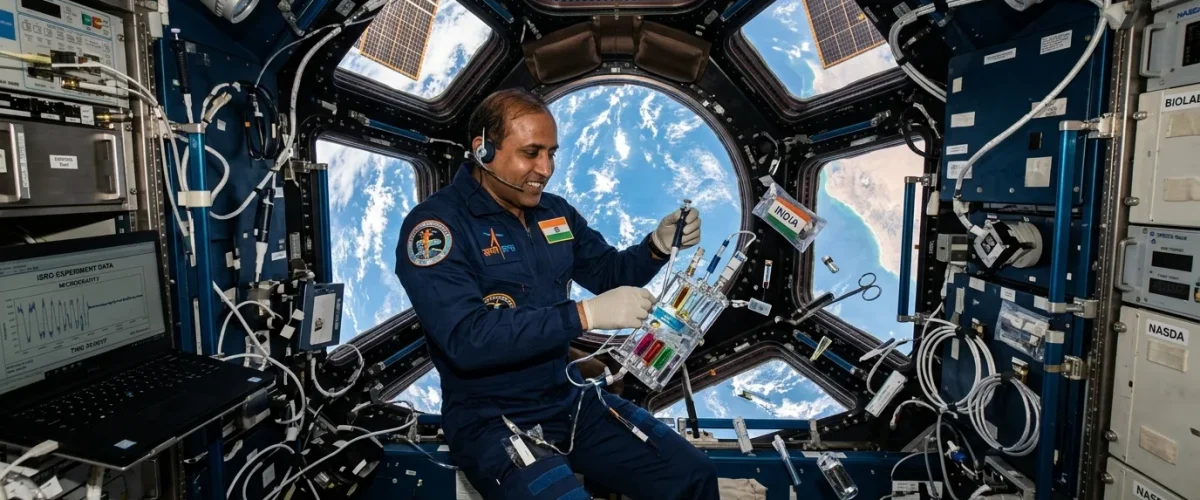
India’s first research astronaut, Gaganyatri Shubhanshu Shukla, successfully completed all seven microgravity experiments aboard the International Space Station (ISS) during the 18-day Axiom-4 mission, marking a series of scientific firsts for the Indian Space Research Organisation (ISRO). The results are now feeding directly into ISRO’s Gaganyaan human spaceflight programme, with the first crewed Indian mission targeted for the first quarter of 2027.
Seven Experiments, Eighteen Days
The Axiom-4 mission launched on 25 June 2025 from Launch Complex 39A at the Kennedy Space Centre aboard a SpaceX Falcon 9 rocket. Shukla, serving as mission pilot, conducted experiments spanning biology, agriculture, biotechnology, and space medicine. The seven completed studies were:
- Indian Tardigrades — Testing the survival and behaviour of Indian-strain tardigrades in microgravity conditions
- Myogenesis — Studying muscle cell formation and degradation in the absence of gravity
- Seed Sprouting — Observing the germination of methi (fenugreek) and moong (mung bean) seeds in space
- Cyanobacteria — Analysing the growth patterns of cyanobacteria, relevant to future life support systems
- Microalgae — Evaluating microalgae cultivation for potential oxygen generation in spacecraft
- Crop Seeds — Exposing agricultural seeds to the space environment for post-mission study
- Voyoger Display — Testing an Indian-made display technology under space conditions
From ISS to Gaganyaan
The data generated from these experiments serves dual purposes. Biologically, the studies on tardigrades, myogenesis, and microalgae address fundamental questions about living organisms in microgravity — knowledge essential for long-duration human spaceflight. Practically, the seed sprouting and cyanobacteria experiments explore technologies for closed-loop life support systems that could sustain astronauts on future Gaganyaan missions.
ISRO’s roadmap positions the first uncrewed Gaganyaan test flight in late 2025, with the crewed mission — carrying Indian astronauts on an Indian-built spacecraft — expected in early 2027. The Axiom-4 data provides critical benchmarks for India’s independent programme.
PM Modi’s Video Call From Space
On Day 3 of the mission (28 June 2025), Shukla participated in a video call with Prime Minister Narendra Modi, discussing national pride, how India looks from space, and Indian food in the microgravity environment. The PM emphasised that the learnings from the mission would benefit India’s entire space programme.
Mission Timeline
| Event | Date | Time (IST) |
|---|---|---|
| Falcon 9 launch | 25 June 2025 | 12:01 PM |
| ISS docking | 26 June 2025 | 4:16 PM |
| All experiments completed | 13 July 2025 | — |
| ISS undocking | 14 July 2025 | 4:35 PM |
| Splashdown (California coast) | 15 July 2025 | 3:00 PM |
What Comes Next for India in Space
The Axiom-4 mission’s success places India among a small group of nations that have conducted biological experiments on the ISS. Combined with ISRO’s ongoing scientific programmes including the Aditya-L1 solar observatory and the NISAR Earth observation satellite, India’s space science portfolio is expanding rapidly.
As the Gaganyaan programme moves toward its crewed phase, the microgravity data from Axiom-4 will inform everything from astronaut health protocols to onboard food production systems — laying the groundwork for India’s ambitions beyond low Earth orbit.

- India’s Startup Funding Crosses $7.2 Billion in H1 2026 - July 1, 2026
- After Ireland Shock, India’s T20I Side Faces Bigger Test - July 1, 2026
- Ireland Stun World Champions India 2-0 in Belfast, Sooryavanshi Debate Rages On - June 29, 2026