From Side Hustles to Success: Five Indian Founders Who Turned Adversity Into Billion-Dollar Ventures

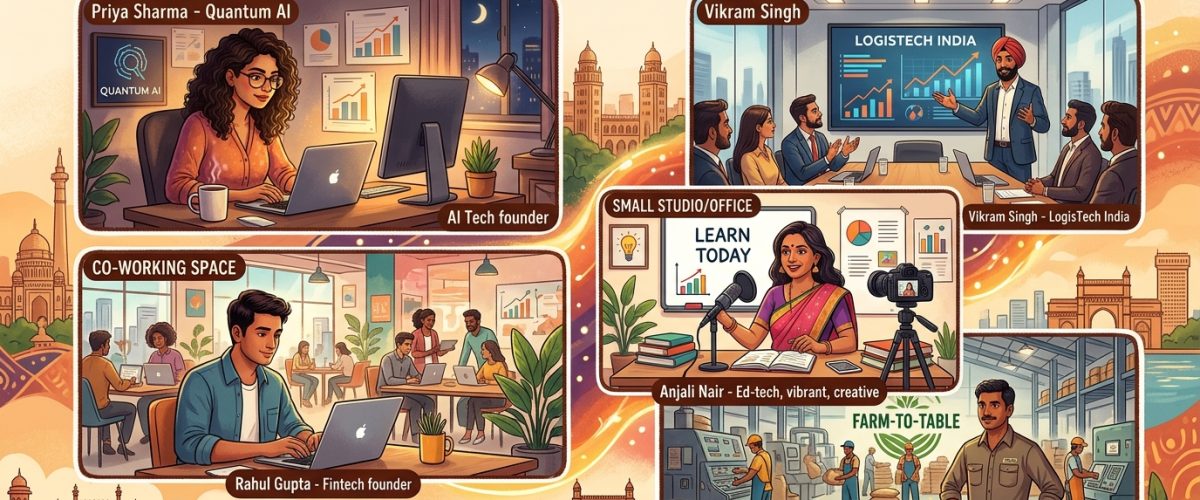
India’s startup ecosystem in 2026 is the product of thousands of individual journeys—stories of founders who spotted opportunities in India’s vast and uneven markets, took the risk of leaving stable careers, and built companies that now employ thousands and serve millions. Behind every funding announcement and valuation milestone are human stories of struggle, resilience, and reinvention. Here are five Indian founders whose paths from adversity to billion-dollar ventures offer both inspiration and practical lessons for the next generation of entrepreneurs.
Aadit Palicha, Zepto: The 21-Year-Old Who Outran the Giants
When Aadit Palicha and Kaivalya Vohra dropped out of Stanford University in 2021 to launch Zepto, a 10-minute grocery delivery startup, the reaction from India’s startup establishment ranged from scepticism to dismissal. Quick commerce was considered a capital-destroying model that only worked in densely populated East Asian cities, and betting on two teenage founders with no industry experience seemed reckless.
Five years later, Zepto is valued at $3.6 billion, operates in 12 cities, and has achieved positive contribution margins—a metric that its larger, better-funded competitors Blinkit and Swiggy Instamart have struggled to match. Palicha’s approach has been characterised by obsessive focus on dark store economics: optimising inventory turnover, delivery routing, and per-order costs with the precision of a manufacturing engineer rather than a consumer internet entrepreneur.
Also read: IPL 2026 Season Preview: Key Transfers, Injuries, and Franchise Strategies
Also read: AI Summit 2026: India Showcases Ambitions but Structural Gaps Exposed
“Everyone told us we were too young, the market was too competitive, and the unit economics didn’t work,” Palicha recalled in a recent interview. “We didn’t argue with them. We just focused on making the unit economics work in one city, then two, then twelve.” Palicha is now 24 years old and one of the youngest billionaires in Indian startup history.
Falguni Nayar, Nykaa: Rewriting the Rules at 50
Falguni Nayar’s story defies every Silicon Valley cliché about startup founders. A former investment banker who spent two decades at Kotak Mahindra Group, Nayar founded Nykaa in 2012 at the age of 49—an age when most startup founders have already exited their companies. Her insight was deceptively simple: Indian women deserved a dedicated, curated platform for beauty and personal care products, one that combined the product range of a department store with the convenience and content of a digital platform.
Nykaa went public in 2021 at a valuation of $13 billion, and despite post-IPO valuation corrections, the company remains one of India’s most successful D2C-to-platform plays. Nayar’s journey is significant not just for its commercial success but for the message it sends about entrepreneurship: that age, gender, and career background need not be barriers to building a transformative company. In 2026, Nykaa generates over ₹6,500 crore in annual revenue and operates 190 physical stores alongside its dominant online platform.
Alakh Pandey, PhysicsWallah: From YouTube Classroom to Unicorn
Alakh Pandey’s story is perhaps the most unlikely of any Indian unicorn founder. Born in Prayagraj (formerly Allahabad) to a middle-class family, Pandey began uploading free physics and chemistry tutorials on YouTube in 2016, motivated by the inability of students like himself to afford expensive coaching institutes. His teaching style—energetic, relatable, and entirely in Hindi—resonated with millions of students across small-town India.
By 2022, Pandey’s YouTube channel had 15 million subscribers, and his startup PhysicsWallah had secured its first round of institutional funding. In 2026, PhysicsWallah is valued at $2.8 billion, operates 65 offline learning centres, and serves over 30 million students annually. What makes Pandey’s story distinctive is his commitment to affordability: PhysicsWallah’s courses cost a fraction of competitors’, and Pandey has publicly stated that he will never allow price to be a barrier to accessing quality education.
Deepinder Goyal, Zomato: Surviving Death and Reinvention
Deepinder Goyal founded Zomato (originally Foodiebay) in 2008 with a simple idea: digitise restaurant menus and make them searchable online. Sixteen years later, the company has a market capitalisation exceeding ₹2 lakh crore on the BSE and has evolved through multiple near-death experiences, pivots, and reinventions that would have destroyed most companies.
Zomato survived the 2015 restaurant review wars, the 2019 food delivery profitability crisis, the 2020 pandemic-induced demand collapse, and the 2022-2023 public market downturn that saw its stock lose 70 per cent of its value. Each crisis forced Goyal to make difficult decisions—exiting unprofitable international markets, laying off employees, shutting down failed verticals—but the company emerged each time leaner and more focused. In 2026, Zomato is profitable, has acquired Blinkit to enter quick commerce, and is one of the most valuable internet companies in India.
Nithin Kamath, Zerodha: The Bootstrapper Who Changed Finance
Nithin Kamath and his brother Nikhil founded Zerodha in 2010 with a contrarian thesis: that India’s brokerage industry was overcharging retail investors and that a technology-first, low-cost model could dramatically expand the investing population. Zerodha charged zero brokerage on equity delivery trades and a flat ₹20 per order for intraday and derivatives trading—a model that existing brokers dismissed as unsustainable.
Sixteen years later, Zerodha is India’s largest brokerage by active clients (over 15 million), has never raised a single rupee of external funding, and generates annual profits exceeding ₹3,000 crore. Kamath’s decision to bootstrap was deliberate: he believed that external funding would create pressure to grow at the expense of product quality and customer experience. The company’s profitability and market leadership vindicate that choice and make Zerodha one of the most unusual success stories in Indian startup history—proof that not every great company needs venture capital to achieve greatness.
The Common Thread
These five founders share no common background, industry, or approach. What they share is conviction in the face of skepticism, resilience through adversity, and an intimate understanding of the Indian consumer. Their stories are not just personal triumphs—they are signposts that illuminate the pathways available to India’s next generation of entrepreneurs, regardless of age, background, or circumstance.

- Startup India at 10: A Decade of Disruption and the Founders Who Shaped the Ecosystem - March 24, 2026
- From Side Hustles to Success: Five Indian Founders Who Turned Adversity Into Billion-Dollar Ventures - March 24, 2026
- Healthtech Funding Shifts Toward Integrated Care Models as Investors Eye Sustainable Growth in India - March 24, 2026